Situation Summary
Oman remains stable with no reported security incidents, civil unrest, or operational disruptions inside the country over the last 24–48 hours. The composite threat score of 19 places Oman in the lower-risk tier globally. Current security dynamics are dominated by regional diplomatic activity rather than domestic instability, with the primary risk concentration confined to Al Wusta Governorate in the south.
Key Developments
- Muscat, 22 June 2026 – Oman–Iran maritime-security talks. Iranian Parliament Speaker Mohammad Bagher Ghalibaf met with Omani Foreign Minister Sayyid Badr bin Hamad Al Busaidi to discuss de-escalation, Strait of Hormuz security, and international shipping lanes, within the context of ongoing U.S.–Iran negotiations and a 60-day regional roadmap. No domestic unrest reported.
- Regional diplomatic activity ongoing. Oman's mediation role in U.S.–Iran talks continues to position the country as a stability actor, though heightened regional tensions create indirect exposure to maritime and energy-shipping disruptions.
- No verified civil unrest, conflict, or crime incidents inside Oman in the last 48 hours. Open-source reporting and social-media monitoring confirm absence of public security events, political instability, or infrastructure disruption.
- Al Wusta Governorate remains elevated-risk area. Composite risk score of 31.2 substantially exceeds all other governorates (all at 1.2), though specific current triggers are not detailed in available reporting.
- Broader economic and technical cooperation proceeding normally. Central Bank of Oman domestic card-scheme testing and other financial/technical initiatives continue without security-related disruptions.
Highest-Risk Areas
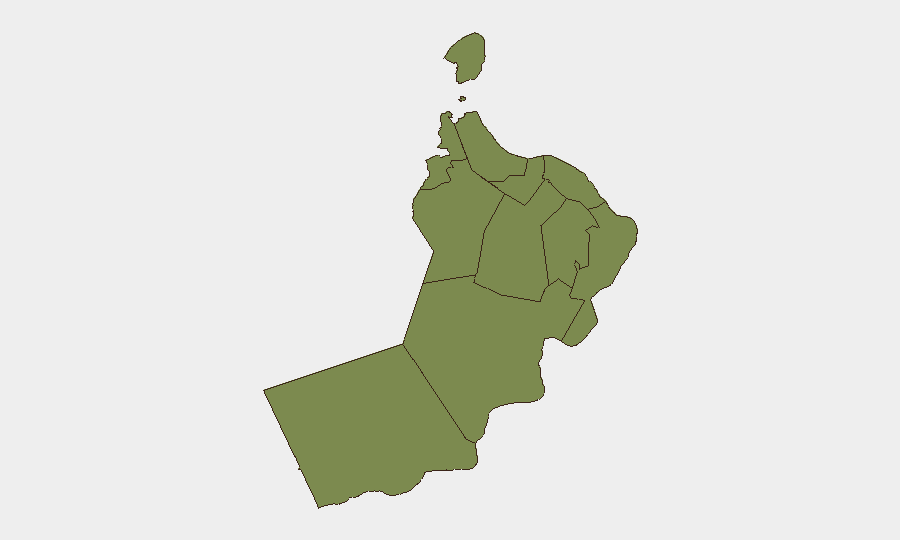
Al Wusta Governorate carries a composite risk score of 31.2—25 times higher than any other region in Oman—and warrants focused monitoring. All other 10 governorates cluster at 1.2, indicating risk is sharply geographically concentrated. The drivers of Al Wusta's elevation are not specified in current open reporting; historical context suggests remote territory, limited state presence, and potential exposure to cross-border activity merit closer investigation. Corporate assets or personnel operating in or transiting Al Wusta should prioritize localized threat intelligence and contingency planning.
How GeoBit Would Assist
Security teams should deploy AOI Monitoring & Early Warning on Al Wusta Governorate to detect emergence of new threats before they escalate. Intel Sweep and multi-language OSINT fusion across local media, Telegram, and social platforms will provide earlier visibility into civil unrest, conflict activity, or crime than international news cycles. Routing & Network Analysis can support duty-of-care planning for personnel movement, identifying safer alternative routes and real-time corridor risk assessment in elevated-risk zones.
7-Day Outlook
No acute security deterioration is forecast over the next week. Oman's diplomatic posture and regional mediation role support stability, though indirect exposure to U.S.–Iran and Israel–Hezbollah dynamics persists. Continued monitoring of Al Wusta Governorate and vigilance for any maritime/energy-sector disruptions from regional tension remain prudent.
Highest-Risk Areas — Ranked
| # | State / Region | Risk |
|---|---|---|
| 1 | Al Wusta Governorate | 31.2 |
| 2 | Muscat Governorate | 1.2 |
| 3 | Al Buraymi Governorate | 1.2 |
| 4 | Ad Dhahirah Governorate | 1.2 |
| 5 | Musandam Governorate | 1.2 |
| 6 | Al Batinah North Governorate | 1.2 |
| 7 | Al Batinah South Governorate | 1.2 |
| 8 | Ad Dakhiliyah Governorate | 1.2 |
| 9 | Ash Sharqiyah North Governorate | 1.2 |
| 10 | Ash Sharqiyah South Governorate | 1.2 |
| 11 | Dhofar Governorate | 1.2 |
Sources
Previous Daily Briefs
A new Oman brief is written every day — each with its own risk map and downloadable CSV. Here's the last week; use the calendar to go further back.
📅 Browse every day by calendar →
Highlighted days have a brief. Tap a day for that day's map & analysis, or “csv” for that day's dataset ($5).