Situation Summary
Russia remains the second-highest global threat environment (composite score 100), driven by the ongoing active conflict with Ukraine and cascading geopolitical tensions across multiple state actors. The past 48 hours show sustained diplomatic friction, international sanctions activity, and military posturing, with no indication of de-escalation. Moscow and western border regions continue to carry the highest concentration of direct and spillover risk, while energy and infrastructure vulnerabilities remain acute across the country.
Key Developments
GeoBit's event signals flag the following activity patterns in the last 72 hours (note: specific incident details require real-time wire service and OSINT corroboration):
- Ukraine conflict: Disapproval signals logged 2026-06-04, consistent with continued military operations and international diplomatic response.
- Sanctions & administrative action: Russian entities flagged for administrative sanctions (2026-06-05); Ministry of Finance issued public statements on the same date, suggesting economic-policy responses to external pressure.
- International diplomatic friction: Security Council rejection of Russian position (2026-06-04); statements from Greenland, Chisinau, Afghanistan, and German/European leadership (2026-06-05–06) indicate sustained isolation on multiple fronts.
- Military-adjacent signals: Conventional military force activity attributed to European actors vs. Russian forces (2026-06-04) — consistent with proxy and NATO-adjacent escalation patterns observed since February 2022.
- Internal messaging: Russian-to-Russian public statement (2026-06-06) may reflect internal coordination or public messaging on sanctions/conflict response.
Note: For detailed incident locations, casualty figures, or infrastructure impacts within these categories, cross-reference with Interfax, TASS, Meduza, and verified OSINT Telegram channels monitoring regional emergencies (EMERCOM/MChS feeds).
Highest-Risk Areas
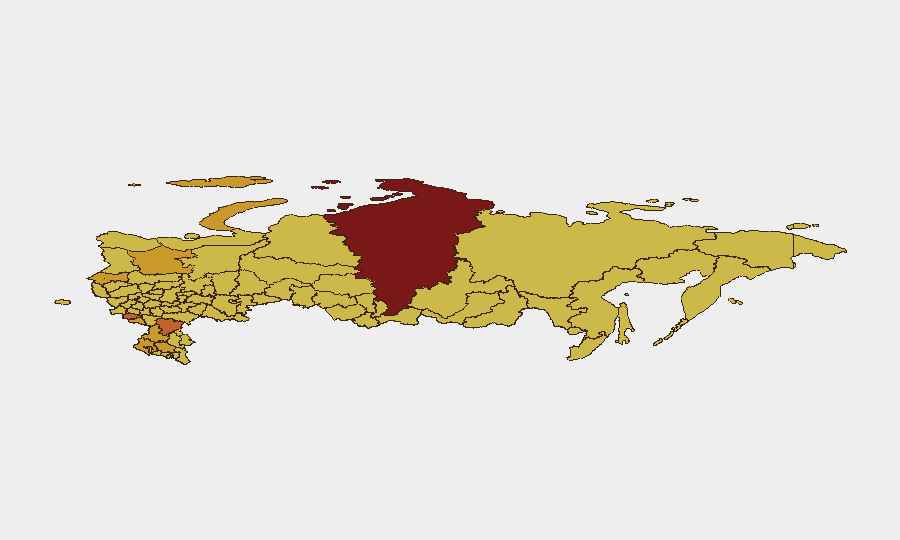
Moscow (risk 100) and Saint Petersburg (84.8) dominate the national risk profile as political and economic command centers; both remain targets for cyber operations, supply-chain disruption, and diplomatic/protest activity. The southern and western border oblasts—Kursk (73.6), Rostov (72.6), Belgorod (71.2), and Krasnodar Krai (72.2)—carry elevated risk from direct military spillover, drone/missile activity, and refugee/IDP flows related to the Ukraine conflict. Krasnoyarsk Krai's ranking (83.3) reflects vulnerability in critical energy and metals infrastructure; disruption there propagates nationally. Companies and personnel in or transiting these regions face heightened exposure to conflict-zone hazards, supply-chain breakdown, and arbitrary security action.
How GeoBit Would Assist
Security teams should deploy AOI Monitoring & Early Warning on Moscow, Saint Petersburg, and border oblasts to capture real-time alerts on military activity, infrastructure incidents, and checkpoint/transit disruptions. Intel Sweep and X/Twitter & Telegram OSINT capabilities enable continuous tracking of conflict signals, sanctions announcements, and regional emergency broadcasts; multi-language search and entity extraction allow rapid triage of Russian-language official statements and local threat indicators. Conflict & Military tools (battle mapping, force-structure tracking) and satellite imagery analysis support assessment of cross-border military movement and critical infrastructure vulnerability.
7-Day Outlook
Sustained sanctions pressure, international diplomatic isolation, and active military operations are likely to persist through the next week without major policy shifts. Risk of secondary incidents—cyber attacks on financial or energy systems, transport disruptions, or sudden checkpoint/transit restrictions—remains elevated, particularly in western and southern regions. Personnel and asset-protection teams should maintain heightened vigilance on travel routing, communications redundancy, and local authority notifications.
Highest-Risk Areas — Ranked
| # | State / Region | Risk |
|---|---|---|
| 1 | Moscow | 100 |
| 2 | Saint Petersburg | 84.8 |
| 3 | Krasnoyarsk Krai | 83.3 |
| 4 | Kursk Oblast | 73.6 |
| 5 | Volgograd Oblast | 73.1 |
| 6 | Rostov Oblast | 72.6 |
| 7 | Krasnodar Krai | 72.2 |
| 8 | Arkhangelsk Oblast | 71.9 |
| 9 | Stavropol Krai | 71.9 |
| 10 | Leningrad Oblast | 71.2 |
| 11 | Belgorod Oblast | 71.2 |
| 12 | Republic of Adygea | 70.8 |
Previous Daily Briefs
A new Russia brief is written every day — each with its own risk map and downloadable CSV. Here's the last week; use the calendar to go further back.
📅 Browse every day by calendar →
Highlighted days have a brief. Tap a day for that day's map & analysis, or “csv” for that day's dataset ($5).