Situation Summary
Senegal remains a relatively stable country (global rank #113, composite score 9/100), but faces acute near-term civil-unrest risk stemming from a constitutional reform and national referendum announced by President Bassirou Diomaye Faye on 29 June 2026. Security incidents in central Dakar over the past 48 hours—including police use of tear gas, forcible removal of opposition MPs, multiple arrests, and one reported incident of targeted political violence—signal escalating tensions between government and opposition factions. Risk is heavily concentrated in the capital and Tambacounda Region; most other regions remain stable. The trajectory is upward volatility in the near term, with referendum campaigning and opposition mobilization likely to sustain protest activity and police presence in Dakar through early July.
Key Developments
- Dakar, National Assembly precincts (29 June, evening) – Police deployed tear gas and erected roadblocks as demonstrators attempted to breach security cordons outside parliament during the constitutional-reform vote; multiple arrests and clashes reported. Traffic and access to the Assembly disrupted; live security footage and social media confirm reinforced police deployment around the parliamentary complex.
- Dakar, National Assembly chamber (29 June) – One opposition MP was forcibly removed from the chamber during the vote, triggering an opposition boycott and escalating hostility inside parliament.
- Dakar, Place Soweto / Plateau area (late 29 June) – Crowds attempting to storm the Assembly compound were dispersed by tear gas; AFP and Africanews documented scuffles, stone-throwing, and multiple arrests by police.
- Dakar, pro-Pastef political gathering (29 June) – A political ally of Prime Minister Ousmane Sonko was assaulted and sustained a broken arm; incident cited by analysts as evidence of emerging targeted political violence tied to the reform power struggle.
- National level (29 June – 1 July) – President Faye announced the adopted constitutional text will proceed to a national referendum; opposition and civil-society groups immediately called for renewed protests and mobilization across Dakar and regional towns. Parliamentary statements and public announcements from both government and opposition dominated media on 1 July.
- Dakar, Assembly area (1 July) – Police maintained elevated presence and checkpoints; government authorities issued public statements reaffirming commitment to the referendum process.
Highest-Risk Areas
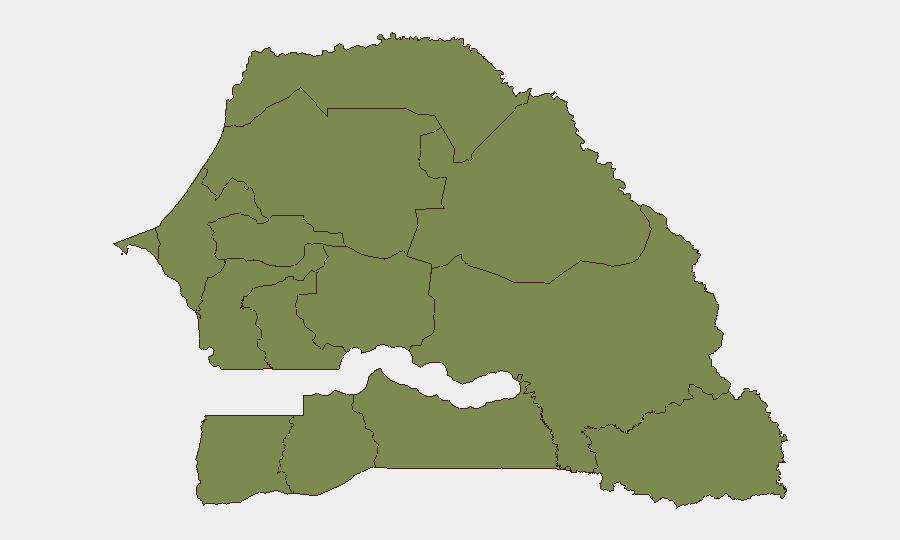
Tambacounda Region (risk 10.4) is the highest-risk sub-national zone, driven by structural vulnerabilities including transnational criminal and smuggling networks, though it has not figured prominently in recent event data. Risk in the capital, Dakar (1.8), is acute but currently localized to the parliamentary district and central business district; the jump in political events and protest activity concentrated around the National Assembly reflects the immediate constitutional-reform crisis rather than systemic instability. All other regions (Diourbel, Louga, Thiès, Fatick, Kaolack, Saint-Louis, Kaffrine, Ziguinchor, Sédhiou, Kolda) register minimal risk (1.8 composite scores each). The discrepancy between Tambacounda's structural rank and Dakar's current event concentration suggests that near-term duty-of-care focus should be on Dakar civil unrest, while longer-term regional monitoring should track Tambacounda.
How GeoBit Would Assist
Security teams should deploy AOI Monitoring & Early Warning (persistent watch of central Dakar, the National Assembly, and main protest corridors) combined with Intel Sweep and OSINT Fusion (real-time synthesis of social media, news, and Telegram channels from opposition and pro-government groups) to detect protest escalation and police repositioning before they impact staff or assets. Routing & Network Analysis can provide alternative journey planning for personnel navigating Dakar's CBD and Assembly district during roadblock periods. Election Monitoring and Sentiment & Temporal Analysis of social media will track referendum-campaign rhetoric and identify flashpoints around campaign events in regional towns.
7-Day Outlook
Opposition mobilization around the referendum is expected to sustain elevated protest activity in central Dakar through early July; police will likely maintain augmented deployment and checkpoint operations around the Assembly and key government buildings. A second major flashpoint may emerge if referendum campaigning extends into regional capitals (Saint-Louis, Kaolack, Ziguinchor), though provincial turnout typically remains lower. Overall risk trajectory is contained escalation rather than systemic instability, provided referendum campaigning remains largely non-violent and scheduled within 2–3 weeks.
Highest-Risk Areas — Ranked
| # | State / Region | Risk |
|---|---|---|
| 1 | Tambacounda Region | 31.8 |
| 2 | Diourbel Region | 10.4 |
| 3 | Dakar Region | 1.8 |
| 4 | Louga Region | 1.8 |
| 5 | Thiès Region | 1.8 |
| 6 | Fatick Region | 1.8 |
| 7 | Kaolack Region | 1.8 |
| 8 | Saint-Louis Region | 1.8 |
| 9 | Kaffrine Region | 1.8 |
| 10 | Ziguinchor Region | 1.8 |
| 11 | Sédhiou Region | 1.8 |
| 12 | Kolda Region | 1.8 |
Sources
Previous Daily Briefs
A new Senegal brief is written every day — each with its own risk map and downloadable CSV. Here's the last week; use the calendar to go further back.
📅 Browse every day by calendar →
Highlighted days have a brief. Tap a day for that day's map & analysis, or “csv” for that day's dataset ($5).