Situation Summary
South Korea faces a convergent security challenge spanning government integrity, critical infrastructure vulnerability, and foreign interference—all surfaced or intensified within the past 48 hours. Regulatory and law-enforcement responses are accelerating, signaling elevated official concern about systemic weaknesses in data protection, financial-market controls, and internal-security oversight. The threat environment remains moderate globally (rank #65), but concentrated incidents in Seoul and national-scale cyber/regulatory failures are driving elevated risk scores and warrant active corporate monitoring.
Key Developments
- Seoul, June 5 – South Korea's Ministry of Science and ICT confirmed that the Coupang mega-data breach (33+ million accounts) was perpetrated by a former software developer who retained unauthorized access credentials after departure, and authorities have escalated the case to potential criminal investigation and corporate-accountability proceedings.
- Seoul & 17 other locations, June 5 – Joint military-police task force conducted coordinated raids on the Defense Intelligence Command, National Intelligence Service, and 16 other sites as part of an investigation into suspected government involvement in unauthorized drone flights into North Korea, with focus on three active-duty soldiers and one NIS employee.
- Nationwide, June 5 – South Korea's financial regulators launched a full investigation into crypto exchange Bithumb following accidental distribution of over US$40 billion equivalent in Bitcoin (vastly exceeding the platform's actual holdings of ~43,000 BTC), labeling it a "serious matter" undermining market order and signaling tighter digital-asset regulation ahead.
- Nationwide, June 5 – Central government announced formation of an interagency coalition to combat large-scale data breaches, coordinating law-enforcement and regulatory response to telecom operator KT's recent mobile-payment incidents and ongoing breach fallout.
- Seoul, June 5 – Ministry of Foreign Affairs briefed on bilateral nuclear-cooperation agreement negotiations with the United States, including South Korea's bid to expand authority over uranium enrichment and reprocessing, a strategic and proliferation-sensitive agenda affecting regional security alignment.
- Nationwide cyber domain, June 4–5 – Analytical reporting highlighted continuing Chinese information operations targeting South Korea via AI-assisted campaigns using Korean-language content on local platforms (Kakao Story, Tistory, Naver) to influence public opinion and electoral dynamics.
Highest-Risk Areas
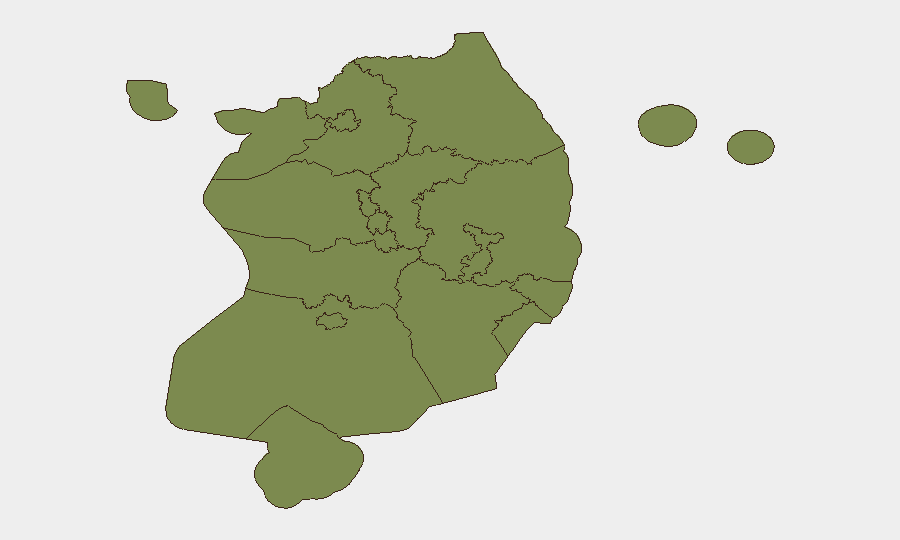
Seoul dominates the sub-national risk profile (31.5), reflecting concentration of government, financial, and tech-sector targets and the volume of incidents (data breaches, regulatory probes, intelligence operations) now unfolding there. North Chungcheong (22) and Busan (7.9) follow at significant distance, likely reflecting secondary government and logistics infrastructure. The risk gradient suggests that Seoul-based corporate operations, supply chains, and data infrastructure warrant priority focus; businesses in Gyeonggi and Incheon should monitor spillover from Seoul-centered regulatory and cyber incidents.
How GeoBit Would Assist
Intel Sweep and multi-language OSINT would track regulatory announcements, law-enforcement communications, and Korean-language social-media chatter on data breaches and financial-market incidents in real time. Network & Actor Analysis and persistent AOI Monitoring would flag emerging patterns in foreign information operations and insider-threat signals within government and critical-sector organizations. Risk & Threat Assessment and Early Warning & Prediction capabilities would enable duty-of-care teams to anticipate regulatory enforcement escalation and operational disruption linked to ongoing probes.
7-Day Outlook
Regulatory enforcement actions are expected to intensify across cyber-security, financial-market, and telecom sectors as inter-agency task forces complete initial investigative phases. Political and media attention to government-integrity issues (drone flights, NIS oversight) may drive secondary operational disruptions or access restrictions at government-linked facilities. Corporate security teams should expect heightened scrutiny of data-handling practices and increased reporting requirements.
Highest-Risk Areas — Ranked
| # | State / Region | Risk |
|---|---|---|
| 1 | Seoul | 31.5 |
| 2 | North Chungcheong | 22 |
| 3 | Busan | 7.9 |
| 4 | Gyeonggi | 6.9 |
| 5 | Gangwon State | 4.4 |
| 6 | Jeju | 4.2 |
| 7 | South Jeolla | 2.2 |
| 8 | Incheon | 1.7 |
| 9 | Daegu | 1.7 |
| 10 | South Chungcheong | 1.5 |
| 11 | Sejong | 1.5 |
| 12 | Jeonbuk State | 1.5 |
Sources
Previous Daily Briefs
A new South Korea brief is written every day — each with its own risk map and downloadable CSV. Here's the last week; use the calendar to go further back.
📅 Browse every day by calendar →
Highlighted days have a brief. Tap a day for that day's map & analysis, or “csv” for that day's dataset ($5).