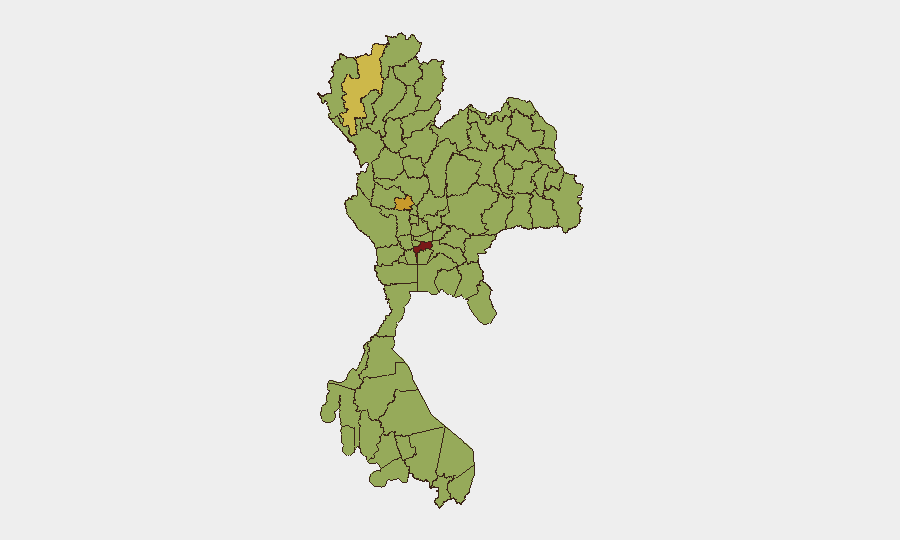
Situation Summary
Thailand (rank #19 globally, composite threat score 74.1) faces a layered security environment combining political instability, civil unrest, and persistent border/southern insurgent activity. Recent event signals point to governance tensions, military involvement, and multiple arrest/detention actions across 2–3 June, suggesting heightened institutional friction. While no major incident has been reported in the last 24 hours, the underlying drivers—political rejection, demonstrated military posturing, and governance disputes—remain active and warrant close monitoring.
Key Developments
- 2026-06-01 · Bangkok · Demonstration/Rally vs Governance — Public protest activity signaling opposition to current governance arrangements; likely linked to broader political tensions.
- 2026-06-02 · Multiple Arrest/Detain Events — At least four separate detention incidents involving Thai authorities, including actions against Canadian nationals and individuals with Guayaquil-related involvement; pattern suggests heightened law-enforcement activity tied to security or political concerns.
- 2026-06-02 · Conventional Military Force Deployment — Direct military force mobilization on 2 June; context unclear but consistent with military/police power-show signals same period.
- 2026-06-02 · Governance Rejection (Population-facing) — Documented public/institutional rejection of Thai governance actions; indicates polarization.
- 2026-06-03 · Bangkok Governance Dispute & Military Threat Signal — Two events on 3 June underscore escalating tensions between governance bodies and military actors at the capital level.
- Border/Southern Provinces (Historical Context) — July 2025 Thailand–Cambodia border escalation involved airstrikes and mass civilian evacuation; southern Thailand continues to experience persistent insurgent violence, per standing Western travel advisories.
- Cyber Threat (March 2025 onwards) — Thai government, military, factory, and banking systems have been targeted by a sustained cyberattack campaign; no remediation timeline confirmed.
Highest-Risk Areas
Bangkok dominates the risk landscape (81.9), driven by governance tensions, military presence, and the concentration of political decision-making and institutional actors. Chai Nat Province (71.6) follows at significant distance, suggesting Bangkok-centric institutional friction rather than dispersed national crisis. Northern provinces (Chiang Mai, Chiang Rai) and northeastern border regions (Nong Khai, Sakon Nakhon, Bueng Kan) carry elevated but moderate risk (52–64), reflecting chronic border instability and insurgent-related violence in the south and historical communal tensions. The clustering of risk scores in the 51–52 band across the northeast and central regions indicates baseline ambient threat from cross-border activity, criminal networks, and sporadic civil disorder, rather than acute crisis.
How GeoBit Would Assist
Security teams should deploy AOI Monitoring & Early Warning on Bangkok and Chai Nat to track real-time governance, military, and protest signals; integrate Intel Sweep (event feeds, X/Telegram OSINT, sentiment & temporal analysis) to detect early signs of institutional escalation or political fragmentation. Conflict & Military force-structure and weapons-capability tracking would clarify military posture; Routing & Network Analysis would support alternative journey planning for personnel in high-risk zones. Cross-referencing Border & Disputed-Territory Search with Satellite & Imagery Analysis enables persistent monitoring of Thailand–Cambodia flashpoints and southern insurgent activity.
7-Day Outlook
Governance and military tensions are likely to remain elevated or fluctuate around current levels absent a major triggering event. Border risk and southern insurgent activity will persist as chronic baseline threats. Watch for further arrest/detention patterns, military mobilization signals, or organized protest escalation in Bangkok and central provinces over the next 7 days as indicators of institutional deterioration.
Highest-Risk Areas — Ranked
| # | State / Region | Risk |
|---|---|---|
| 1 | Bangkok | 81.9 |
| 2 | Chai Nat Province | 71.6 |
| 3 | Chiang Mai Province | 63.9 |
| 4 | Prachuap Khiri Khan Province | 57.4 |
| 5 | Surat Thani Province | 53.4 |
| 6 | Chon Buri Province | 52.9 |
| 7 | Chiang Rai Province | 52.4 |
| 8 | Kanchanaburi Province | 52.4 |
| 9 | Bueng Kan Province | 51.9 |
| 10 | Nong Khai Province | 51.9 |
| 11 | Udon Thani Province | 51.9 |
| 12 | Sakon Nakhon Province | 51.9 |
Sources
Previous Daily Briefs
A new Thailand brief is written every day — each with its own risk map and downloadable CSV. Here's the last week; use the calendar to go further back.
📅 Browse every day by calendar →
Highlighted days have a brief. Tap a day for that day's map & analysis, or “csv” for that day's dataset ($5).