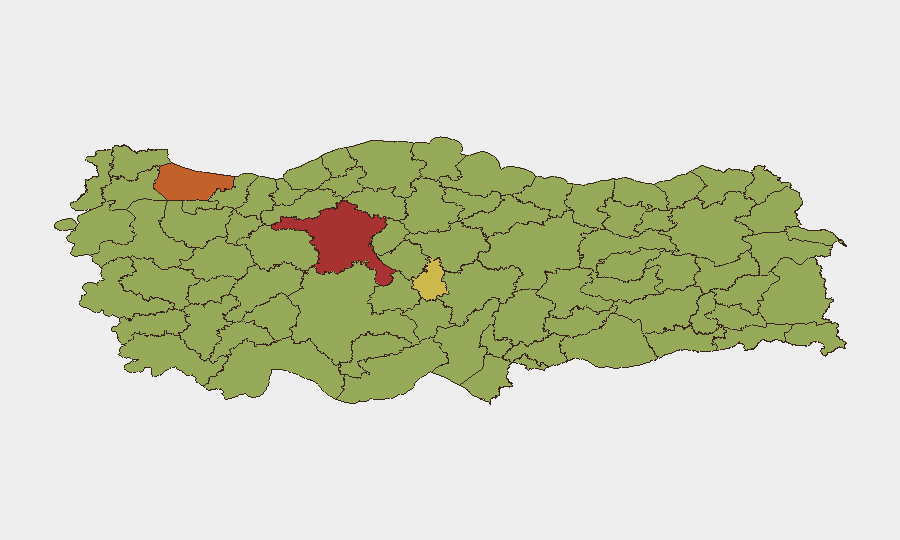
Situation Summary
Turkey remains a moderate-risk environment (rank #20 globally, composite score 69.8) but faces converging pressures from armed conflict in the southeast, elevated terrorism threat in major urban centers, and regional instability spillover from Syria and Iraq. Recent events—including military engagements, administrative sanctions, arrests, and diplomatic friction—point to sustained internal political tension alongside external security challenges. The U.S. State Department's updated advisory reinforces "increased caution" nationwide and maintains Level 4 restrictions on border zones; the U.S. Consulate in Adana remains closed to routine services.
Key Developments
- Southeast border escalation (2026-06-01–02): Conventional military force incidents reported between Turkey and Azerbaijan; ongoing armed conflict in southeast provinces (Diyarbakır, Gaziantep, Van, Hakkari, Mardin) linked to February spillover and NATO air-defense operations against Iranian ballistic missiles. Level 3 travel advisory now active for the entire region.
- U.S. consular drawdown—Adana (ongoing): U.S. Consulate in Adana remains closed to consular services; non-emergency staff and families ordered departed due to regional conflict risk. U.S. citizens directed to Ankara or Istanbul for assistance.
- Arrest and detention wave (2026-06-01–02): Multiple arrest/detain and investigation signals logged; a Mesopotamia-linked detention reported 2026-06-02. Pattern suggests intensified security operations.
- Administrative sanctions and governance friction (2026-06-03): Government-issued administrative sanctions against citizens and public statements indicate internal political friction; parliamentary tensions in Ankara highlight opposition disunity and potential for protest activity.
- Immigration fraud targeting expatriates (recent, nationwide): Turkish authorities warn of organized fraud rings using fake residence-permit websites and unlicensed consultancies to exploit foreign nationals and employers. Elevated cyber and financial-crime risk for expat and corporate populations.
- Terrorism risk in urban centers: UK and U.S. advisories reinforce persistent threat to Ankara, Istanbul, and tourist sites. Public transport, crowded venues, and major events flagged as high-risk vectors.
Highest-Risk Areas
Ankara (78.9) and Istanbul (73.2) drive the composite threat ranking, driven by terrorism incidents, political activity, and administrative action. Ankara additionally shows elevated political tension centered on parliamentary opposition dynamics. Nevşehir (63.5) and Denizli (58.6) register moderate-to-elevated risk; their drivers merit monitoring but remain secondary to the capital and largest metro. Southeast provinces (Adıyaman, Bingöl, Erzurum, Kars) cluster in the 48.9–55.3 range, reflecting armed-conflict spillover and border proximity rather than independent incident density. The capital and Istanbul thus warrant the highest duty-of-care attention for corporate and expatriate populations.
How GeoBit Would Assist
Security teams should deploy AOI Monitoring & Early Warning on Ankara (parliament, administrative centers) and Istanbul (transit hubs, tourism zones) to track protest, security operation, and incident signals in near-real-time. OSINT & Network Analysis—drawing on Telegram, Twitter, and local news feeds—would illuminate emerging opposition rhetoric, fraud-ring activity targeting expatriates, and militia/PKK signaling in southeast zones. Conflict & Military tracking combined with GIS & Spatial Analysis enables persistent watch on Turkey–Azerbaijan force posture and Syria–Iraq border incidents, feeding into route planning and AOI risk refresh for field teams.
7-Day Outlook
Expect sustained administrative and security operations in Ankara and continued military posturing on southeast borders; no near-term de-escalation is signaled. Fraud activity targeting expatriates will likely persist. Parliamentary opposition activity may generate localized protest or rhetorical escalation in Ankara but is unlikely to produce nationwide instability in the next week.
Highest-Risk Areas — Ranked
| # | State / Region | Risk |
|---|---|---|
| 1 | Ankara | 78.9 |
| 2 | Istanbul | 73.2 |
| 3 | Nevşehir | 63.5 |
| 4 | Denizli | 58.6 |
| 5 | Adıyaman | 55.3 |
| 6 | Bingöl | 54.5 |
| 7 | Izmir | 49.7 |
| 8 | Antalya | 49.7 |
| 9 | Erzurum | 48.9 |
| 10 | Kars | 48.9 |
| 11 | Yozgat | 48.9 |
| 12 | Niğde | 48.9 |
Previous Daily Briefs
A new Turkey brief is written every day — each with its own risk map and downloadable CSV. Here's the last week; use the calendar to go further back.
📅 Browse every day by calendar →
Highlighted days have a brief. Tap a day for that day's map & analysis, or “csv” for that day's dataset ($5).