Situation Summary
Tuvalu remains a low-threat environment with no verified domestic security incidents, civil unrest, or crime spikes reported in the last 24–48 hours. The country's current risk profile is driven by indirect strategic exposure to regional militarization, specifically the 7–9 July Chinese ballistic missile test over Pacific airspace, to which Tuvalu's government has issued formal diplomatic condemnation. No travel restrictions, infrastructure disruptions, or immediate on-the-ground hazards have been documented, and the security posture remains stable within Tuvaluan territory.
Key Developments
- Tuvalu (national level) – 8–9 July 2026 – Government officials issued statements characterizing China's recent ballistic missile test as a "grave and serious concern" for regional peace, sovereignty, and small island state security.
- Tuvalu (national level) – 8–9 July 2026 – Tuvalu joined Vanuatu and Palau in a coordinated Pacific regional position opposing militarization of the Pacific and condemning the Chinese missile launch, signaling alignment with a broader diplomatic bloc.
- Funafuti – 8–9 July 2026 – Government statements originating from the capital framed the missile test as a direct threat to regional stability and small island sovereignty, with no domestic unrest or political violence reported.
- Tuvalu (national level) – Early July 2026 – Australian ministerial remarks referenced Tuvalu as a security partner in deepened resilience arrangements, reflecting ongoing cooperative security engagement with allied powers but noting no new incident.
- Regional assessment – 8–9 July 2026 – Open-source monitoring across Pacific security briefs confirms no civil unrest, major crime, political violence, or travel-risk escalation within Tuvalu despite regional strategic concern over the missile test.
Highest-Risk Areas
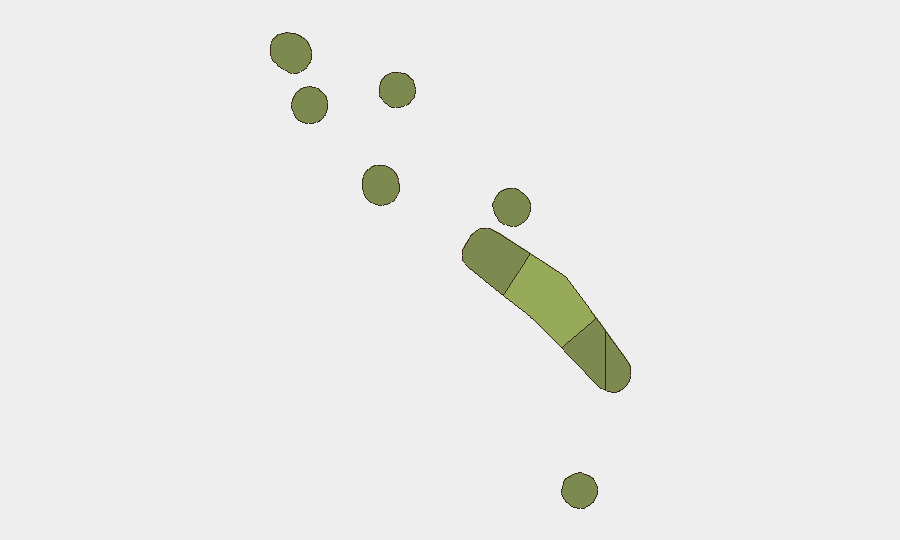
Funafuti (composite risk 45) dominates the sub-national ranking and remains the highest-exposure area, driven primarily by its status as the capital, seat of government, and focal point for diplomatic activity and foreign presence. Vaitupu (28) and Nui (25) rank second and third but carry substantially lower risk scores, reflecting Tuvalu's overall small population and limited infrastructure density. The elevated composite score for Funafuti reflects concentration of political decision-making, media activity, and exposure to regional strategic developments rather than active domestic security threats; no localized crime surge, unrest, or infrastructure failure has been documented in any atoll.
How GeoBit Would Assist
Security teams with personnel or assets in Tuvalu would benefit from persistent Area-of-Interest (AOI) monitoring on Funafuti and other populated atolls to detect early signals of civil unrest, political tension, or infrastructure disruption. Intel Sweep and multi-source OSINT fusion—combining government statements, social media sentiment, regional security briefs, and maritime/aviation tracking—would provide continuous early warning of any escalation in regional tensions that could affect operations. Conflict and regime-stability monitoring would allow teams to distinguish between legitimate diplomatic responses to external events (as currently observed) and material shifts in internal political stability or security posture.
7-Day Outlook
Over the next seven days, Tuvalu's security environment is expected to remain stable on the ground, with no domestic incidents forecast. Diplomatic activity regarding the regional missile test may continue, but this poses no direct operational risk to corporate personnel or assets within Tuvaluan territory. Monitoring should focus on any escalation in broader Pacific militarization dynamics and their indirect impact on regional partnerships and port/airfield access rather than on imminent domestic security threats.
Highest-Risk Areas — Ranked
| # | State / Region | Risk |
|---|---|---|
| 1 | Funafuti | 45 |
| 2 | Vaitupu | 28 |
| 3 | Nui | 25 |
| 4 | Nukufetau | 22 |
| 5 | Niutao | 20 |
| 6 | Nanumanga | 18 |
| 7 | Nanumea | 15 |
| 8 | Nukulaelae | 12 |
Sources
Previous Daily Briefs
A new Tuvalu brief is written every day — each with its own risk map and downloadable CSV. Here's the last week; use the calendar to go further back.
📅 Browse every day by calendar →
Highlighted days have a brief. Tap a day for that day's map & analysis, or “csv” for that day's dataset ($5).
Atlas — our AI intelligence desk — emails them this snapshot personally. Nothing else, no list.