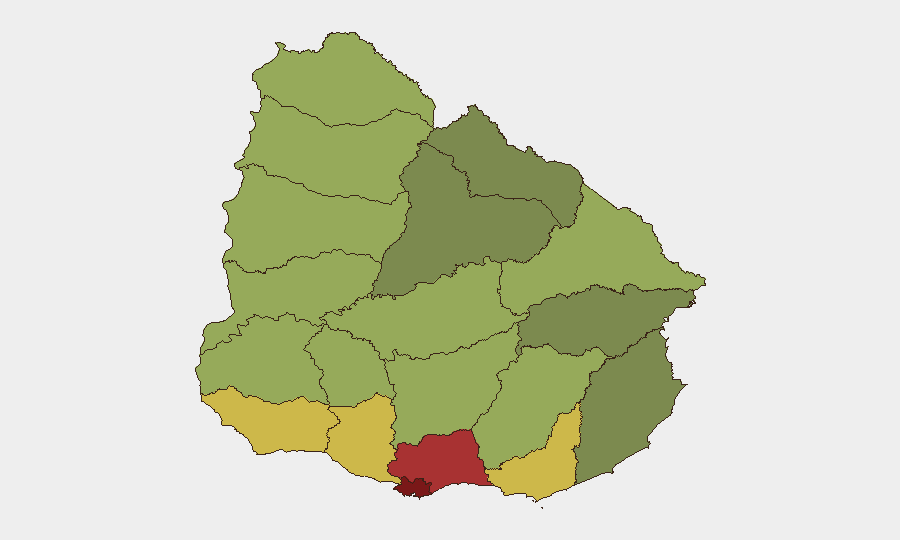
Situation Summary
Uruguay remains one of the Western Hemisphere's most stable countries, ranked #106 globally with a composite threat score of 6/100. No significant security incidents, civil unrest, infrastructure disruptions, or political instability have been corroborated in the past 24–48 hours. Routine urban crime—principally robbery and theft in Montevideo and Canelones—remains the baseline risk, with no documented crime spikes or operational security events in the reporting window.
Key Developments
- National – 13 June 2026 – Diplomatic messaging
The Uruguayan government issued a public statement on relations with the Dominican Republic. Open-source monitoring confirms no associated protests, domestic political reaction, or operational security incidents on Uruguayan soil.
- National – 13 June 2026 – Argentina–Uruguay diplomatic signal
A "reduce relations" diplomatic signal was recorded between Argentina and Uruguay. Reporting confirms this remains limited to public diplomatic messaging, with no border incidents, military mobilization, or civil unrest documented.
- National – 12 June 2026 – Military activity signal (unconfirmed)
A conventional military force activity signal was flagged nationally. Location, scale, and operational details remain unconfirmed and lack corroboration in open sources or social-media monitoring; no linked incidents or disruptions are documented.
- Montevideo & Canelones – 11–13 June 2026 – Routine urban crime baseline
Monitoring confirms continued elevated baseline urban crime (robbery, theft) in both departments, but no new discrete crime spikes, organized-crime escalations, or notable security events documented in the past 48 hours.
- National – 11 June 2026 – Prison-related signal (unconfirmed, outside 48h strict window)
A prison-related rejection signal was registered; no location, facility details, or operational impact available or corroborated. This event falls just outside the 48-hour reporting window and carries no confirmed operational significance.
Highest-Risk Areas
Montevideo (risk 92) and Canelones (risk 78) drive the national risk profile, driven primarily by persistent urban crime—robbery, theft, and property crime—rather than organized violence, terrorism, or political instability. Maldonado (68), San José (64), and Colonia (62) show elevated but secondary risk. The concentration of risk in Montevideo and immediate Canelones reflects population density, economic disparities, and established urban-crime patterns; no emerging conflict, gang violence, or institutional breakdown has altered this baseline in the past 48 hours.
How GeoBit Would Assist
Security teams with personnel or assets in Montevideo, Canelones, and tourist-destination areas (Maldonado) would benefit from persistent AOI (area-of-interest) monitoring and alerting to detect early shifts in crime patterns or unplanned security events; Intel Sweep and X/Telegram OSINT to track street-level crime reporting and gang activity in real time; and risk and threat assessment workflows to validate diplomatic signals (Argentina, Dominican Republic) and assess any second-order impact on business continuity or travel safety. Satellite and imagery analysis can supplement asset-location monitoring in high-risk urban zones.
7-Day Outlook
No indicators suggest a significant security deterioration in the next seven days. Diplomatic messaging with Argentina and the Dominican Republic is unlikely to escalate into operational incidents affecting civilian or corporate activity. Routine urban crime will remain the primary concern; personnel in Montevideo and Canelones should maintain standard personal-security hygiene. Monitoring of unconfirmed military activity and prison signals should continue to establish corroboration or closure.
Highest-Risk Areas — Ranked
| # | State / Region | Risk |
|---|---|---|
| 1 | Montevideo | 92 |
| 2 | Canelones | 78 |
| 3 | Maldonado | 68 |
| 4 | San José | 64 |
| 5 | Colonia | 62 |
| 6 | Soriano | 58 |
| 7 | Río Negro | 56 |
| 8 | Salto | 54 |
| 9 | Artigas | 52 |
| 10 | Paysandú | 50 |
| 11 | Florida | 48 |
| 12 | Flores | 46 |
Previous Daily Briefs
A new Uruguay brief is written every day — each with its own risk map and downloadable CSV. Here's the last week; use the calendar to go further back.
📅 Browse every day by calendar →
Highlighted days have a brief. Tap a day for that day's map & analysis, or “csv” for that day's dataset ($5).