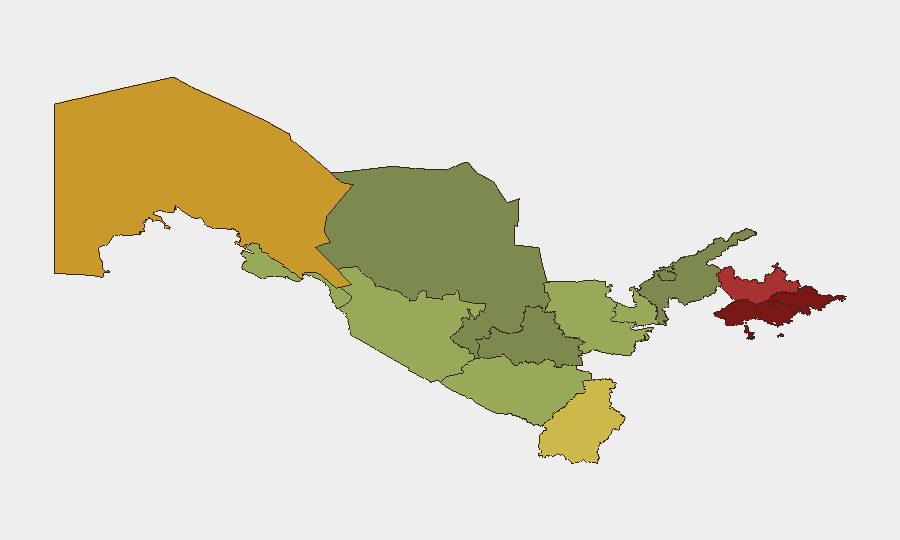
Situation Summary
Uzbekistan remains a stable, low-threat environment at the national level (global rank #103, composite threat score 6/100). No discrete security incidents, civil unrest, infrastructure failures, or travel disruptions have been documented in the last 24–48 hours across reliable open-source channels. The country's baseline security posture is defined by persistent but localized extremism risk in the Fergana Valley region, low petty crime in urban centers, and routine border management with neighboring states.
Key Developments
No specific, time-stamped security incidents in Uzbekistan have been confirmed in the last 24–48 hours. Open-source research identified two coast-guard-related detention events flagged in the GEOBIT event feed (2026-06-14), but these require geographic and operational clarification to confirm whether they occur within Uzbek territorial waters or jurisdiction. A concurrent public statement from China regarding Kazakhstan (2026-06-13) does not directly impact Uzbek security. Baseline monitoring should continue on: (i) Fergana Valley extremist networks, where activity remains endemic but not acute; (ii) border-crossing procedures and unofficial migration flows, particularly along the Tajikistan and Kyrgyzstan frontiers; (iii) cyber-crime trends (cumulative soum theft reported by Ministry of Internal Affairs, though incident dates remain unclear); and (iv) structural military/air-force reforms underway, which do not indicate imminent instability.
Highest-Risk Areas
The Fergana Valley dominates Uzbekistan's sub-national threat profile: Andijan Region (risk 88), Fergana Region (risk 82), and Namangan Region (risk 78) account for the top three highest-risk zones. This clustering reflects decades of Islamic Movement of Uzbekistan (IMU) recruitment, sectarian tensions, youth radicalization pathways, and porous borders with Tajikistan and Kyrgyzstan. Karakalpakstan (risk 72) presents secondary risk driven by resource scarcity, regional isolation, and historical ethnic/political grievances. Surxondaryo Region (risk 65) remains sensitive due to proximity to the Afghan border and transit routes for contraband and illicit actors. Central and western regions (Samarqand, Bukhara, Navoiy) present materially lower risk and are suitable for most corporate operations.
How GeoBit Would Assist
Corporate security teams should deploy AOI Monitoring & Early Warning on high-risk Fergana Valley districts (Andijan city, Margilon, Kokand) to detect upticks in protest activity, security-force mobilizations, or extremist signaling via social media and Telegram. Multi-language OSINT (X, Telegram, Russian/Uzbek web) paired with sentiment & temporal analysis will surface emerging civil tensions or incident reporting before mainstream media lag. Network & Actor Analysis focused on known IMU affiliates, recruitment hubs, and financing channels provides continuous threat mapping for risk teams with personnel in affected zones. Routing & Network Analysis enables alternative journey planning for staff movements through contested or high-surveillance areas.
7-Day Outlook
No acute escalation is forecast. Extremism risk in the Fergana Valley remains endemic and seasonal (summer months historically see upticks in recruitment and cross-border activity). Border management with Kyrgyzstan and Tajikistan will likely remain routine. Continued monitoring of cumulative cyber-crime trends and military restructuring is advised, but neither poses imminent operational disruption. Corporate duty-of-care teams should maintain baseline vigilance in Andijan and Fergana regions and review travel protocols for staff in those zones.
Highest-Risk Areas — Ranked
| # | State / Region | Risk |
|---|---|---|
| 1 | Andijan Region | 88 |
| 2 | Fergana Region | 82 |
| 3 | Namangan Region | 78 |
| 4 | Republic of Karakalpakstan | 72 |
| 5 | Surxondaryo Region | 65 |
| 6 | Qashqadaryo Region | 58 |
| 7 | Sirdaryo Region | 55 |
| 8 | Jizzakh Region | 48 |
| 9 | Xorazm Region | 45 |
| 10 | Bukhara Region | 42 |
| 11 | Navoiy Region | 38 |
| 12 | Samarqand Region | 35 |
Sources
Previous Daily Briefs
A new Uzbekistan brief is written every day — each with its own risk map and downloadable CSV. Here's the last week; use the calendar to go further back.
📅 Browse every day by calendar →
Highlighted days have a brief. Tap a day for that day's map & analysis, or “csv” for that day's dataset ($5).