Situation Summary
Guinea-Bissau is experiencing a military coup d'état following contested November 2025 elections. On or around 4 June 2026, the self-styled "High Military Command for the Restoration of National Security and Public Order" deposed President Umaro Sissoco Embaló, dissolved all republican institutions, suspended the electoral process, and imposed border closures and a curfew in the capital. The takeover proceeded with limited reported violence, though gunfire was heard near the presidential palace and electoral commission; the incumbent was arrested without force. The situation reflects acute institutional instability with significant near-term risks to movement, commerce, and foreign national safety.
Key Developments
- Bissau (capital) – Military coup announced on state television. Army officers announced formal seizure of power, dissolution of state institutions, suspension of elections, and closure of all land, sea, and air borders. Social media shutdown ordered.
- Presidential Palace & Electoral Commission (Bissau) – Gunfire and arrest. Shots fired near both the presidential palace and national electoral commission headquarters during the takeover; President Embaló arrested at his office without reported use of force.
- Bissau citywide – Curfew and military lockdown. A citywide curfew (from 19:00) has been imposed, with heavy military presence in streets and reported effective shutdown of normal activity, though conditions later appeared calmer.
- National governance – Transitional military presidency installed. Major-General Horta N'tá Na Man sworn in as transitional president for a declared one-year term following formal deposition of the elected president.
- Electoral process – Suspension following disputed 23 November 2025 vote. The coup followed closely contested presidential and legislative elections in which both leading candidates claimed victory; the military cited the disputed outcome as justification for takeover.
- Diplomatic isolation – AU emergency session and expected suspension. The African Union Peace and Security Council convened an emergency session; Guinea-Bissau is expected to be suspended from AU activities pending restoration of constitutional order.
- U.S. Embassy security alert issued. The U.S. Embassy (accredited from Senegal) advised U.S. citizens to shelter in place, avoid demonstrations, and monitor local media due to curfew and restricted movements.
- Travel advisory escalation. The U.S. travel advisory continues to urge reconsidering travel to Guinea-Bissau, citing unrest, inadequate health infrastructure, unexploded ordnance in multiple regions (Bafatá, Oio, Biombo, Quinara, Tombali), and ineffective port security.
Highest-Risk Areas
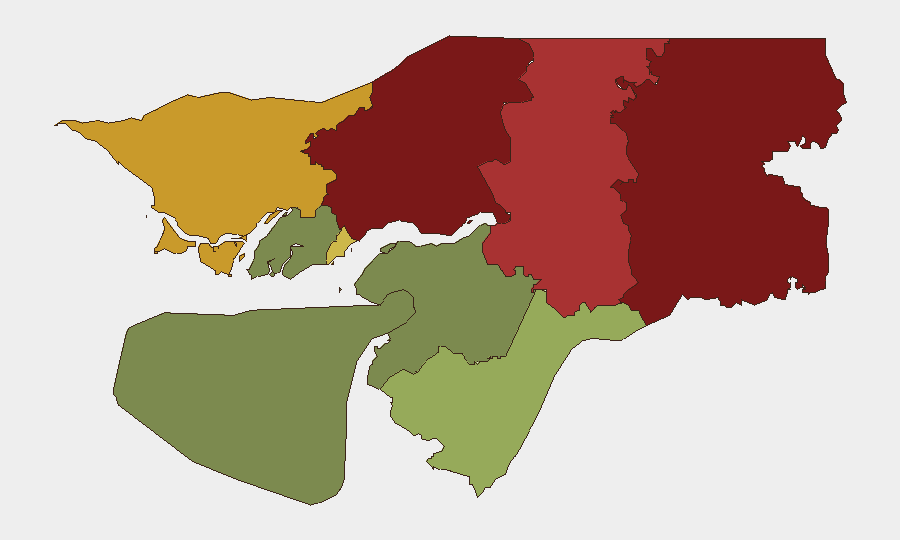
Gabu, Oio, and Bafatá regions carry the highest composite risk scores (92, 85, and 78 respectively), driven by historical instability, residual conflict infrastructure, and proximity to porous borders. Cacheu and the Bissau Autonomous Sector (scores 72 and 68) present elevated risk due to armed-group activity and direct exposure to the capital's current political crisis. The remaining regions show lower but non-negligible risk, particularly given the presence of unexploded ordnance across Bafatá, Oio, Biombo, Quinara, and Tombali.
How GeoBit Would Assist
Security teams should deploy AOI (Area-of-Interest) Monitoring & Early Warning on Bissau, Gabu, Oio, and Bafatá to track military movements, checkpoint activity, and curfew enforcement in real time. Regime-stability and election monitoring search capabilities, combined with network & actor analysis, enable tracking of military factions, civil-society response, and AU/international diplomatic signaling. Routing & Network Analysis supports identification of alternative travel corridors and supply-chain resilience outside closed borders and curfew zones.
7-Day Outlook
The military's consolidation of control is likely to harden over the next week, with border closures remaining in effect and curfews expanded or formalized. Diplomatic isolation will intensify as the AU and major powers respond; expect further travel restrictions and potential targeted sanctions. The risk of civil resistance, localized unrest, or intra-military factionalism remains material, particularly if the transitional presidency fails to establish legitimacy or if electoral disputes persist.
Highest-Risk Areas — Ranked
| # | State / Region | Risk |
|---|---|---|
| 1 | Gabu Region | 92 |
| 2 | Oio Region | 85 |
| 3 | Bafatá Region | 78 |
| 4 | Cacheu Region | 72 |
| 5 | Bissau Autonomous Sector | 68 |
| 6 | Tombali Region | 45 |
| 7 | Quinara Region | 38 |
| 8 | Biombo Region | 32 |
| 9 | Bolama Region | 15 |