Situation Summary
Azerbaijan remains a lower-tier global security concern (composite threat score 38, ranked #null globally) with no significant open-source-visible security incidents reported in the last 24–48 hours. The country's risk profile is heavily concentrated in Ujar District (score 31.3), which accounts for the majority of the composite national score; the capital Baku and other districts show substantially lower risk levels. Recent diplomatic activity between Armenia and Azerbaijan (confidence-building meetings on 14 June in Dilijan, with planned follow-up in Azerbaijan) reflects ongoing de-escalatory processes, though the broader Armenia–Azerbaijan dispute remains a structural risk factor.
Key Developments
- No acute security incidents identified in open sources for 17–19 June 2026. Web monitoring, X/Twitter OSINT, and major news feeds reveal no confirmed conflict, terrorism, major crime, civil unrest, infrastructure disruption, or significant travel-risk events in the last 48 hours.
- Diplomatic engagement: Armenia–Azerbaijan confidence-building meeting (14 June, Dilijan). Armen Grigoryan (Armenia Security Council Secretary) and Hikmet Hajiyev (Azerbaijani presidential aide) discussed peace and confidence-building measures; next working-level meeting planned in Azerbaijan. No reported incidents or protests tied to the process.
- Educational event in Baku (17 June). Sixth stage of the "Sultan bin Abdulaziz Al Saud International Program for Language Training" opened in Baku with no reported security disruptions.
- EU policy commentary (mid-June). EU Neighbours East released the "Azerbaijan Annual Survey 2026 – Country Report" (analytical, not an incident); separate open reporting on potential foreign sanctions proposals mentioning Azerbaijan, with no evidence of domestic unrest triggered.
Highest-Risk Areas
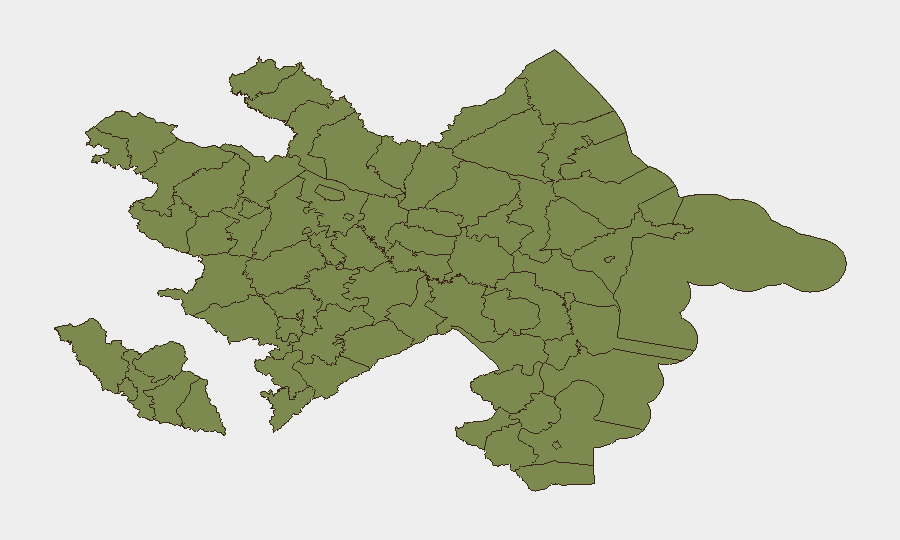
Ujar District dominates the sub-national risk landscape with a composite score of 31.3—approximately 2.7 times higher than Baku City (11.9) and orders of magnitude above all other tracked regions. This concentration warrants focused monitoring. Baku, as the capital and economic hub, presents baseline urban security considerations (petty crime, traffic, civil administration) typical of major cities in the region. All other districts (Siazan, Tovuz, Shusha, and eleven others) score below 4, indicating substantially lower assessed risk. The concentration of risk in Ujar suggests either historical incident clustering, border or disputed-territory sensitivity, or ongoing monitoring of specific actors or events; investigation of Ujar's specific risk drivers is recommended.
How GeoBit Would Assist
Security teams should deploy AOI Monitoring & Early Warning on Ujar District and Baku to maintain persistent watch for emerging incidents with real-time alerting. Intel Sweep and OSINT fusion (multi-language feeds, X/Twitter & Telegram monitoring, event-feed aggregation) would provide 24/7 situational awareness beyond English-language news cycles and corroborate or challenge open-source incident reports. Network & Actor Analysis linked to Ujar's elevated risk profile would help identify whether the risk score reflects border-zone activity, regime-stability dynamics, or discrete threat actors, enabling more targeted protective measures for personnel or assets.
7-Day Outlook
No imminent acute escalation is evident in available open sources. The Armenia–Azerbaijan diplomatic process and absence of reported incidents in the last 48 hours suggest a near-term holding pattern. However, the persistent structural risk—particularly in Ujar District—and the sensitivity of Armenia–Azerbaijan relations mean that situational awareness should remain continuous; any breakdown in diplomatic engagement or border-adjacent incident could shift risk posture rapidly.
Highest-Risk Areas — Ranked
| # | State / Region | Risk |
|---|---|---|
| 1 | Ujar District | 31.3 |
| 2 | Baku City | 11.9 |
| 3 | Siazan District | 3.7 |
| 4 | Tovuz District | 3.1 |
| 5 | Shusha District | 1.9 |
| 6 | Sadarak District | 1.3 |
| 7 | Qazakh District | 1.3 |
| 8 | Sharur District | 1.3 |
| 9 | Yevlakh District | 1.3 |
| 10 | Kangarli District | 1.3 |
| 11 | Nakhchivan Autonomous Republic | 1.3 |
| 12 | Aghstafa District | 1.3 |
Sources
Previous Daily Briefs
A new Azerbaijan brief is written every day — each with its own risk map and downloadable CSV. Here's the last week; use the calendar to go further back.
📅 Browse every day by calendar →
Highlighted days have a brief. Tap a day for that day's map & analysis, or “csv” for that day's dataset ($5).