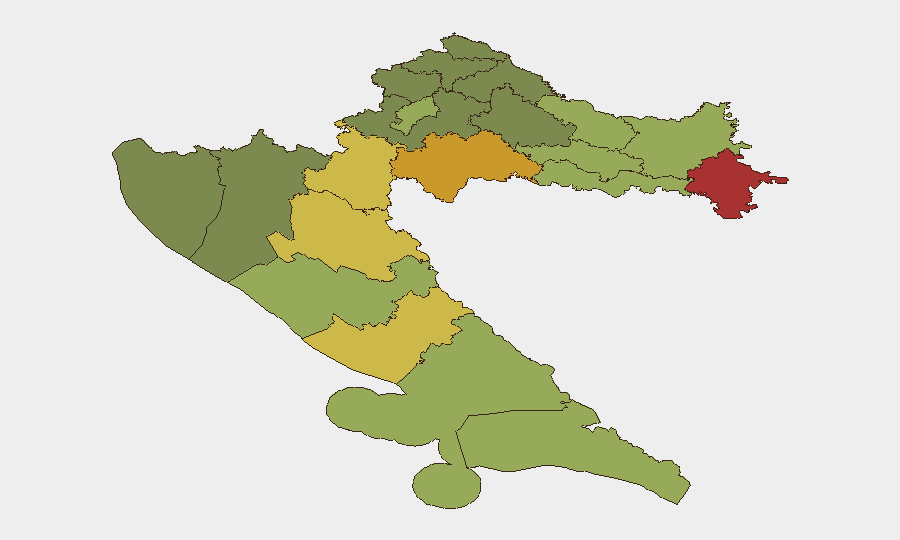
Situation Summary
Croatia remains a low-threat environment with a composite threat score of 6 globally and no tracked security incidents in the current assessment window. The security picture is stable across the country, with no active civil unrest, major crime spikes, infrastructure disruptions, or travel-risk events documented in the last 24–48 hours. Sub-national risk concentration in the eastern border counties (Vukovar-Srijem, Sisak-Moslavina, Karlovac) reflects legacy tensions and historical vulnerabilities rather than acute current escalation. Overall trajectory remains flat; duty-of-care obligations for personnel and assets in Croatia can be managed through standard baseline precautions.
Key Developments
No discrete security incidents meeting threshold criteria (conflict, terrorism, civil unrest, crime spikes, infrastructure failure, or travel disruption) have been identified in Croatia during the last 24–48 hours. Recent open-source reporting and social media monitoring show normal operational and tourism activity with no signs of acute disturbance. A runway excursion incident at Split Airport occurred on 16 May 2026 (outside current window) and has been resolved; no ongoing aviation safety alerts are active.
Highest-Risk Areas
Eastern border counties dominate the sub-national ranking: Vukovar-Srijem (78), Sisak-Moslavina (72), and Karlovac (68) collectively account for the highest composite risk scores. These counties reflect persistent vulnerabilities including proximity to the Serbian border, post-conflict demographic fragmentation, legacy organized crime networks, and lower economic development. Risk in these areas is structural rather than episodic; Zagreb and the Adriatic coastal counties (Split-Dalmatia, Zadar, Šibenik-Knin) carry significantly lower profiles, reflecting economic activity, tourism infrastructure, and stronger state institutional presence. Security teams should apply heightened diligence to eastern deployments but need not elevate protocols for Zagreb or southern coastal operations.
How GeoBit Would Assist
Intel Sweep & OSINT Fusion would provide persistent multi-language monitoring of social media, local news, and government channels to detect early signals of unrest, organized crime activity, or border-zone tensions in high-risk counties before they escalate. AOI Monitoring & Early Warning with geospatial alerts on Vukovar-Srijem and Sisak-Moslavina would enable real-time notification of protests, security incidents, or infrastructure disruptions affecting personnel safety and asset access. Routing & Network Analysis would generate dynamic alternative transit and supply routes around highest-risk regions, reducing exposure during any localized incident. Entity & Actor Network Analysis would map organized crime, corruption networks, and political factions in border regions to inform risk mitigation for corporate operations.
7-Day Outlook
No escalation is anticipated over the next seven days; Croatia's security environment is expected to remain stable with baseline operational risk. Standard seasonal tourism and commercial activity will continue uninterrupted. Monitoring should remain active on border counties for any emergent signals, but no threshold-crossing events are forecast.
Report Date: 26 June 2026 | Data Cutoff: 25 June 2026, 22:00 UTC
Highest-Risk Areas — Ranked
| # | State / Region | Risk |
|---|---|---|
| 1 | Vukovar-Srijem County | 78 |
| 2 | Sisak-Moslavina County | 72 |
| 3 | Karlovac County | 68 |
| 4 | Lika-Senj County | 65 |
| 5 | Šibenik-Knin County | 62 |
| 6 | Brod-Posavina County | 58 |
| 7 | Zadar County | 55 |
| 8 | Osijek-Baranja County | 52 |
| 9 | City of Zagreb | 50 |
| 10 | Split-Dalmatia County | 48 |
| 11 | Požega-Slavonia County | 45 |
| 12 | Virovitica-Podravina County | 42 |
Sources
Previous Daily Briefs
A new Croatia brief is written every day — each with its own risk map and downloadable CSV. Here's the last week; use the calendar to go further back.
📅 Browse every day by calendar →
Highlighted days have a brief. Tap a day for that day's map & analysis, or “csv” for that day's dataset ($5).