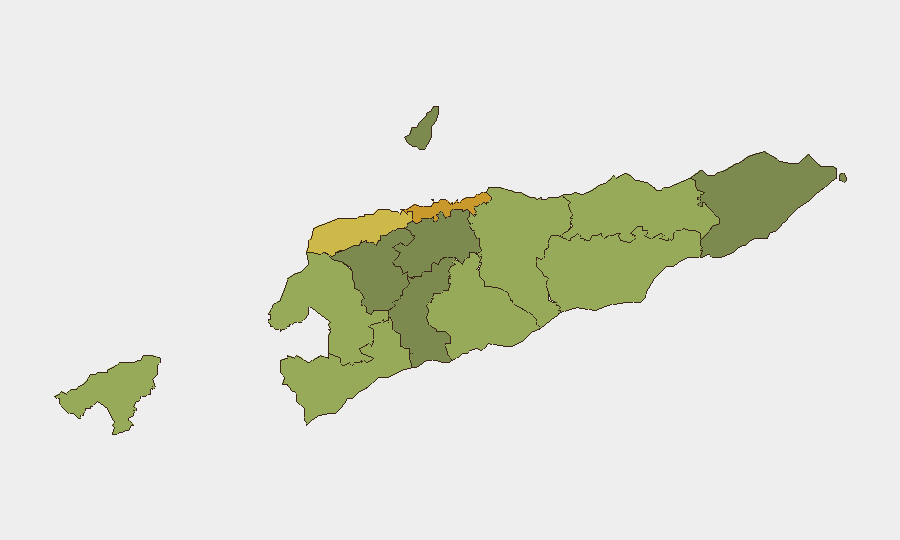
Situation Summary
East Timor's security environment remains stable with no confirmed incidents reported in the last 24–48 hours. The broader threat landscape is shaped by transnational organized crime networks, particularly online fraud and illegal gambling operations that have drawn sustained law enforcement attention over the past two weeks. Sub-national risk concentrations in Dili, Liquiçá, and Baucau reflect urban crime density and transit corridors rather than active conflict or civil unrest.
Key Developments
- No new incidents verified in the last 24–48 hours. Open-source news, official advisories, and social media monitoring show no corroborated reports of civil unrest, armed violence, infrastructure disruption, or acute travel-risk changes.
- Context (19–23 July): Nationwide crackdown on transnational scam operations. Over the past two weeks, police conducted multiple raids on fortified call-centre compounds across multiple provinces, arresting over 400 foreign nationals (primarily Chinese, Cambodian, Indonesian) on charges of illegal online gambling, fraud, and money laundering. Sites in Oé‑Cusse Ambeno were identified as particular hubs.
- Context (19 July): High-profile hotel detention in Dili. Police detained one Japanese national and one Chinese national at a Dili hotel on suspicion of involvement in international phone and online fraud; the Japanese embassy confirmed cooperation with authorities.
- Context (22–23 July): Cybersecurity policy escalation. The government announced a "zero tolerance" policy on illegal online activities, approved a draft cybersecurity law package, and cancelled licenses for online gambling and betting platforms, citing national security risks. UNODC briefings highlighted Timor‑Leste's vulnerability to transnational cybercrime expansion, particularly in Oé‑Cusse's Digital Centre.
Highest-Risk Areas
Dili's composite risk score of 72 reflects its status as the capital, primary commercial hub, and concentration point for organized crime activities and law enforcement operations. Liquiçá (62) and Baucau (58) rank second and third, likely driven by port activity, transit corridors, and smaller population bases that may amplify per-capita crime impact. Oé‑Cusse Ambeno (48) has emerged as a secondary priority following recent identification as a base for transnational fraud networks, despite its mid-ranking score. Peripheral and rural provinces (Aileu, Ermera, Ainaro) show materially lower risk, consistent with limited urban infrastructure and lower asset concentration.
How GeoBit Would Assist
Security teams operating in East Timor should deploy Intel Sweep and multi-language OSINT to monitor Dili-based hotel and port environments for organized crime indicators, and AOI Monitoring & Early Warning on Oé‑Cusse Ambeno and other known scam-compound sites to detect resurgence or relocation of transnational networks. Entity extraction and network analysis capabilities can map linkages between arrested foreign nationals and their home-country criminal organizations, informing travel and supply-chain risk. GIS & Spatial Analysis and Routing & Network Analysis support alternative-route planning and facility-location assessment, particularly for assets in high-risk Dili and Liquiçá.
7-Day Outlook
Law enforcement momentum against transnational organized crime is expected to persist, with continued raids and arrests likely in secondary provinces. No indicators suggest imminent escalation to civil unrest or infrastructure disruption; risk remains concentrated in crime and fraud vectors rather than political instability. Corporate and NGO operations should maintain standard duty-of-care protocols in Dili and monitor official travel advisories for changes related to cybersecurity enforcement.
Highest-Risk Areas — Ranked
| # | State / Region | Risk |
|---|---|---|
| 1 | Dili | 72 |
| 2 | Liquiçá | 62 |
| 3 | Baucau | 58 |
| 4 | Cova Lima | 55 |
| 5 | Bobonaro | 53 |
| 6 | Oecussi-Ambeno | 48 |
| 7 | Manufahi | 45 |
| 8 | Viqueque | 42 |
| 9 | Manatuto | 40 |
| 10 | Ainaro | 38 |
| 11 | Ermera | 36 |
| 12 | Aileu | 32 |
Sources
Previous Daily Briefs
A new East Timor brief is written every day — each with its own risk map and downloadable CSV. Here's the last week; use the calendar to go further back.
📅 Browse every day by calendar →
Highlighted days have a brief. Tap a day for that day's map & analysis, or “csv” for that day's dataset ($5).
Atlas — our AI intelligence desk — emails them this snapshot personally. Nothing else, no list.