Situation Summary
Grenada's security environment remains stable with no confirmed incidents in the last 24–48 hours across crime, civil unrest, terrorism, or infrastructure domains. Open-source monitoring and regional feeds report a quiet operational picture, consistent with the national composite threat score of 2. Routine travel with standard precautions remains appropriate; no acute risks have emerged to alter this posture.
Key Developments
- National (Grenada) – 3–4 August 2026: No confirmed new security, crime, civil-unrest, political-instability, infrastructure, or travel-risk incidents reported in the last 24–48 hours across all monitored feeds.
- National (Grenada) – 3–4 August 2026: Open-source monitoring confirms no robbery surges, violent-crime clusters, protests, or disorder affecting Grenada during this window.
- National (Grenada) – 3–4 August 2026: Cybersecurity monitoring reports no new cyberattacks, breaches, or critical-infrastructure disruptions in the last 24–48 hours.
- National (Grenada) – 3–4 August 2026: Political coverage in local media remains non-violent, focused on routine governance and economic issues with no evidence of emerging civil unrest or instability.
- St. George's & nationwide – context (late July–early August, outside current window): Royal Grenada Police Force reported no criminal incidents during Carnival 2026 activities to date and stated no intelligence indicates threats to ongoing Carnival events, supporting the current low-risk posture around mass gatherings.
Highest-Risk Areas
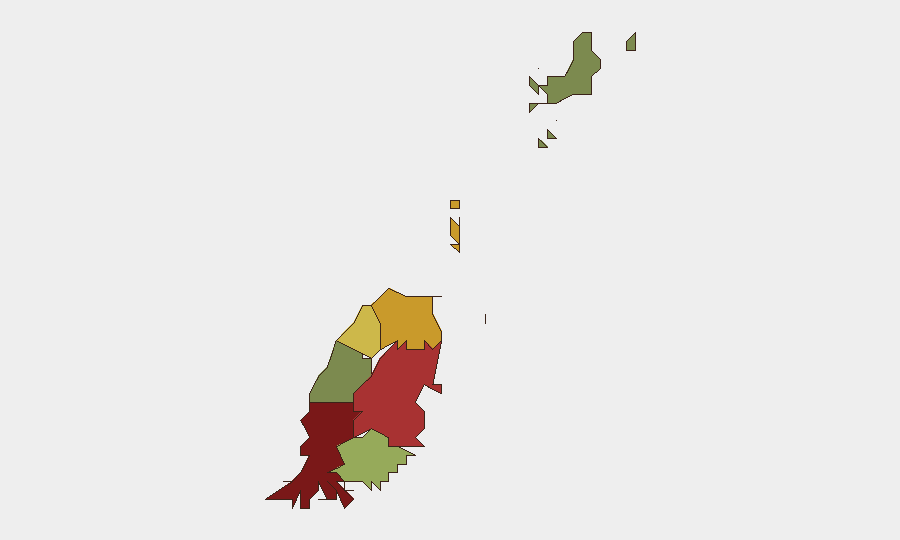
Saint George (risk 92) and Saint Andrew (risk 78) are the primary drivers of sub-national risk and warrant priority monitoring. These parishes contain the capital and largest urban centers, where concentrations of commercial activity, tourism infrastructure, and population density create higher baseline exposure to crime and crowding-related incidents. Saint Patrick (71) and Saint Mark (64) show moderately elevated risk, while the southern parishes and Carriacou/Petite Martinique (12) remain low-risk. The gradient reflects urban–rural disparity typical of Eastern Caribbean jurisdictions; no acute developments in the last 24–48 hours have shifted these baselines.
How GeoBit Would Assist
Corporate security teams operating in Grenada would employ Intel Sweep and multi-language OSINT feeds to detect emerging incidents, crime clusters, or civil unrest in real time, particularly in high-risk parishes. AOI Monitoring & Early Warning configured for Saint George and Saint Andrew would enable persistent watch on known risk nodes (ports, commercial districts, tourist areas) with automated alerting if incident signals emerge. Network & Actor Analysis and Sentiment & Temporal Analysis of local media, social platforms, and police communications would provide leading indicators of instability before it affects operations or personnel.
7-Day Outlook
No acute threat drivers are evident in the current window, and the security environment is expected to remain stable through mid-August absent external shocks. Carnival activities and routine tourism continue without reported disruption. Continued monitoring of Saint George and Saint Andrew for baseline crime and crowding dynamics is advisable; no escalation is anticipated.
Highest-Risk Areas — Ranked
| # | State / Region | Risk |
|---|---|---|
| 1 | Saint George | 92 |
| 2 | Saint Andrew | 78 |
| 3 | Saint Patrick | 71 |
| 4 | Saint Mark | 64 |
| 5 | Saint David | 52 |
| 6 | Saint John | 38 |
| 7 | Carriacou and Petite Martinique | 12 |
Sources
Previous Daily Briefs
A new Grenada brief is written every day — each with its own risk map and downloadable CSV. Here's the last week; use the calendar to go further back.
📅 Browse every day by calendar →
Highlighted days have a brief. Tap a day for that day's map & analysis, or “csv” for that day's dataset ($5).
Atlas — our AI intelligence desk — emails them this snapshot personally. Nothing else, no list.