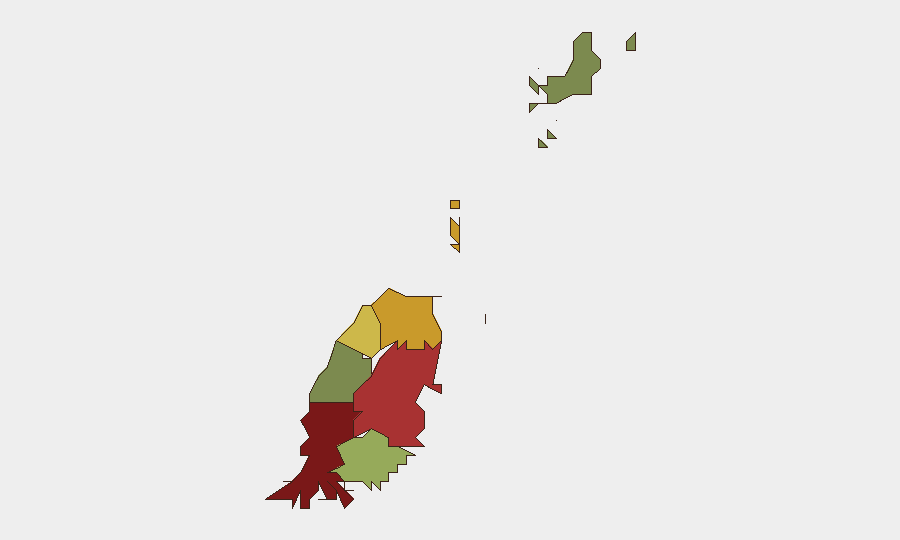
Situation Summary
Grenada remains a low-threat jurisdiction globally (rank #180, composite score 5) with no tracked security incidents in the reporting period. The primary near-term risk driver is the 5 November general election, scheduled to occur one week after this brief's publication date. Political stability and potential labor unrest around public-sector wage disputes represent the principal domestic concerns; Saint George parish, home to the capital and primary commercial hub, carries the highest sub-national risk profile at 92.
Key Developments
- Grenada Trade Centre, St George's — 28 October: Leaders of the National Democratic Congress (NDC), New National Party (NNP), and Dominica's Democratic Party (DPM) participated in a nationally televised election debate scheduled ahead of the 5 November general election.
- Grenada — 26 October: Election campaign activity intensified as main party leaders were confirmed for the 28 October debate; political rhetoric and rally turnout remained focal points for stability assessment in the final week before polling.
- Grenada — 22–27 October: The Grenada Public Workers' Union formally accused the government of excluding public officers from benefits under the 2026–2028 collective agreement and warned that the dispute could escalate to industrial action or labor unrest.
- Grenada — 25 October: Advocacy groups renewed international pressure on the UK government regarding a stalled investigation into the death of British national Andrew Frederick (incident occurred approximately 10 months prior); the renewed advocacy signals sustained diplomatic friction but does not reflect a new security incident.
- Grand Anse — 23 October: Omnibus driver Quormie N. Skeete was arrested and charged with dangerous driving; this represents localized criminal activity in Saint George parish with minimal broader security implications.
Highest-Risk Areas
Saint George parish (risk 92) dominates Grenada's threat profile, driven by its concentration of government, commerce, and urban population density; election-week activity and large gatherings in the capital amplify exposure. Saint Andrew (78) and Saint Patrick (71) present secondary risk, though incidents and unrest signals remain minimal across all parishes. The outer islands of Carriacou and Petite Martinique (risk 12) remain substantially lower-risk. Risk concentration in the capital underscores the importance of situational awareness during the final pre-election period and potential post-election transition.
How GeoBit Would Assist
Election monitoring and sentiment analysis capabilities would provide early warning of escalating political rhetoric, crowd dynamics, or protest activity during the 5 November polling period and transition. AOI monitoring and alerting on Saint George parish—particularly government buildings, polling centers, and commercial districts—would enable duty-of-care teams to detect disruptions, unrest, or labor action in real time. OSINT fusion across news, social media, and local feeds would triangulate labor-union communications and track public-sector worker sentiment for advance warning of any industrial escalation.
7-Day Outlook
The election on 5 November will be the primary driver of near-term risk; historical precedent suggests Grenada's elections proceed without violence, but crowding, campaign rhetoric, and post-election sentiment warrant close monitoring. Resolution of the public-sector labor dispute remains uncertain; if unresolved by election day, post-election industrial action is a plausible secondary risk. Overall threat trajectory remains low, but election-day situational awareness and post-poll period monitoring are operationally prudent.
Highest-Risk Areas — Ranked
| # | State / Region | Risk |
|---|---|---|
| 1 | Saint George | 92 |
| 2 | Saint Andrew | 78 |
| 3 | Saint Patrick | 71 |
| 4 | Saint Mark | 64 |
| 5 | Saint David | 52 |
| 6 | Saint John | 38 |
| 7 | Carriacou and Petite Martinique | 12 |
Sources
Previous Weekly Briefs
A new Grenada brief is written every Monday, covering the week — each with its own risk map and downloadable CSV. Use the calendar to go further back.
- October 20, 2026
- October 13, 2026
- October 6, 2026
- September 29, 2026
- September 22, 2026
- September 15, 2026
- September 8, 2026
📅 Browse past briefs by calendar →
Highlighted days have a brief. Tap a day for that day's map & analysis, or “csv” for that day's dataset ($5).
Atlas — our AI intelligence desk — emails them this snapshot personally. Nothing else, no list.