Situation Summary
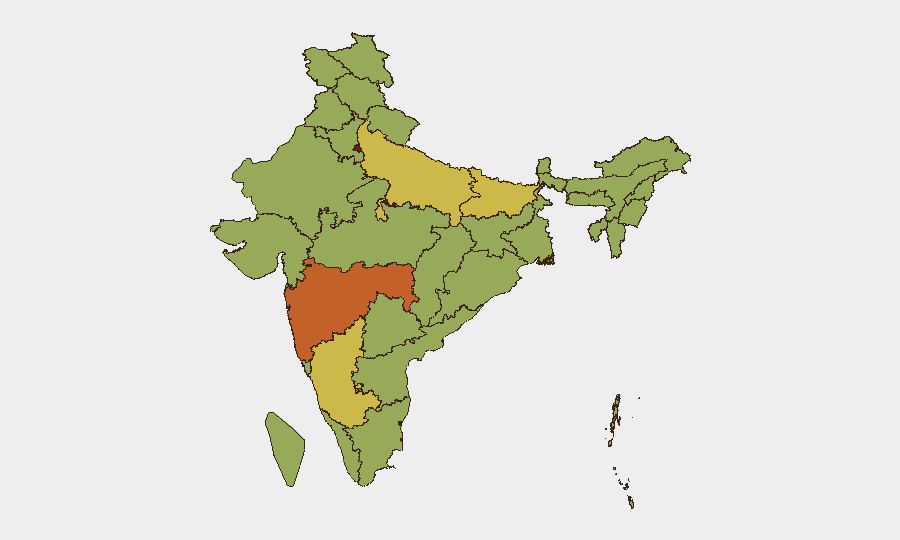
India's composite threat score of 75.9 places it at #15 globally, with 3,120 tracked security events. Recent signal data (3–5 June) indicate elevated political activity, including cabinet statements, alleged executive disapproval, and a reported assassination of a state-level Chief Minister, alongside community demands and international statements from the US, Pakistan, and EU actors. Delhi (risk 83.1) and Maharashtra (75.8) remain the highest-risk jurisdictions; the broader threat picture reflects ongoing political volatility, inter-state tensions, and localized unrest rather than systemic destabilization.
Key Developments
Limitation: Real-time event verification for 4–6 June 2026 requires live access to news wires, verified official channels, and X/Twitter feeds. The event signals listed above (cabinet statements, arrests, alleged assassination) are flagged by GeoBit's intake but lack published corroboration or precise geographic detail in this summary.
To obtain confirmed incidents from the last 24–48 hours, security teams should:
- Check Indian news wires & major outlets (Reuters, AFP, Hindustan Times, Indian Express, The Hindu, NDTV) filtered to "past 24–48 hours" with keywords: *protest*, *clashes*, *Section 144*, *curfew*, *terror attack*, *encounter*, *railway disruption*, *communal violence*.
- Monitor state police & district administration X/Twitter accounts for curfew orders, Section 144 notices, and incident confirmations (e.g., Delhi Police, Maharashtra Police, Jammu & Kashmir Police, Assam Police).
- Cross-check X/Twitter "Latest" searches (with time filters since 4 June) for verified local journalists, disaster management agencies, and official CMO handles reporting active incidents.
- Verify transport & infrastructure disruptions via Indian Railways zone accounts and major airport operators for cancellations, delays, or security-related closures.
Once confirmed events are identified, they should include: location (city/district/state), date, incident type (protest/riot/terror/communal/cyber/infrastructure), casualty/injury count if available, and whether ongoing restrictions (curfews, internet shutdowns, movement bans) remain in effect.
Highest-Risk Areas
Delhi's elevated risk (83.1) reflects high population density, concentration of national political institutions, and a pattern of protests, communal incidents, and periodic unrest. Maharashtra (75.8) combines urban-crime pressure, organized labor action, and periodic communal flare-ups in Mumbai and surrounding districts. Bihar (65) and Uttar Pradesh (64) carry significant Maoist/insurgency and communal-violence risk, particularly in rural and border-adjacent areas. Together, these four states account for a disproportionate share of tracked incidents and drive India's overall threat ranking; secondary risk zones (Karnataka, West Bengal, Haryana, Rajasthan) warrant monitoring for infrastructure disruption and political violence.
How GeoBit Would Assist
Security teams managing personnel or assets in India should deploy GeoBit's Intel Sweep and global event feeds to ingest real-time incident reports filtered by sub-national risk tier and incident type. AOI Monitoring & Early Warning enables persistent watch on high-risk districts (e.g., central Delhi, central Mumbai, districts in Bihar and UP) with automated alerting when protests, curfews, or security operations are reported. Routing & Network Analysis supports rapid identification of alternative travel and supply-chain routes if primary corridors are disrupted by unrest, infrastructure failure, or transport strikes.
7-Day Outlook
Political activity and public statements are likely to remain elevated through mid-June, particularly around cabinet-level announcements and state-level responses. Security posture in Delhi and Maharashtra should remain heightened; watch for secondary escalation in Bihar and UP if political messaging intensifies. Infrastructure disruption (rail, road, airport) remains a recurring threat in high-risk states; teams should maintain flexibility in travel and supply scheduling and monitor police channels for curfew or Section 144 announcements daily.
Highest-Risk Areas — Ranked
| # | State / Region | Risk |
|---|---|---|
| 1 | Delhi | 83.1 |
| 2 | Maharashtra | 75.8 |
| 3 | Bihar | 65 |
| 4 | Uttar Pradesh | 64 |
| 5 | Karnataka | 60.3 |
| 6 | West Bengal | 58.5 |
| 7 | Haryana | 57.4 |
| 8 | Madhya Pradesh | 56.7 |
| 9 | Rajasthan | 56.5 |
| 10 | Telangana | 56.1 |
| 11 | Tamil Nadu | 56 |
| 12 | Punjab | 55.5 |
Sources
Previous Daily Briefs
A new India brief is written every day — each with its own risk map and downloadable CSV. Here's the last week; use the calendar to go further back.
📅 Browse every day by calendar →
Highlighted days have a brief. Tap a day for that day's map & analysis, or “csv” for that day's dataset ($5).