Situation Summary
Israel remains the second-highest-threat environment globally (composite score 100), driven by active multi-front military operations across southern, central, and northern sectors. The past 48 hours have seen sustained conventional military exchanges with Iranian and Lebanese actors, concurrent operations in Gaza, and notable diplomatic friction with Western allies. The threat environment remains volatile with no immediate de-escalation indicators.
Key Developments
- 2026-06-08 · Iran–Israel military exchange: Multiple reports of Iranian artillery/tank and conventional military force actions directed at Israeli positions, with reciprocal Israeli aerial weapons employment. Geographic focus appears to include northern territories.
- 2026-06-08 · Beirut–Israeli operations: Conventional military force engagement reported between Beirut-aligned actors and Israeli forces, consistent with northern district escalation patterns.
- 2026-06-08 · U.S. diplomatic signal: White House public statement regarding Israel issued 2026-06-08, indicating elevated U.S. policy engagement and potential pressure on Israeli operational posture.
- 2026-06-08 · UK-Israel appeal proceedings: Legal/diplomatic appeal filed between Israel and United Kingdom on 2026-06-08, suggesting potential dispute escalation or bilateral friction requiring senior attention.
- 2026-06-07 · Gaza operations: Conventional military force operations by Israeli forces in Gaza reported, maintaining sustained pressure in southern district.
- 2026-06-08 · Counterterrorism operations: Israeli forces conducted conventional military action against terrorist actors, indicating ongoing asymmetric threat activity within operational zones.
- 2026-06-08 · Domestic political friction: Israeli-to-Israeli public statement recorded, reflecting internal policy divergence or political contestation.
- 2026-06-08 · Unconventional violence: Non-conventional armed activity (origin: Army vs. Israel) signals potential armed-group or rogue-element activity within Israeli territory or controlled zones.
Highest-Risk Areas
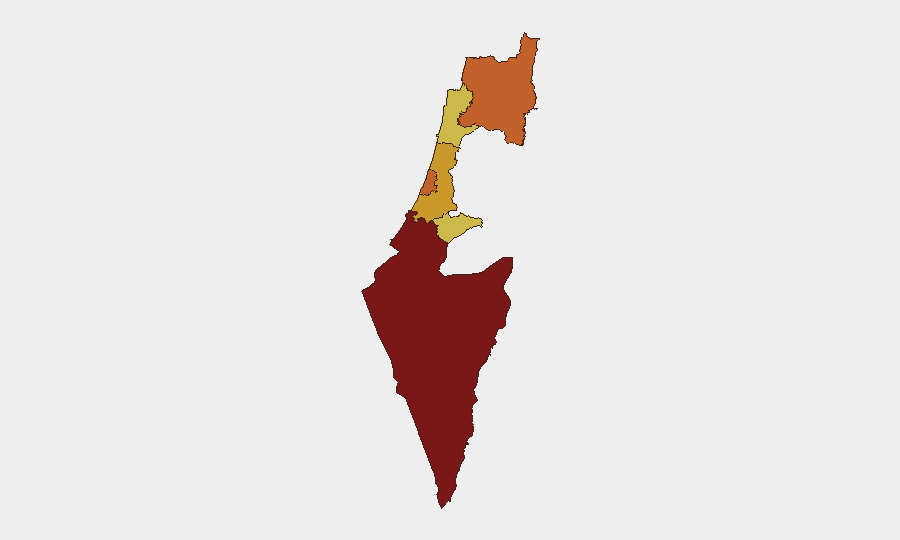
The South District (risk score 100) remains the primary flashpoint, driven by sustained Gaza operations and proximity to southern rocket/drone launch zones. Tel Aviv (75.7) and the North District (75.4) follow closely, with the North reflecting direct Iranian and Lebanese military engagement and Tel Aviv experiencing both indirect fire risk and political/diplomatic vulnerability. Jerusalem (70.3), Center (71.9), and Haifa (70) districts face elevated but somewhat lower composite risk, though all remain above standard operational thresholds. Risk concentration in South and North reflects the dual-theater nature of current conflict.
How GeoBit Would Assist
Corporate security teams should activate AOI Monitoring & Early Warning on South, North, and Tel Aviv districts with real-time alerting on military event clustering and weapons employment. Intel Sweep and X/Twitter OSINT provide 24-hour conflict-event tracking and sentiment analysis to detect escalation or de-escalation signals before formal announcements. Battle Mapping and Force Structure analysis enable duty-of-care teams to model safe routing, facility vulnerability, and staff evacuation corridors; Routing & Network Analysis supports alternative journey planning around active operational zones.
7-Day Outlook
Military operations are expected to sustain through the near term with no clear off-ramp. Diplomatic signals from the U.S. and UK suggest potential pressure for restraint, but operational pace in South and North districts will likely continue. Risk of horizontal escalation (additional actor involvement) or vertical intensification (weapons employment scale) remains elevated; corporate teams should maintain heightened alert posture and contingency readiness.
Highest-Risk Areas — Ranked
| # | State / Region | Risk |
|---|---|---|
| 1 | South District | 100 |
| 2 | Tel-Aviv District | 75.7 |
| 3 | North District | 75.4 |
| 4 | Center District | 71.9 |
| 5 | Jerusalem District | 70.3 |
| 6 | Haifa District | 70 |
Previous Daily Briefs
A new Israel brief is written every day — each with its own risk map and downloadable CSV. Here's the last week; use the calendar to go further back.
📅 Browse every day by calendar →
Highlighted days have a brief. Tap a day for that day's map & analysis, or “csv” for that day's dataset ($5).