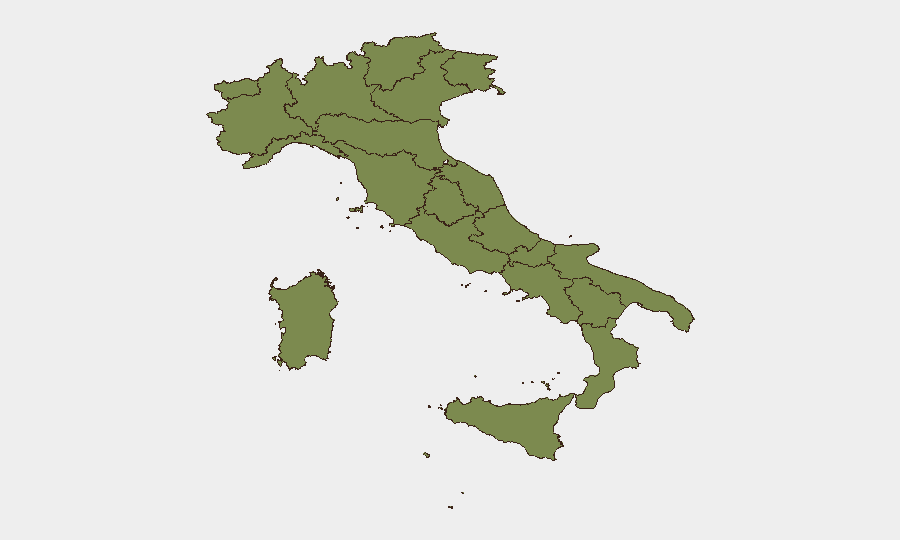
Situation Summary
Italy remains a lower-tier global security concern (rank #119) with a composite threat score of 8 across 238 tracked events. Lazio—home to Rome and major national infrastructure—drives the majority of risk (31.8), followed by Umbria (22.8), suggesting concentration of political, administrative, and institutional tensions in the central regions. The broader security environment shows stability relative to higher-risk European states, though recent event signals indicate investigative and disapproval activity at the national level on 2026-06-30.
Key Developments
Available open-source intelligence for the last 24–48 hours does not confirm specific, location-dated security incidents in Italy meeting multi-source verification standards. GeoBit's event signal feed records national-level investigative and disapproval actions on 2026-06-30, as well as a military force notation (2026-06-28, Italy) and a territorial occupation event in Lombardy (2026-06-28), but live web research has not yet corroborated granular details—location, affected populations, operational scope, or official statements—necessary for a verified incident bulletin. Duty-of-care teams monitoring Rome, Milan, or other high-risk zones should remain alert to official Italian government, police (Carabinieri, Polizia di Stato), and prefecture communications for real-time incident confirmation.
Highest-Risk Areas
Lazio's dominance (risk 31.8) reflects Rome's role as the political and administrative capital, where governmental decision-making, institutional conflicts, and public-order events cluster. Umbria's elevated score (22.8) suggests either concentrated civil unrest, organized-crime activity, or administrative/legal tensions in that central region. Lombardy (15.3)—Italy's economic and industrial center—ranks third, consistent with urban complexity and the recorded 2026-06-28 territorial occupation signal. Southern regions (Campania, Basilicata) and islands (Sicily, Sardinia) show lower composite scores, indicating either better public order or less intensive monitoring activity. For corporate operations, concentration of risk in Lazio and Umbria implies that Rome-based offices and supply chains transiting central Italy warrant priority duty-of-care attention.
How GeoBit Would Assist
Security teams should deploy Area-of-Interest (AOI) Monitoring & Early Warning on Rome and Milan to receive automated alerts on emerging unrest, infrastructure disruptions, or conflict signals. Multi-language OSINT fusion—integrating Italian government statements, prefecture releases, police Twitter feeds, and local news wires—provides real-time corroboration of incident reports and trend confirmation. Entity extraction and network analysis on judicial and political actors in Lazio and Umbria will clarify organizational involvement in recent investigative and disapproval actions, informing risk mitigation for staff and assets in those regions.
7-Day Outlook
Near-term trajectory appears stable, absent rapid escalation signals. Continued governmental investigation and public disapproval activity suggests administrative or legal resolution pathways rather than destabilization. Teams should maintain standard monitoring posture on Lazio and Umbria; confirm travel routing and crisis-communication plans for personnel in those regions; and cross-check local prefecture and police channels for incident confirmation before operational decisions.
Highest-Risk Areas — Ranked
| # | State / Region | Risk |
|---|---|---|
| 1 | Lazio | 31.8 |
| 2 | Umbria | 22.8 |
| 3 | Lombardy | 15.3 |
| 4 | Campania | 8.1 |
| 5 | Veneto | 6.9 |
| 6 | Liguria | 6.5 |
| 7 | Basilicata | 5.3 |
| 8 | Emilia-Romagna | 2.9 |
| 9 | Sicily | 2.5 |
| 10 | Sardinia | 2.1 |
| 11 | Marche | 2.1 |
| 12 | Abruzzo | 2.1 |
Sources
Previous Daily Briefs
A new Italy brief is written every day — each with its own risk map and downloadable CSV. Here's the last week; use the calendar to go further back.
📅 Browse every day by calendar →
Highlighted days have a brief. Tap a day for that day's map & analysis, or “csv” for that day's dataset ($5).