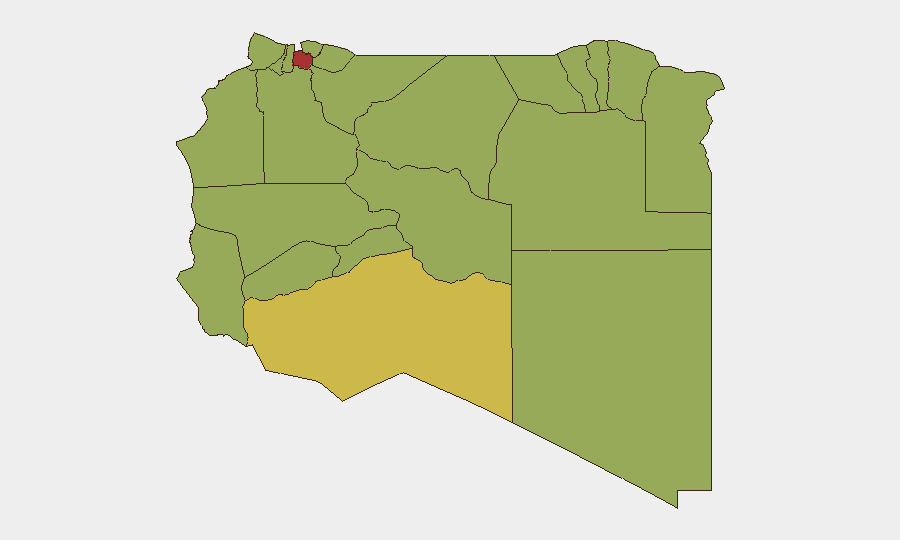
Situation Summary
Libya remains at composite threat rank #25 globally with 43 tracked events and a risk score of 69, indicating persistent instability driven by competing state and non-state actors. The past 24 hours have surfaced arrest operations targeting activists and Tunisian nationals, alongside investigative action by both state and corporate entities, suggesting elevated tension around civil dissent and border security. Tripoli and the western Jafara region continue as focal points of instability. Without verified developments from the preceding 48 hours beyond raw event signals, the assessment reflects an operationally active but not catastrophically escalating environment.
Key Developments
- 2026-06-05 · Arrest/Detain operations (Tripoli/nationwide): Libyan authorities have conducted multiple arrests targeting activists and at least one Tunisian national. The timing and scale suggest a coordinated security response, likely linked to civil unrest or cross-border movement concerns.
- 2026-06-05 · Presidential rejection and public statements: Presidential statements and rejection actions on 2026-06-05 signal intra-governmental or state-opposition friction; accompanying public statements by activists indicate civil-society pushback.
- 2026-06-05 · Corporate investigation: A company-level investigation (sector unknown from available signals) has been initiated, suggesting potential involvement of international or domestic firms in security incidents or regulatory concern.
- 2026-06-05 · Prison-related public statement: A statement concerning prison conditions or detainee handling has entered the public record, implying transparency pressure or allegations of mistreatment.
- 2026-06-04 · Activist demand: An activist demand (likely related to civil rights or governance) was lodged on 2026-06-04, preceding the arrest wave.
- 2026-06-03 · Administrative sanctions (Libya vs. African bodies): Libyan authorities or entities faced administrative sanctions from African regional bodies, suggesting diplomatic or institutional friction.
Note: Specific locations, casualty figures, and operational details for the above events are not fully populated in the available signal set. Field verification and open-source corroboration are recommended.
Highest-Risk Areas
Jafara (78.3) and Murzuq (63.3) drive the composite national risk; both regions are characterized by ungoverned space, smuggling networks, and militia presence. Tripoli (57.0) and Sirte (49.5) follow, reflecting capital-city instability and continued fragmentation along the Sirte–Benghazi axis. The remaining tier of medium-risk districts—Nalut, Ghat, Az Zawiya, and the Wadi regions—reflects distributed low-intensity activity (smuggling, militia checkpoints, tribal disputes) rather than acute conflict. Western and southern Libya pose the greatest hazard to corporate and expatriate presence due to proximity to migrant routes, fuel smuggling corridors, and under-resourced law-enforcement.
How GeoBit Would Assist
Corporate security teams should activate AOI Monitoring & Early Warning on Tripoli, Jafara, and Murzuq to detect force movements, checkpoint activity, and civil unrest in real time. Intel Sweep and multi-language OSINT (X/Twitter, Telegram, local media) will disambiguate the activist arrests and presidential statements to clarify threat vector (e.g., sectarian, tribal, or reform-driven). Network & Actor Analysis will map relationships between detained activists, state security, and regional backers to predict secondary escalation or negotiated release.
7-Day Outlook
No imminent military escalation is signaled, but the arrest wave and activist demands suggest sustained civil-political friction. Expect continued border-security operations targeting migrant and smuggling flows. Monitor Tripoli for further detention activity or street protests; watch Jafara for militia repositioning or cross-border incursions from southern Tunisia. Assess whether the presidential rejection portends cabinet reshuffles or policy shifts by week's end.
Highest-Risk Areas — Ranked
| # | State / Region | Risk |
|---|---|---|
| 1 | Jafara | 78.3 |
| 2 | Murzuq | 63.3 |
| 3 | Tripoli | 57 |
| 4 | Sirte | 49.5 |
| 5 | Nalut | 48.3 |
| 6 | Ghat | 48.3 |
| 7 | Baladiyah Surman | 48.3 |
| 8 | Az Zawiya District | 48.3 |
| 9 | Wadi al Shatii | 48.3 |
| 10 | Wadi al Hayaa | 48.3 |
| 11 | Kufra | 48.3 |
| 12 | Nuqat al Khams | 48.3 |
Sources
Previous Daily Briefs
A new Libya brief is written every day — each with its own risk map and downloadable CSV. Here's the last week; use the calendar to go further back.
📅 Browse every day by calendar →
Highlighted days have a brief. Tap a day for that day's map & analysis, or “csv” for that day's dataset ($5).