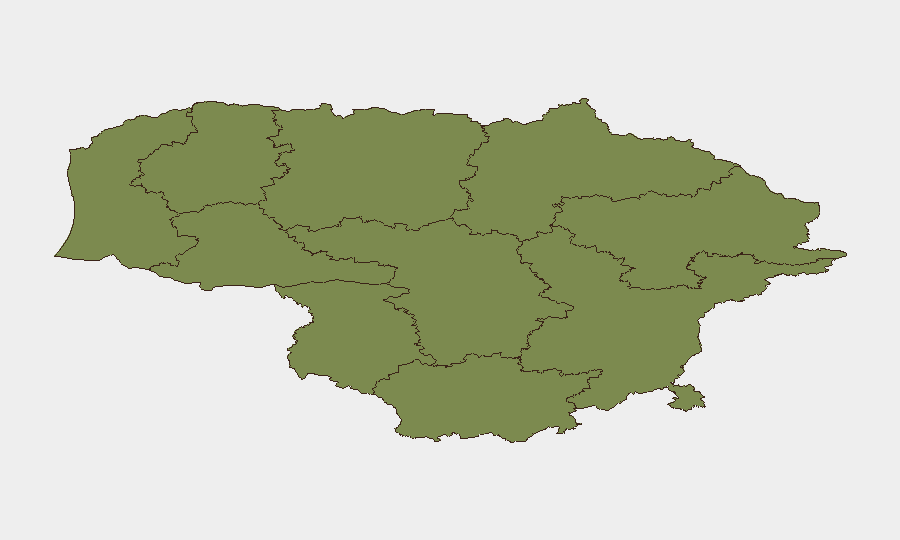
Situation Summary
Lithuania remains a moderate-risk environment (rank #139 globally, composite threat score 5) with acute infrastructure-security concerns concentrated in Siauliai County. The past 48 hours have seen a spike in coordinated false-threat incidents, official warnings of Russian targeting of critical energy and transport systems, and regional migration-pressure developments along the Latvia border. Overall threat trajectory is elevated but not yet indicative of imminent kinetic activity; however, psychological-operations and critical-infrastructure vulnerability remain the dominant near-term risk vectors.
Key Developments
- Vilnius & Kaunas, 17 July 2026 – Coordinated false bomb threats emailed to Teltonika premises (Vilnius), office buildings, and emergency medical services in both cities triggered evacuations and police response; pre-trial investigation opened for false public-danger reporting under Criminal Code.
- National, 17 July 2026 – President Nausėda confirmed intelligence signals of Russian planning for limited kinetic operations targeting Lithuanian critical infrastructure; authorities have tightened security protocols around energy, transport, and electricity-grid–connected facilities.
- National / Baltic region, 17 July 2026 – Kremlin publicly denied Lithuanian sabotage allegations, characterizing infrastructure warnings as NATO militarization pretext, signaling sustained rhetorical escalation.
- Lithuania–Latvia border, mid-July (confirmed statements 17–18 July) – Incoming Interior Minister Katelynas reported fourfold increase in secondary migration from Belarus via Latvia; Lithuania is considering temporary reintroduction of border controls with Latvia and has deployed additional border guards to assist Latvia.
- Marijampolė, 16 July 2026 – Central Electoral Commission revoked powers of Mayor Povilas Isoda following Court of Appeal conviction for misuse of expense allowances; creates local governance transition and potential political-stability gap.
- Marijampolė, 15–16 July 2026 (night) – Violent assault on minor involving repeated strikes and phone impact, recorded and posted to social media by bystanders; prosecutors opened pre-trial investigation for public-order violation.
Highest-Risk Areas
Siauliai County dominates the sub-national risk profile (composite score 31.8), substantially outranking all other regions and driving national-level threat elevation. Vilnius County (score 10.0) represents secondary concern, reflecting capital-city concentration of political, administrative, and infrastructure assets. The remaining eight counties cluster at low risk (1.8–4.5), suggesting threat distribution is geographically concentrated rather than dispersed. Siauliai's elevated score likely reflects critical infrastructure density, proximity to regional borders, and cumulative signal volume; security teams with assets in that county should prioritize facility hardening and access-control review.
How GeoBit Would Assist
Security and duty-of-care teams operating in Lithuania would benefit from AOI (Area-of-Interest) Monitoring & Early Warning on Siauliai and Vilnius County critical infrastructure and energy facilities, coupled with persistent multi-language OSINT feeds (X/Twitter, Telegram, local news) to detect emerging threat signals before public disclosure. GIS & Spatial Analysis combined with conflict mapping would enable rapid identification of safe corridors and alternative routing during potential infrastructure disruption or civil-unrest scenarios. Shodan and network analysis capabilities would support vulnerability assessment of connected industrial systems in high-risk zones.
7-Day Outlook
Intelligence warnings regarding Russian infrastructure targeting will likely persist; expect continued security-protocol tightening and potential minor operational disruptions around energy and transport nodes. False-threat campaigns may continue as psychological-pressure vectors; business continuity plans should assume periodic evacuations. Migration-pressure developments along the Latvia border carry lower direct risk to businesses but may trigger temporary border delays; monitor official Interior Ministry statements for border-check implementation timeline.
Highest-Risk Areas — Ranked
| # | State / Region | Risk |
|---|---|---|
| 1 | Siauliai County | 31.8 |
| 2 | Vilnius County | 10 |
| 3 | Panevezys County | 4.5 |
| 4 | Telsiai County | 1.8 |
| 5 | Klaipeda County | 1.8 |
| 6 | Taurage County | 1.8 |
| 7 | Kaunas County | 1.8 |
| 8 | Marijampole County | 1.8 |
| 9 | Utena County | 1.8 |
| 10 | Alytus County | 1.8 |
Sources
Previous Daily Briefs
A new Lithuania brief is written every day — each with its own risk map and downloadable CSV. Here's the last week; use the calendar to go further back.
📅 Browse every day by calendar →
Highlighted days have a brief. Tap a day for that day's map & analysis, or “csv” for that day's dataset ($5).
Atlas — our AI intelligence desk — emails them this snapshot personally. Nothing else, no list.