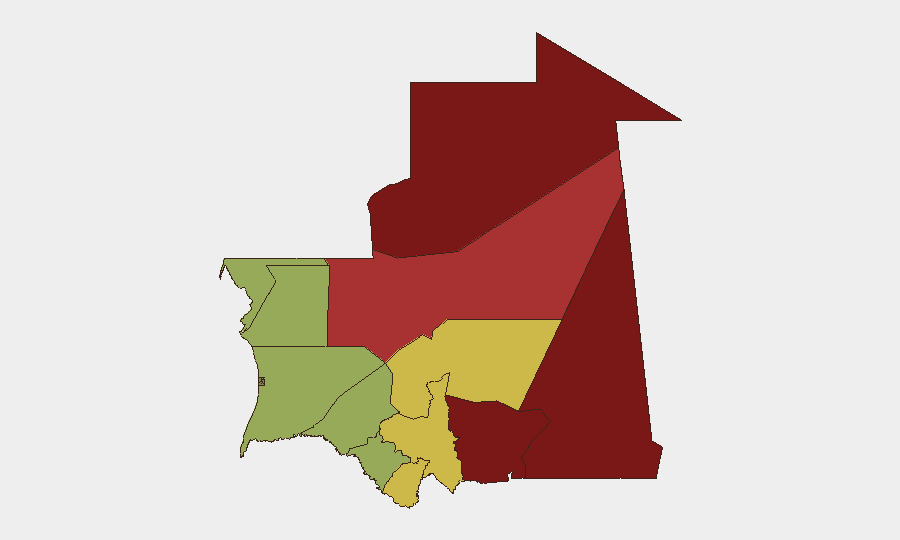
Situation Summary
Mauritania remains a low-to-moderate composite threat environment (#79 globally) with no major incident escalation reported in the last 48 hours. The military has explicitly denied recent online reports of cross-border fighter movements, and the country's critical infrastructure and border crossings remain operationally intact, though some disruption persists. Regional security cooperation is active—reflected in the Benin presidential visit—but the country's vulnerability to wider Sahel instability and the concentration of risk in its eastern and northern regions remain the primary concern vectors.
Key Developments
- Nouakchott, 9 July 2026: Mauritania's General Staff issued a formal denial of "reports circulated by some digital media alleging movements of fighters across the country's borders," characterizing such claims as "false and unfounded." This is a direct response to online rumors and suggests no confirmed new cross-border militant incursions as of that date.
- Nouakchott, 9 July 2026: President of Benin visited Mauritania to discuss bilateral security cooperation in the context of widening regional instability, signaling active multilateral coordination on Sahel-wide threats.
- Rosso border crossing (Mauritania–Senegal), 8 July 2026: Over 80 Moroccan freight trucks remain stranded following diversion from Mali routes, creating ongoing logistics disruption at this critical southern crossing and affecting overland supply chains.
- N'Diago, southwestern Mauritania, within last 24–48 hours: Public communication released on strategic N'Diago power project, framed as milestone for long-term energy and industrial security; no incidents reported.
- Mauritania diplomatic response, 9 July 2026: Mauritania joined Egypt in condemning Iranian missile strikes on Jordan, positioning itself in active regional foreign-policy response to Middle Eastern escalation.
Highest-Risk Areas
Tiris Zemmour (risk 95) and Hodh Ech Chargui (risk 85) dominate the sub-national threat landscape, reflecting their proximity to Mali and Algeria and their exposure to cross-border militant networks, trafficking, and ungoverned-space vulnerabilities. The second-tier cluster—Hodh El Gharbi, Adrar, and Tagant—extends this eastern and northern vulnerability corridor. These five regions account for the majority of Mauritania's structural risk; the southern and coastal regions (Brakna, Dakhlet Nouadhibou, Trarza) present significantly lower composite scores, making them relatively safer for personnel and asset concentration. Risk is heavily skewed toward the periphery; Nouakchott and the immediate littoral maintain lower threat profiles.
How GeoBit Would Assist
Intel Sweep and multi-language OSINT fusion are critical for distinguishing verified security incidents from online rumors—as demonstrated by the need to corroborate the military's denial of fighter movements. AOI Monitoring & Early Warning on Tiris Zemmour and Hodh Ech Chargui—the two highest-risk zones—would provide persistent watch and early alerting on cross-border activity, militant presence changes, or trafficking surges. Routing & Network Analysis is operationally essential for teams using Rosso and other border crossings, enabling real-time alternative-route planning around disruptions. Conflict & Military monitoring and Network & Actor Analysis would track Sahel-wide actor movements and their potential penetration into Mauritanian territory.
7-Day Outlook
Near-term risk escalation is unlikely given the military's explicit denial posture and the absence of corroborated incident reports. However, structural vulnerabilities in the northeast remain sensitive to wider Sahel dynamics; the Benin security talks and Jordan missile-strike diplomacy underscore the region's exposure to external shocks. Personnel and asset movements should remain alert to border-area disruptions and maintain contingency routing around Rosso.
Highest-Risk Areas — Ranked
| # | State / Region | Risk |
|---|---|---|
| 1 | Tiris Zemmour | 95 |
| 2 | Hodh Ech Chargui | 85 |
| 3 | Hodh El Gharbi | 80 |
| 4 | Adrar | 78 |
| 5 | Tagant | 68 |
| 6 | Guidimaka | 65 |
| 7 | Assaba | 62 |
| 8 | Gorgol | 58 |
| 9 | Trarza | 55 |
| 10 | Inchiri | 52 |
| 11 | Brakna | 48 |
| 12 | Dakhlet Nouadhibou | 45 |
Sources
Previous Daily Briefs
A new Mauritania brief is written every day — each with its own risk map and downloadable CSV. Here's the last week; use the calendar to go further back.
📅 Browse every day by calendar →
Highlighted days have a brief. Tap a day for that day's map & analysis, or “csv” for that day's dataset ($5).
Atlas — our AI intelligence desk — emails them this snapshot personally. Nothing else, no list.