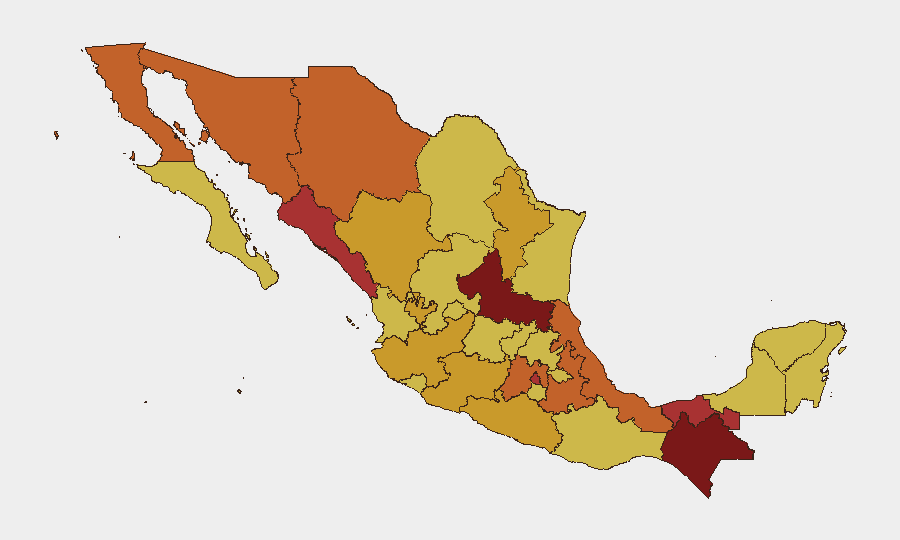
Situation Summary
Mexico remains at composite threat rank #6 globally, driven primarily by insurgency-related activity and tracked across 960 recent events. Security posture is currently split between heightened World Cup–related protective deployments in major venues (notably Guadalajara) and persistent organized-crime and political tensions in northern and southern border regions. The security environment shows no signs of acute deterioration in the past 48 hours, though underlying risks in high-threat states remain elevated and operative.
Key Developments
- Guadalajara, Jalisco – 10 June – Authorities deployed approximately 15,000 security personnel, including National Guard and heavily armed police with vehicle-mounted weapons, around World Cup stadium and key venues to deter cartel activity and reassure attendees.
- Jalisco state – 10 June – Official security statements downplayed current incident frequency, with state officials asserting no recent security issues and no expected cartel-violence resurgence during the tournament period.
- Mexico City (Centro Histórico) – 9–10 June – CNTE teachers' union protests and encampments prompted police cordons and street closures around downtown and government buildings, disrupting commerce and access to World Cup fan areas.
- UK travel advisory – 10 June update – The FCDO reaffirmed "all but essential travel" warnings for multiple high-risk jurisdictions, including Tijuana, Tecate, most of Chihuahua, Tamaulipas, Colima, Guerrero, and parts of Chiapas and Jalisco, citing organized crime, armed violence, and road-security risks.
- Tijuana & Tecate, Baja California – 10 June – UK government explicitly advises against non-essential travel to both cities and transit routes, citing crime, cartel violence, and kidnapping risk; limited exceptions apply for airport and specific toll corridors.
- Tamaulipas state – 10 June – Continued "do not travel" advisory for highways and border regions due to organized crime, armed robbery, and kidnapping threats, particularly on inter-city roads.
- Chiapas (Guatemala border and Highway 199) – 10 June – UK and U.S. advisories maintain warnings against travel within 40 km of the border and along Federal Highway 199 due to armed-group activity and road insecurity.
- U.S. Embassy countrywide advisory – 10 June – Message reiterated state-level risk differentiation for World Cup travelers, highlighting Tamaulipas and Jalisco as elevated-risk zones and warning against night travel on certain highways due to armed robbery and carjacking.
Highest-Risk Areas
San Luis Potosí (rank 100), Chiapas (82.9), and Tabasco (77.8) remain the highest-risk states by composite score, followed closely by Sinaloa (76.3) and Mexico City itself (76). Northern border states—particularly Chihuahua (75.7), Sonora (74.4), and Baja California (73.1)—continue to drive risk through organized-crime activity, armed-group presence, and trafficking networks. Southern and southeastern zones (Chiapas, Tabasco) face compounded risk from armed groups, migration flows, and limited state capacity. Mexico City's elevated ranking reflects both political volatility (recent labor unrest, judicial tensions) and ongoing gang-related crime in peripheral zones.
How GeoBit Would Assist
Security teams should deploy AOI Monitoring & Early Warning on Guadalajara, Jalisco border crossings, and Chiapas Federal Highway 199 to detect shifts in cartel activity or incident clustering around World Cup dates. Intel Sweep and Telegram/X OSINT would provide real-time sentiment and actor-network intelligence on organized-crime and protest movements. Routing & Network Analysis enables duty-of-care teams to identify secure alternative routes for personnel transiting high-risk northern and southern corridors.
7-Day Outlook
World Cup security deployments will likely sustain in Guadalajara and other host cities, suppressing localized violence in those zones through mid-tournament. Underlying risks in San Luis Potosí, Chiapas, and northern border areas remain unaffected by event-specific measures; personnel and asset movement through these regions should assume baseline threat levels. No significant policy or security-force shifts are anticipated in the near term.
Highest-Risk Areas — Ranked
| # | State / Region | Risk |
|---|---|---|
| 1 | San Luis Potosí | 100 |
| 2 | Chiapas | 82.9 |
| 3 | Tabasco | 77.8 |
| 4 | Sinaloa | 76.3 |
| 5 | Mexico City | 76 |
| 6 | Chihuahua | 75.7 |
| 7 | State of Mexico | 75 |
| 8 | Sonora | 74.4 |
| 9 | Puebla | 74 |
| 10 | Veracruz | 73.9 |
| 11 | Baja California | 73.1 |
| 12 | Durango | 72.3 |
Previous Daily Briefs
A new Mexico brief is written every day — each with its own risk map and downloadable CSV. Here's the last week; use the calendar to go further back.
📅 Browse every day by calendar →
Highlighted days have a brief. Tap a day for that day's map & analysis, or “csv” for that day's dataset ($5).