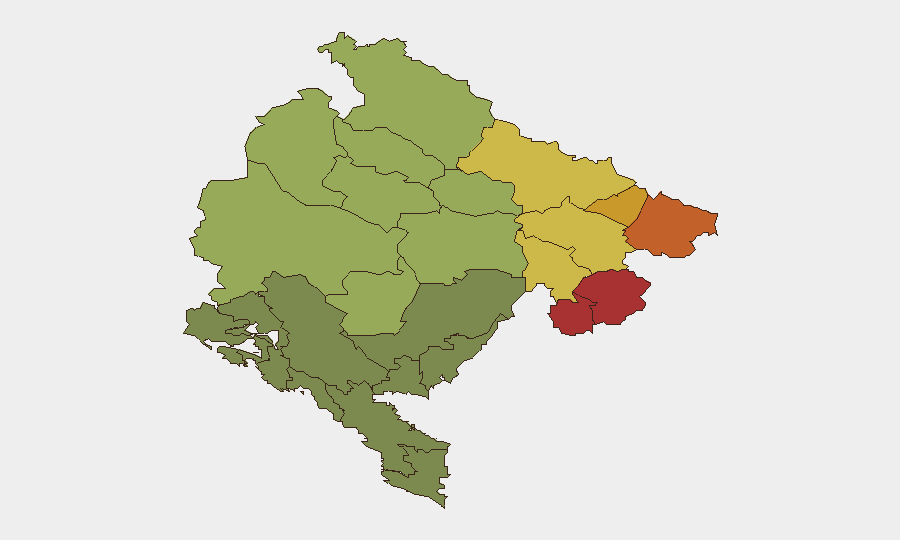
Situation Summary
Montenegro remains a low-to-moderate-risk environment at the national level (composite threat score 11; global rank #105), with no corroborated security incidents reported in the last 24–48 hours. Risk is concentrated in the northern municipalities bordering Serbia and Albania, where historical trafficking, organized crime networks, and inter-community tensions persist. The country's EU accession process and strengthened border management continue to shape the security posture, though localized vulnerabilities in remote regions remain structurally intact.
Key Developments
Current open-source intelligence does not yield clearly timestamped, cross-confirmed security incidents in Montenegro for 2–4 July 2026. Recent items in circulation—including reports of an Iranian national's arrest and EU border-management documentation dated 30 June—lack precise incident dates or multi-source corroboration within the last 48 hours. Security teams should monitor the following backdrop:
- Northern border regions remain elevated-risk zones: Plav, Gusinje, Rožaje, Petnjica, and Andrijevica municipalities (risk scores 68–78) continue to see trafficking and organized-crime activity, though no specific operations have been confirmed in the last 24–48 hours.
- EU engagement ongoing: European Commission accession monitoring and border-management funding discussions (late June 2026) reflect sustained EU attention to Montenegro's law-enforcement capacity and regional migration control.
- Police and authority activity: Routine law-enforcement operations and policy directives are ongoing, consistent with baseline security management.
Without independent corroboration from news agencies, official statements, or social-media signals with precise timestamps, issuing speculative incident alerts would not meet intelligence-led standards.
Highest-Risk Areas
Northern municipalities—Plav, Gusinje, Rožaje, Petnjica, and Andrijevica—drive Montenegro's sub-national risk profile (scores 62–78). These border regions face endemic trafficking (narcotics, persons), clan-based organized crime, weak state capacity in remote areas, and historical inter-community disputes linked to the broader Balkans conflict legacy. Plužine, Pljevlja, and Žabljak present moderate risk (50–58), reflecting lower population density but persistent smuggling corridors and limited police presence. Central and coastal areas (not in the top 12) carry substantially lower risk. Organizations with personnel or supply chains in the north should assume heightened exposure to organized crime, document fraud, and local instability.
How GeoBit Would Assist
Security teams operating in or transiting Montenegro should employ AOI (Area-of-Interest) Monitoring & Early Warning on Plav, Gusinje, and Rožaje municipalities to detect shifts in trafficking activity, protest signals, or police operations. OSINT Fusion & Corroboration (X/Twitter, Telegram, local media, cross-language search) provides real-time incident verification and sentiment analysis to separate noise from actionable threats. Routing & Network Analysis supports duty-of-care planning for staff movement, identifying alternative routes around known smuggling zones and checkpoints, while Entity Extraction & Network Analysis maps criminal and political actors in northern regions to inform risk briefings and access control.
7-Day Outlook
No imminent security escalation is forecast for Montenegro in the next week. Northern municipalities will likely remain stable at baseline risk, with routine law-enforcement activity and EU dialogue continuing. Security teams should maintain standard vigilance protocols for the north and monitor for any EU-related policy announcements that might signal enforcement changes or border-management initiatives.
Highest-Risk Areas — Ranked
| # | State / Region | Risk |
|---|---|---|
| 1 | Plav Municipality | 78 |
| 2 | Gusinje Municipality | 76 |
| 3 | Rožaje Municipality | 74 |
| 4 | Petnjica Municipality | 72 |
| 5 | Andrijevica Municipality | 68 |
| 6 | Bijelo Polje Municipality | 65 |
| 7 | Berane Municipality | 62 |
| 8 | Plužine Municipality | 58 |
| 9 | Pljevlja Municipality | 55 |
| 10 | Šavnik Municipality | 52 |
| 11 | Žabljak Municipality | 50 |
| 12 | Kolašin Municipality | 48 |
Sources
Previous Daily Briefs
A new Montenegro brief is written every day — each with its own risk map and downloadable CSV. Here's the last week; use the calendar to go further back.
📅 Browse every day by calendar →
Highlighted days have a brief. Tap a day for that day's map & analysis, or “csv” for that day's dataset ($5).
Atlas — our AI intelligence desk — emails them this snapshot personally. Nothing else, no list.