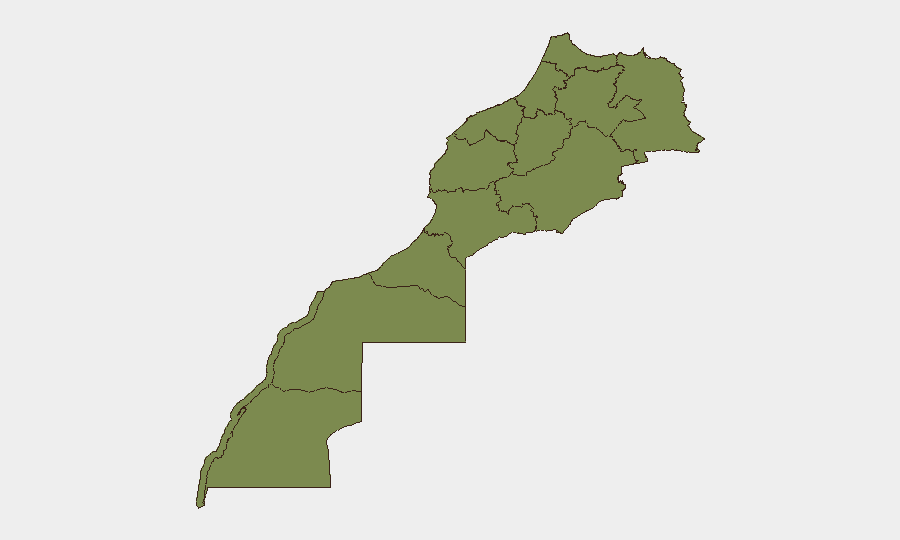
Situation Summary
Morocco's composite threat score of 16 places it in the lower-to-middle risk band globally, though sub-national variation is acute: Tangier-Tetouan-Al Hoceima carries a risk score nearly 4× the national average. Terrorism remains the primary driver—recent security service operations dismantled a Daesh/IS Sahel-linked cell with plots targeting sensitive sites—but open-source incident reporting for the last 24–48 hours is sparse, suggesting either effective operational security by threat actors or a temporary lull in publicly observable events. Critical infrastructure investment (rail) is proceeding without reported disruption, and no new travel warnings have been issued for specific regions in the immediate term.
Key Developments
- Casablanca, 23 July 2026 – A demonstration/rally was reported, with official disapproval recorded by interior ministry. Nature and scale of the gathering remain unclear from available sources; standard precaution for large public assemblies applies.
- National level, 23 July 2026 – Moroccan authorities registered rejection and internal threats (Moroccan vs. Moroccan actors), suggesting domestic political or factional tensions. Details are limited; likely reflects labor, regional, or policy disagreement rather than security crisis.
- Tehran–Morocco diplomatic axis, 25 July 2026 – A public statement from Tehran toward Morocco was recorded. Given Morocco's geopolitical position in Western Sahara and NATO alignment, diplomatic messaging warrants monitoring for escalation of rhetoric, though no imminent kinetic threat is indicated.
- Maritime incident, 25 July 2026 – An arrest/detain event involving a merchant ship was recorded. Context (piracy, sanctions evasion, or routine port security) is not yet clarified; maritime operators should confirm vessel details and port authority status.
- Morocco–France military signals, 25 July 2026 – Two conventional military force events between France and Morocco were logged on the same date. These may reflect joint exercises, border operations, or diplomatic signaling; GeoBit's conflict and military tracking capability should clarify whether these are routine or escalatory.
- Morocco vs. airline disapproval, 24 July 2026 – An official action or statement against an airline operator. Likely regulatory or labor-related rather than security-driven, but corporate flight operators should verify any operational restrictions.
- Military investigation, 23 July 2026 – Moroccan military initiated an investigation. Target and scope are not specified in available data; this may relate to the internal threat signals or to a discrete incident.
Highest-Risk Areas
Tangier-Tetouan-Al Hoceima dominates the risk profile, with a composite score of 31.3—substantially higher than Casablanca-Settat (8.3) or the capital region (5.3). The northern region's elevated risk reflects terrorism activity, cross-border dynamics with Spanish enclaves, and drug-trafficking networks feeding into Europe. Casablanca and Rabat-Salé-Kénitra carry secondary but material risk, chiefly from terrorism plots and occasional civil unrest; all other regions score at or near 1.3, indicating background-level volatility. Personnel and assets in the north should maintain heightened vigilance; southern and interior zones pose minimal incremental risk relative to the national baseline.
How GeoBit Would Assist
Security teams should deploy AOI monitoring & early warning on Tangier-Tetouan-Al Hoceima and Casablanca with automated alerting on arrests, military activity, and protest signals. Conflict & military tracking combined with OSINT fusion (X/Telegram, Arabic-language news, entity extraction) will clarify the France–Morocco military events and any diplomatic escalation from Tehran. Routing & network analysis can identify alternative transport corridors and safe zones should northern instability worsen.
7-Day Outlook
No imminent security crisis is evident, though the accumulation of diplomatic, military, and domestic political signals within 48 hours suggests heightened state activity and possible friction points. Terrorism risk remains endemic; disruption-focused operations by Moroccan services are ongoing. Expect continued monitoring of Franco-Moroccan military coordination and Iranian diplomatic messaging; any sharp escalation would likely manifest first in military posturing or militia recruitment signals detectable via OSINT.
Highest-Risk Areas — Ranked
| # | State / Region | Risk |
|---|---|---|
| 1 | Tangier-Tetouan-Al Hoceima | 31.3 |
| 2 | Casablanca-Settat | 8.3 |
| 3 | Rabat-Salé-Kénitra | 5.3 |
| 4 | Marrakech-Safi | 5.3 |
| 5 | Western Sahara | 1.3 |
| 6 | Laâyoune-Sakia El Hamra | 1.3 |
| 7 | Guelmim-Oued Noun | 1.3 |
| 8 | Dakhla-Oued Ed-Dahab | 1.3 |
| 9 | Béni Mellal-Khénifra | 1.3 |
| 10 | Fez-Meknes | 1.3 |
| 11 | Oriental | 1.3 |
| 12 | Drâa-Tafilalet | 1.3 |
Sources
Previous Daily Briefs
A new Morocco brief is written every day — each with its own risk map and downloadable CSV. Here's the last week; use the calendar to go further back.
📅 Browse every day by calendar →
Highlighted days have a brief. Tap a day for that day's map & analysis, or “csv” for that day's dataset ($5).
Atlas — our AI intelligence desk — emails them this snapshot personally. Nothing else, no list.