Situation Summary
Nicaragua remains a low-threat environment by global composite ranking (18/100), but concentrated risk in Managua Department (31.3) reflects acute political instability and governance uncertainty. A major constitutional development announced on 21 July—President Daniel Ortega's public statement that Nicaragua will hold no further elections—signals potential escalation of regime consolidation and raises medium-term risks of opposition mobilization, civil friction, and politically motivated detentions. No active armed conflict, large-scale unrest, or acute security incidents were reported in the last 48 hours; the primary threat vector remains political repression and structural instability rather than acute violence.
Key Developments
- Managua – Presidential Statement on Electoral Cancellation (21 July)
President Daniel Ortega announced that Nicaragua will "no longer hold elections," canceling scheduled 2027 general elections and consolidating indefinite rule. Multiple international outlets confirmed the statement via televised remarks marking the Sandinista Revolution anniversary. This represents a formal elimination of electoral competition and constitutes a major governance rupture likely to elevate opposition mobilization risk and detentions in coming weeks.
- Diplomatic Friction – Turkey Embassy Statement (21 July)
A public statement from the Nicaraguan embassy or diplomatic counterpart regarding Turkey was recorded in event feeds, indicating emerging diplomatic tension or formal grievance. Underlying cause and scope remain unclear from publicly available sources; no armed or consular incident was reported.
- Presidential/Political Statements – Multiple Actors (20–21 July)
Additional public statements from Nicaragua's president, government officials, and international actors (including Bolivia and the international community) were logged in event feeds over the 20–21 July window, though specific content and impact remain unconfirmed in mainstream media. These suggest heightened political communication or messaging activity but do not indicate acute incidents.
- Ambassador Relations – Reduced Diplomatic Engagement (19 July)
An ambassador-level reduction in relations was signaled, suggesting bilateral or multilateral diplomatic cooling. No specific country, departure, or concrete operational disruption was confirmed in available reporting.
*No additional discrete incidents (armed clashes, mass protests, terrorism, criminal events, infrastructure disruptions) were confirmed in the last 48 hours by multiple independent sources.*
Highest-Risk Areas
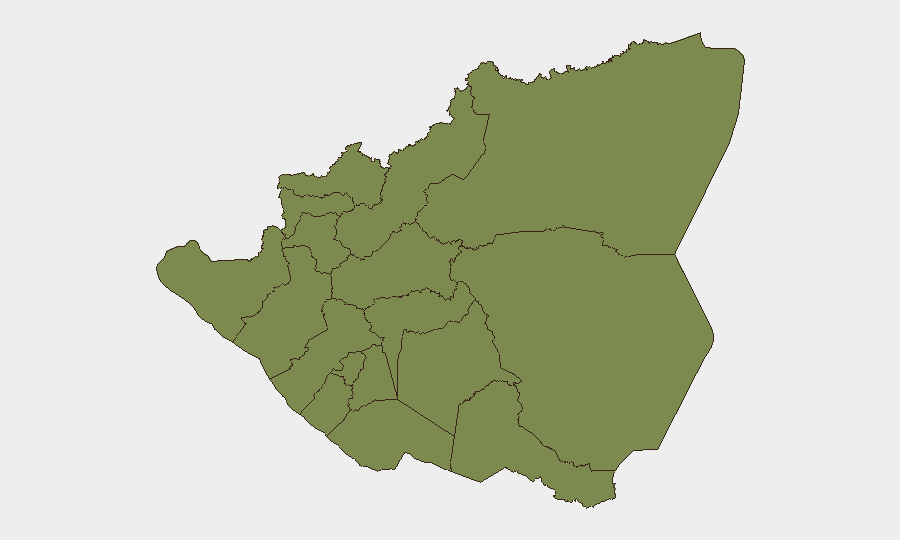
Managua Department dominates the risk landscape (31.3 vs. 7.9 for the next-ranked region), driven by presidential office, government concentration, opposition activity, and recent political volatility. The South Caribbean Coast (Autonomous Regions; 7.9) reflects standing maritime crime and gang presence but shows no acute recent escalation. All remaining departments cluster at 1.3, indicating relatively homogeneous background risk outside the capital and coastal zones. Security teams should concentrate protective measures, monitoring, and contingency planning on Managua and the Caribbean autonomous regions, where crime, detention risk, and political uncertainty intersect.
How GeoBit Would Assist
Teams with staff or assets in Nicaragua should deploy Intel Sweep and multi-language event feeds to catch political statements and opposition mobilization in real time; AOI Monitoring & Early Warning on Managua, Granada, and Caribbean-coast tourist corridors to detect protest formation or security incidents; and Regime-Stability Search to track constitutional amendments, arrests of opposition figures, and diplomatic ruptures that signal escalation. Network & Actor Analysis can map opposition and security-force movements; Routing & Network Analysis can pre-plan alternative evacuation or movement routes if Managua instability accelerates.
7-Day Outlook
The electoral cancellation announcement is likely to trigger opposition statements, civil-society pushback, and potential small-scale street mobilization in Managua over the next 7–10 days. Risk of politically motivated arrests and selective detentions of opposition figures will rise. No imminent armed conflict or mass unrest is predicted, but the governance rupture increases unpredictability and may accelerate emigration or expat departure from the capital.
Highest-Risk Areas — Ranked
| # | State / Region | Risk |
|---|---|---|
| 1 | Managua Department | 31.3 |
| 2 | South Caribbean Coast | 7.9 |
| 3 | Carazo Department | 1.3 |
| 4 | Chontales Department | 1.3 |
| 5 | Rivas Department | 1.3 |
| 6 | Río San Juan Department | 1.3 |
| 7 | Chinandega Department | 1.3 |
| 8 | Nueva Segovia Department | 1.3 |
| 9 | Madriz Department | 1.3 |
| 10 | Estelí Department | 1.3 |
| 11 | León Department | 1.3 |
| 12 | Masaya Department | 1.3 |
Sources
Previous Daily Briefs
A new Nicaragua brief is written every day — each with its own risk map and downloadable CSV. Here's the last week; use the calendar to go further back.
📅 Browse every day by calendar →
Highlighted days have a brief. Tap a day for that day's map & analysis, or “csv” for that day's dataset ($5).
Atlas — our AI intelligence desk — emails them this snapshot personally. Nothing else, no list.