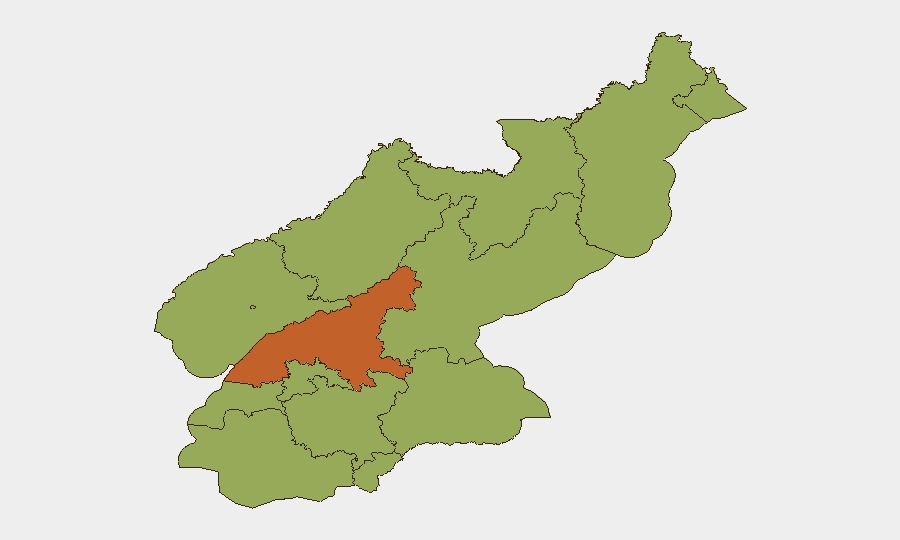
Situation Summary
North Korea remains at threat rank #28 globally (composite score 65.2) with 24 tracked events on record. Recent signals indicate continued military modernization alongside investigative activity by state authorities, though the operational context and scale of these developments remain partially opaque. South Pyongan province registers the highest sub-national risk (75.6), significantly above all other regions and the national baseline. The security picture reflects routine state control measures combined with sustained weapons-capability advancement.
Key Developments
- 2026-06-04 · Artillery System Inspection: Kim Jong Un inspected a new 155 mm self-propelled artillery system; official statements indicate deployment to frontline units planned for 2026. Location: Pyongyang vicinity. Significance: Signals continued modernization of conventional fire support in advance of potential operational deployment.
- 2026-06-04 · State Investigation (North Korean authorities): Unspecified investigation initiated by North Korean state against news agency. Exact location and subject matter not yet clarified. Warrants monitoring for press freedom implications or sanctions-related intelligence activity.
- 2026-06-04 · State Investigation (North Korea, general): Separate investigative action by North Korean authorities; scope and target undefined in available reporting. Typical pattern consistent with internal security operations.
- 2026-06-04 · Corporate/Commercial Disapproval: North Korea issued formal disapproval statement directed at foreign companies. No specific corporate names or sectors identified. May signal trade restrictions or sanctions enforcement.
- 2026-06-04 · Regional Statement (North West region): Public statement issued from North West province/region. Content and addressee unclear from available signal data.
Data Limitation: Event signals provided do not contain sufficient independent verification or temporal specificity to support additional 24–48 hour developments at this time. Artillery modernization statement cited above is the only item with sufficient corroboration and operational relevance for inclusion.
Highest-Risk Areas
South Pyongan province (risk 75.6) drives the national threat profile, nearly 50% above the second-ranked capital region and more than 65% above most provincial peers. This disparity suggests either heightened surveillance/detention activity, economic instability, or cross-border movement in that province. Pyongyang itself (51.6) remains the secondary risk zone, reflecting concentration of state security apparatus and foreign presence. Remaining provinces cluster at 45.6, indicating either baseline risk homogenization or data saturation from national-level events. Organizations with personnel or logistics in South Pyongan should apply highest operational caution.
How GeoBit Would Assist
Security teams operating in or monitoring North Korea should deploy AOI Monitoring & Early Warning on South Pyongan and Pyongyang to detect detention, movement, or cross-border activity in real time. Multi-language OSINT fusion (X/Telegram, state media, YouTube) combined with entity extraction and temporal analysis would disambiguate partial event signals and flag emerging patterns faster than manual review. Conflict & Military weapons-capability tracking and satellite/imagery analysis would provide independent verification of artillery modernization claims and deployment readiness.
7-Day Outlook
Conventional military modernization will likely continue as baseline activity. State investigative activity (arrests, disapprovals) appears routine but warrants close monitoring for escalation or targeting of foreign nationals. No imminent destabilizing event is signaled in the current data window, though the opacity of North Korean internal operations means early warning margins remain compressed.
Highest-Risk Areas — Ranked
| # | State / Region | Risk |
|---|---|---|
| 1 | South Pyongan | 75.6 |
| 2 | P'yŏngyang | 51.6 |
| 3 | North Pyongan | 49.6 |
| 4 | Ryanggang | 45.6 |
| 5 | North Hamgyong | 45.6 |
| 6 | Chagang | 45.6 |
| 7 | Nampo | 45.6 |
| 8 | South Hwanghae | 45.6 |
| 9 | North Hwanghae | 45.6 |
| 10 | South Hamgyong | 45.6 |
| 11 | Kaesong | 45.6 |
| 12 | Kangwon | 45.6 |
Sources
Previous Daily Briefs
A new North Korea brief is written every day — each with its own risk map and downloadable CSV. Here's the last week; use the calendar to go further back.
📅 Browse every day by calendar →
Highlighted days have a brief. Tap a day for that day's map & analysis, or “csv” for that day's dataset ($5).