Situation Summary
Poland remains in a low-acute-threat environment (rank #124 globally) with no confirmed kinetic incidents, civil unrest, or infrastructure disruptions reported in the last 24–48 hours. Security concern is dominated by ongoing geopolitical tension with Russia, hybrid-threat vectors (disinformation, cyber), and diplomatic friction with Ukraine rather than active ground-level attacks or mass disturbances. Risk is heavily concentrated in Masovian Voivodeship (Warsaw and surroundings), which accounts for the majority of the country's composite threat score.
Key Developments
- Poland-wide, 2026-06-29 to 2026-06-30: No confirmed terror attacks, armed clashes, large-scale protests, or major infrastructure disruptions recorded in Poland during the last 24–48 hours. Security posture remains stable at the operational level.
- Warsaw / Eastern Flank (national level), 2026-06-29: Polish and allied security sources continue to monitor heightened concern over Russian hybrid activity and potential provocations (disinformation, false-flag scenarios, drone incursions), but no specific new verified incident has been confirmed within Poland's territory during this period.
- Diplomatic Level, 2026-06-28 to 2026-06-29: Ukrainian Foreign Minister Andrii Sybiha issued public statements acknowledging a "state of crisis" in Polish–Ukrainian diplomatic relations; however, this reflects political tension rather than new security or civil-unrest incidents on Polish soil.
- Background Context (prior to 48h window): Authorities detained 11 Ukrainian and Belarusian nationals allegedly involved in Russian-linked efforts to incite unrest among Ukrainian refugee populations across Warsaw, Wrocław, Kraków, and other cities; operation occurred in late June but pre-dates the current 24–48h reporting window.
- Ongoing Threat Posture: Multi-source monitoring indicates that the primary near-term risk vector remains hybrid and geopolitical (cyber, disinformation, border provocation) rather than acute kinetic or mass-casualty events.
Highest-Risk Areas
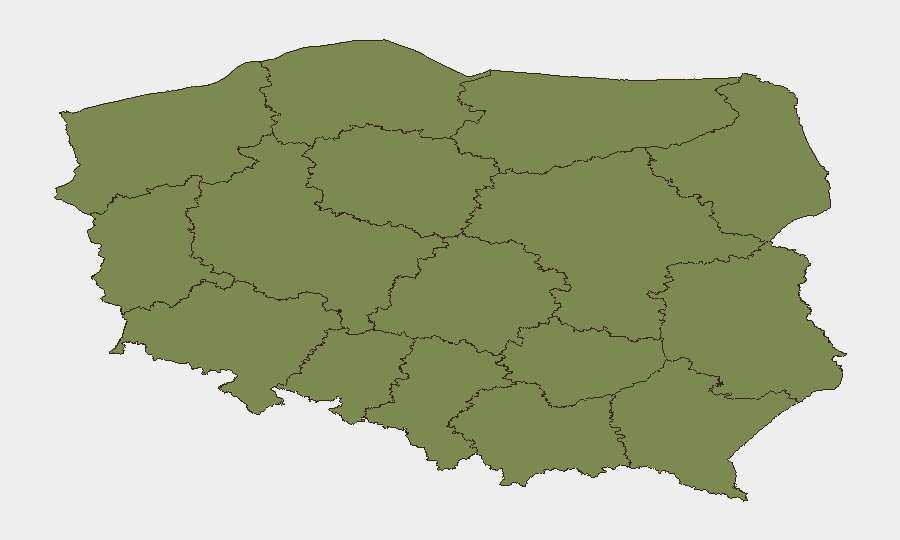
Masovian Voivodeship (Warsaw metropolitan area) dominates Poland's threat profile with a composite risk score of 31.8—more than three times higher than Łódź Voivodeship (10.2), the second-ranked region. This concentration reflects Warsaw's role as the capital, seat of government and security agencies, international diplomatic hub, and largest urban center; it is the natural focal point for political instability, cyber targeting, and external influence operations. Łódź Voivodeship ranks second but at a significantly lower absolute level, suggesting that threat distribution in Poland is heavily skewed toward the capital region. Remaining voivodeships cluster at scores between 1.8 and 2.6, indicating relatively even low-level baseline risk across the periphery, with no secondary hotspot emerging.
How GeoBit Would Assist
Intel Sweep, OSINT fusion, and multi-language search enable continuous monitoring of Polish-language security discourse, official statements, and cross-border hybrid-threat indicators (disinformation, cyber activity, border anomalies) that may precede escalation. AOI Monitoring & Early Warning with persistent watch over Masovian Voivodeship and eastern border zones provides automated alerting for emerging unrest, security incidents, or infrastructure disruptions. Network & Actor Analysis and Entity Extraction applied to Ukrainian, Russian, and Polish security-agency communications can flag shifts in hybrid-threat intensity or coordination that inform protective posture for personnel and assets in high-risk zones.
7-Day Outlook
The near-term trajectory remains stable operationally, with no imminent indicators of acute escalation (attacks, mass unrest, major sabotage). Geopolitical and hybrid-threat pressure will likely persist; monitoring should focus on diplomatic signaling, cross-border movements, and disinformation narratives as leading indicators of potential operational shifts. Risk concentration in Warsaw and the eastern flank means that duty-of-care teams should maintain baseline heightened awareness in those zones but need not anticipate broad-based disruption across Poland in the coming week.
Highest-Risk Areas — Ranked
| # | State / Region | Risk |
|---|---|---|
| 1 | Masovian Voivodeship | 31.8 |
| 2 | Łódź Voivodeship | 10.2 |
| 3 | Subcarpathian Voivodeship | 2.6 |
| 4 | Greater Poland Voivodeship | 2.4 |
| 5 | Opole Voivodeship | 2.4 |
| 6 | West Pomeranian Voivodeship | 2.2 |
| 7 | Warmian-Masurian Voivodeship | 1.8 |
| 8 | Podlaskie Voivodeship | 1.8 |
| 9 | Lublin Voivodeship | 1.8 |
| 10 | Lubusz Voivodeship | 1.8 |
| 11 | Lower Silesian Voivodeship | 1.8 |
| 12 | Pomeranian Voivodeship | 1.8 |
Sources
Previous Daily Briefs
A new Poland brief is written every day — each with its own risk map and downloadable CSV. Here's the last week; use the calendar to go further back.
📅 Browse every day by calendar →
Highlighted days have a brief. Tap a day for that day's map & analysis, or “csv” for that day's dataset ($5).