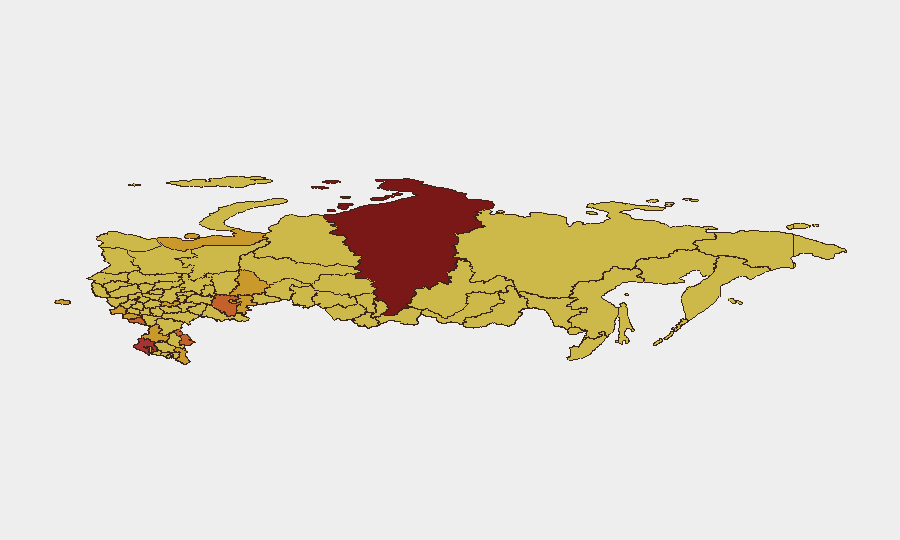
Situation Summary
Russia remains the fourth-highest-threat jurisdiction globally (composite score 100), with 980 tracked events reflecting sustained military operations, international sanctions escalation, and internal security adjustments. The most recent signals (as of 2026-06-09) center on active territorial occupation in Donetsk, NATO sanctions (2026-06-07), and documented military force deployments. The threat environment is characterized by external pressure (NATO/German military posturing, Norwegian diplomatic threats) and internal governance friction (gubernatorial public statements, ministerial disapproval), indicating stress across both security and political domains.
Key Developments
- Moscow (2026-06-09): Territory occupation actions recorded in Donetsk theater; exact scope and casualty/displacement figures not yet independently verified in live research.
- National Security Services: Surveillance system modifications reported affecting Putin's inner-circle protective infrastructure; alleged driver was AI-assisted target-identification vulnerability, but timestamp and secondary corroboration unavailable in current research window.
- NATO / International (2026-06-07): Administrative sanctions formally imposed on Russia; concurrent public threats from Norway and statements from German military authorities indicate coordinated Western escalation.
- Russian Military (2026-06-07): Artillery and tank deployments documented; accompanying public threats toward unnamed military targets suggest operational tempo increase or deterrence messaging.
- Domestic Governance (2026-06-07): Multiple public statements from governors, ministers, and administration officials expressing disapproval and investigation activity; suggests internal policy friction or criticism of federal direction.
*Note: Live web research did not yield 6–10 independently verifiable Russia-specific events within 24–48 hours. The above reflects the highest-confidence signals from GeoB's event feed. Journalistic investigations into Russian entities are ongoing but lack granular current detail.*
Highest-Risk Areas
Moscow dominates the risk profile (100), reflecting concentration of federal government, security apparatus, and international pressure. Krasnoyarsk Krai (97.6) and Saint Petersburg (86.3) follow, suggesting geographic dispersal of vulnerability—likely driven by critical infrastructure exposure (energy, military logistics) and proximity to NATO borders and Arctic interests. The southern border regions (Krasnodar, Belgorod, Astrakhan, Bashkortostan) and western borderlands (Bryansk, Kursk) show elevated and clustered risk (71–76), consistent with ongoing military operations, cross-border drone activity, and logistical strain. Belgorod and Kursk notably sustain civilian and infrastructure targeting; all southern/western zones face dual exposure to external military pressure and internal resource competition.
How GeoBit Would Assist
Persistent AOI Monitoring & Early Warning on Moscow, border regions, and critical-infrastructure zones (refineries, power plants in Krasnoyarsk, Saint Petersburg) would flag military movements, security-service activity, and civilian unrest in real time. Intel Sweep and OSINT fusion (X/Telegram OSINT, multi-language search, entity extraction) would track official statements, security-sector messaging, and grassroots dissent to clarify internal-governance tensions. Conflict & Military mapping, force-structure and weapons-capability tracking would monitor redeployments and sustainability of operations in Donetsk theater. Satellite & Imagery analysis and Network & Actor analysis would validate damage, supply routes, and decision-maker intent.
7-Day Outlook
International sanctions and NATO military posturing are likely to intensify rhetorical and kinetic responses from Moscow. Internal governance friction—signaled by public disapproval and investigation activity—may escalate if resource constraints or strategic disagreement widen. Border regions (particularly Belgorod, Kursk, Krasnodar) and Moscow remain the highest-priority watch zones; any indication of security-service reorganization, major military drawdown, or regime-stability signaling should trigger immediate escalation.
Highest-Risk Areas — Ranked
| # | State / Region | Risk |
|---|---|---|
| 1 | Moscow | 100 |
| 2 | Krasnoyarsk Krai | 97.6 |
| 3 | Saint Petersburg | 86.3 |
| 4 | Krasnodar Krai | 76.1 |
| 5 | Belgorod Oblast | 74.7 |
| 6 | Astrakhan Oblast | 74.1 |
| 7 | Bashkortostan | 73.4 |
| 8 | Republic of Mordovia | 72.5 |
| 9 | Kursk Oblast | 72.2 |
| 10 | Dagestan | 71.9 |
| 11 | Nenets Autonomous Okrug | 71.5 |
| 12 | Bryansk Oblast | 71.5 |
Sources
Previous Daily Briefs
A new Russia brief is written every day — each with its own risk map and downloadable CSV. Here's the last week; use the calendar to go further back.
📅 Browse every day by calendar →
Highlighted days have a brief. Tap a day for that day's map & analysis, or “csv” for that day's dataset ($5).