Situation Summary
Thailand's composite threat score of 70.1 (rank #22 globally) reflects persistent structural risks: southern insurgency, northern border instability with Myanmar, organized crime networks, and emerging state-versus-business tensions. Signal intensity spiked on 2026-06-05 with multiple force-deployment and territorial incidents, though the full operational context remains incomplete pending corroboration. The security environment is volatile but not in acute systemic breakdown; trajectory depends heavily on whether border incidents and criminal activity remain compartmentalized or trigger broader escalation.
Key Developments
- 2026-06-05 · Myanmar–Kanchanaburi Border · Occupy Territory incident: Myanmar forces or proxies have occupied or breached territory in Kanchanaburi Province (risk 58.6). This represents the most acute cross-border military signal in the current dataset and directly affects the western frontier.
- 2026-06-05 · Nationwide · Police Conventional Military Force Deployment: Thai police executed a major force mobilization, likely in response to the Kanchanaburi border incursion or organized crime activity. Timing and specific location(s) require confirmation.
- 2026-06-05 · Criminal/Gang Violence · Multiple Actors: Both criminal enterprises and organized gangs deployed or threatened conventional force on the same date, indicating either coordinated escalation or simultaneous independent incidents across separate jurisdictions.
- 2026-06-05 · Nationwide · Authority Power Show: Thai authorities conducted a military or police presence demonstration, consistent with crisis response posturing.
- 2026-06-04 · Nationwide · Business Threats & Demands: Thai state or state-aligned actors issued threats and formal demands against unnamed business entities. This signals potential extortion, regulatory enforcement crackdown, or nationalist pressure against foreign or domestic corporate interests.
- 2026-06-04 · Government Public Statement: Thai government released an official statement (content/intent unconfirmed pending open-source verification).
- 2026-06-03–04 · Nationwide · State Threats: Thai authorities issued unspecified threats, potentially tied to military personnel or defense-critical sectors.
Note: Full incident details, locations within provinces, casualty counts, and operational intentions remain unconfirmed. These signals indicate elevated threat activity but lack the granularity needed for precise operational risk assessment to individual assets or personnel.
Highest-Risk Areas
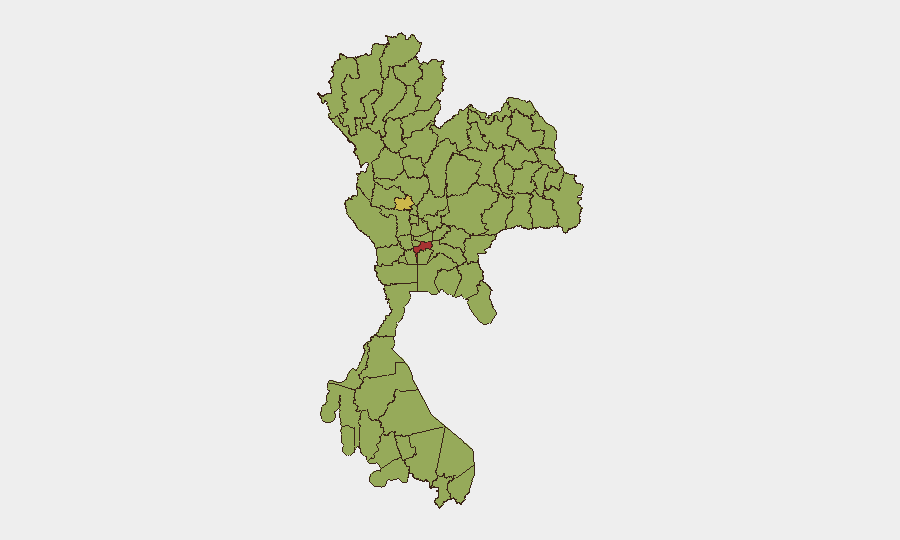
Bangkok (79.1) dominates the risk profile by a significant margin and is the driver of national threat elevation. Capital-based risks include political instability, organized crime, and state enforcement actions—all of which directly affect foreign nationals and multinational business operations. Kanchanaburi Province (58.6) has jumped to acute prominence due to the cross-border Myanmar incident and now ranks second; this is a sudden escalation rather than a chronic baseline. Chai Nat Province (60.8) sits between them, suggesting a corridor of elevated activity in central Thailand. The northeastern cluster (Maha Sarakham, Bueng Kan, Nong Khai, Udon Thani, and others, all 49.1) remains elevated but relatively stable, reflecting enduring organized-crime and trafficking networks rather than acute military or state crisis.
How GeoBit Would Assist
AOI Monitoring & Early Warning on Bangkok, Kanchanaburi, and border zones would detect force movements, state actions, and criminal escalations in near-real time via satellite and signals integration. Multi-language OSINT & X/Telegram Sweeps would corroborate official government and police statements, corporate threat announcements, and gang/cartel communications within hours of posting. Conflict & Military battle mapping and network actor analysis would clarify which specific criminal syndicates, state units, and Myanmar actors are involved, enabling targeted avoidance and asset hardening.
7-Day Outlook
If the Myanmar border incident is contained to Kanchanaburi and police operations succeed in limiting criminal violence escalation, the threat picture may stabilize by mid-June. However, if either the border tension expands or state-versus-business pressure hardens into systematic harassment, corporate operations and expatriate safety could deteriorate rapidly. Monitoring official Thai and Myanmar statements, police operational updates, and business-sector reporting will be critical to distinguishing containment from drift toward broader conflict.
Highest-Risk Areas — Ranked
| # | State / Region | Risk |
|---|---|---|
| 1 | Bangkok | 79.1 |
| 2 | Chai Nat Province | 60.8 |
| 3 | Kanchanaburi Province | 58.6 |
| 4 | Maha Sarakham Province | 51.3 |
| 5 | Bueng Kan Province | 49.1 |
| 6 | Nong Khai Province | 49.1 |
| 7 | Udon Thani Province | 49.1 |
| 8 | Sakon Nakhon Province | 49.1 |
| 9 | Nakhon Phanom Province | 49.1 |
| 10 | Chaiyaphum Province | 49.1 |
| 11 | Khon Kaen Province | 49.1 |
| 12 | Prachin Buri Province | 49.1 |
Previous Daily Briefs
A new Thailand brief is written every day — each with its own risk map and downloadable CSV. Here's the last week; use the calendar to go further back.
📅 Browse every day by calendar →
Highlighted days have a brief. Tap a day for that day's map & analysis, or “csv” for that day's dataset ($5).