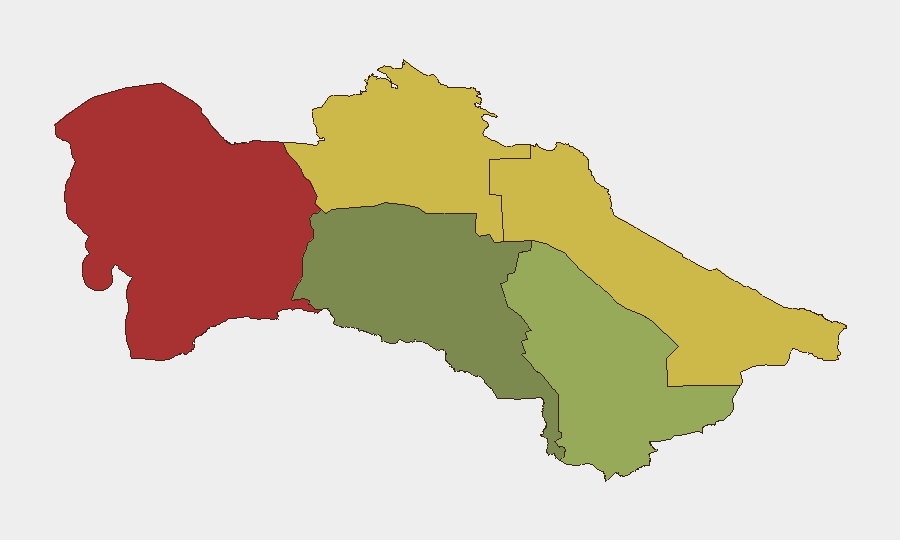
Situation Summary
Turkmenistan remains a low-incident environment with a global threat composite score of 2 and no tracked security events in the current assessment window. The country's overall stability profile is consistent with prior periods, reflected in its #193 global ranking. No significant security, civil-unrest, crime, conflict, or infrastructure incidents were detected in open-source channels during the last 24–48 hours. The security posture in the capital and western regions remains materially more stable than peripheral zones, particularly the Balkan and Lebap regions bordering Afghanistan and Uzbekistan.
Key Developments
- No discrete security incidents detected (24–48 hour window). Open-source monitoring identified no new conflict, crime, civil unrest, political instability, or infrastructure failures reported in Turkmenistan since 13 June 2026.
- Most recent policy signal: UN remarks on regional connectivity (10 June). Ashgabat's statement to the UN focused on Afghanistan policy, TAPI/TAP energy and transit projects, and development cooperation—routine diplomatic activity with no security implications.
- Routine governance and development messaging ongoing. Social media and government communications continue to reflect SDG cooperation and inter-governmental dialogue themes; no incident-related reporting detected.
- Monitor: Balkan and Lebap border zones remain highest-risk sub-national areas. These regions show elevated composite risk scores (78 and 68, respectively) and warrant sustained monitoring despite absence of current active incidents.
Highest-Risk Areas
The Balkan Region (risk score 78) and Lebap Region (risk score 68) drive the country's overall risk profile, primarily due to proximity to Afghanistan and porous border dynamics. Dashoguz Region (62) also presents elevated risk as a secondary transit corridor. These three northwestern and northern zones have historically been associated with cross-border smuggling networks, irregular migration flows, and militant transit activity, though no acute incidents are currently reported. Ashgabat City (risk 18) and the southern Ahal Region (35) remain substantially more stable, reflecting tighter state control and lower cross-border exposure.
How GeoBit Would Assist
Security teams operating in or monitoring Turkmenistan should employ persistent Area-of-Interest (AOI) monitoring and early-warning alerting focused on Balkan, Lebap, and Dashoguz regions to detect emerging cross-border or criminal activity before escalation. Multi-language OSINT fusion (Turkmen, Russian, and regional social media/Telegram channels) would capture local reporting and sentiment signals not visible in English-language feeds. Routing and network analysis capabilities support secure travel planning for personnel in high-risk zones, while regime-stability and border-security search functions enable proactive assessment of policy shifts or enforcement changes affecting corporate operations.
7-Day Outlook
No material changes to the current low-threat environment are anticipated over the next seven days absent new developments. Monitoring should remain focused on Balkan and Lebap border zones for any uptick in cross-border activity or regional instability spillover from Afghanistan. Corporate security teams should maintain standard duty-of-care protocols and consider AOI alerting for persistent early warning of emerging incidents.
Highest-Risk Areas — Ranked
| # | State / Region | Risk |
|---|---|---|
| 1 | Balkan Region | 78 |
| 2 | Lebap Region | 68 |
| 3 | Dashoguz Region | 62 |
| 4 | Mary Region | 42 |
| 5 | Ahal Region | 35 |
| 6 | Ashgabat City | 18 |
Sources
Previous Daily Briefs
A new Turkmenistan brief is written every day — each with its own risk map and downloadable CSV. Here's the last week; use the calendar to go further back.
📅 Browse every day by calendar →
Highlighted days have a brief. Tap a day for that day's map & analysis, or “csv” for that day's dataset ($5).