Situation Summary
The United Arab Emirates faces an acute air-defense emergency driven by sustained hostile drone and ballistic missile activity over the past 48 hours, with six confirmed interceptions reported by the Ministry of Defense on 16 June. Concurrent diplomatic engagement—including the first senior-level UAE–Iran security meeting since the start of regional conflict and reported financial concessions to Iran—signals an attempt to de-escalate, but the trajectory remains volatile. Ground-level debris from air-defense operations has caused minor casualties, and regional analysts have publicly warned of escalation risk should the current limited exchanges expand. The security environment is characterized by simultaneous kinetic threat and diplomatic repositioning, creating compounded uncertainty for corporate operations.
Key Developments
- Abu Dhabi, 16 June: UAE Ministry of Defense confirmed interception of six hostile drones over UAE territory within 48 hours, with all threats neutralized and no reported casualties or infrastructure damage.
- Multiple emirates, 16 June: Air defense systems intercepted hostile UAVs targeting civilian and vital infrastructure sites; debris from interceptions caused minor injuries on the ground, indicating spillover risk to populated areas.
- Regional escalation, 16 June: Gulf strikes tracker and regional reporting confirm large volumes of ballistic missiles and drones intercepted during the current escalation, establishing a sustained heightened threat environment over 1–2 days.
- Abu Dhabi–Tehran channel, mid-June (reported last 48h): Senior national security officials from the UAE and Iran held their first in-person meeting since start of Iran war, framed as de-escalation effort amid ongoing strikes.
- Financial concessions, 15–16 June: Regional media reported UAE agreement to unlock billions of dollars for Iran following weeks of Iranian attacks, disclosed as tactical shift aimed at reducing further strikes on UAE territory.
- UN-level warning, 16 June: Arab Group representatives (including UAE) warned of "growing regional escalation" and flagged risk that limited exchanges could expand into wider regional conflict.
- Security realignment, 16 June: Commentary indicates UAE may be signaling reduced reliance on U.S. security guarantees, reflecting shift in external security posture amid current strikes and diplomatic activity.
Highest-Risk Areas
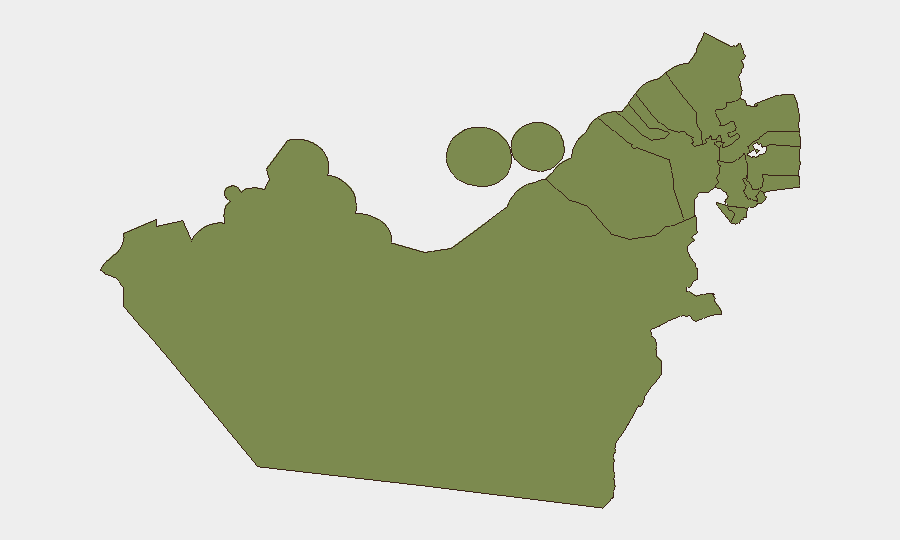
Abu Dhabi Emirate (risk 31.4) and Dubai (risk 20.7) account for the overwhelming majority of tracked threat activity and dominate the sub-national ranking. Abu Dhabi's elevated score reflects its role as the national capital and primary target for air-defense engagement, as well as concentration of critical infrastructure and government decision-making. Dubai's secondary risk reflects tourism, commercial density, and economic significance; the recent recorded "reduce relations" event between tourist and Dubai entities suggests reputational or operational friction. Remaining emirates (Sharjah, Ajman, Ras al-Khaimah, Fujairah, Umm al-Quwain) register minimal relative risk (1.4 each), indicating geographically dispersed but lower-intensity threat profiles.
How GeoBit Would Assist
Corporate security teams should employ AOI Monitoring & Early Warning to establish persistent watch over Abu Dhabi and Dubai facilities, with real-time alerting on air-defense activity and debris-fall zones. Conflict & Military mapping and Intel Sweep capabilities enable tracking of drone/missile intercept locations and patterns to refine route planning and site-hardening decisions. Network & Actor Analysis and multi-language OSINT fusion provide continuous monitoring of UAE–Iran diplomatic and security communications to detect further de-escalation moves or reversals in policy that would affect corporate risk exposure.
7-Day Outlook
The near term will likely oscillate between kinetic activity (drone/missile strikes triggering air-defense responses) and diplomatic negotiation, with the financial concessions and bilateral security meeting suggesting a de-escalation window. However, the explicit UN warning of expansion risk and the volume of recent intercepts indicate the ceasefire remains fragile. Corporate teams should expect elevated air-defense operations, ground-level debris hazards, and potential supply-chain disruptions in the 7-day window, with risk recalibration dependent on next high-level Iran–UAE communications.
Highest-Risk Areas — Ranked
| # | State / Region | Risk |
|---|---|---|
| 1 | Abu Dhabi Emirate | 31.4 |
| 2 | Dubai | 20.7 |
| 3 | Sharjah Emirate | 1.4 |
| 4 | Ajman Emirate | 1.4 |
| 5 | Ras al-Khaimah | 1.4 |
| 6 | Fujairah Emirate | 1.4 |
| 7 | Umm al-Quwain | 1.4 |
Sources
Previous Daily Briefs
A new United Arab Emirates brief is written every day — each with its own risk map and downloadable CSV. Here's the last week; use the calendar to go further back.
📅 Browse every day by calendar →
Highlighted days have a brief. Tap a day for that day's map & analysis, or “csv” for that day's dataset ($5).