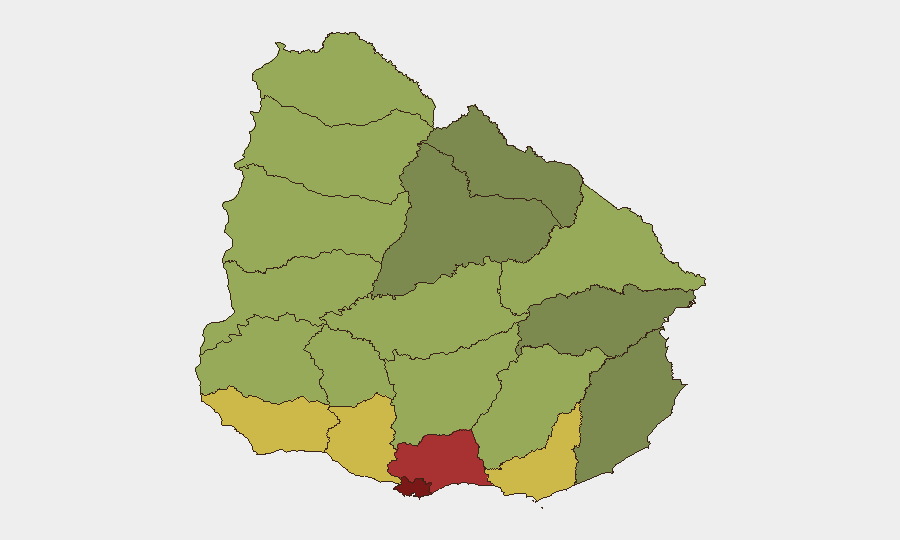
Situation Summary
Uruguay maintains a stable, low-threat security environment as of 16 June 2026, with no confirmed security incidents, civil unrest, infrastructure disruptions, or political instability recorded in the past 48 hours. Routine urban crime persists in Montevideo and Canelones departments, consistent with baseline patterns and not indicative of escalation. The national security posture shows no indicators of deterioration, and the outlook for the near term remains steady.
Key Developments
- Countrywide – 16 June 2026 – Presidential public statement issued; specific content and implications not yet fully clarified in available open-source reporting.
- Countrywide – 16 June 2026 – Investigation initiated by Uruguay authorities; scope and subject matter remain under review and require further corroboration.
- Countrywide – 16 June 2026 – Political-related investigation announced; no civil unrest, street activity, or institutional breakdown reported as of latest check.
- Diplomatic – 16 June 2026 – Uruguay issued public statement in relation to Sweden; nature of statement (protest, joint declaration, clarification) not yet substantiated in independent sources.
- Diplomatic – 16 June 2026 – Uruguay issued public statement in relation to Saudi Arabia; diplomatic context and operational impact remain unclear pending further reporting.
- Countrywide – 15–16 June 2026 – No spike in crime, gang violence, or security incidents in Montevideo or Canelones; routine theft and robbery activity remains within normal bounds.
Highest-Risk Areas
Montevideo (risk score 92) and Canelones (risk score 78) dominate the sub-national threat profile, driven by concentration of urban crime—primarily robbery and theft—and larger population density. Maldonado (68), San José (64), and Colonia (62) represent secondary risk nodes, likely reflecting tourism corridors, border-zone activity, or transit infrastructure exposure. Risk gradation across remaining departments (Soriano through Flores) remains significantly lower, indicating that threat concentration is geographically contained and that broad swaths of Uruguay remain low-risk for corporate operations and personnel.
How GeoBit Would Assist
Security teams operating in or transiting Uruguay would employ AOI Monitoring & Early Warning to establish persistent watch over Montevideo, Canelones, and border regions, triggering alerts on crime spikes, civil unrest, or infrastructure disruption before they escalate. Intel Sweep (global event feeds, X/Twitter OSINT, multi-language search, and OSINT fusion) would provide real-time corroboration of police reports, diplomatic statements, and emerging incidents, reducing reliance on delayed official channels. Routing & Network Analysis would support journey planning for personnel moving between Montevideo and lower-risk departments, identifying safer transit corridors and alternative routes in the event of localized incident activity.
7-Day Outlook
No significant deterioration in Uruguay's security environment is anticipated over the next seven days. Routine urban crime in high-density areas will likely persist at baseline levels; diplomatic activity and internal investigations (noted above) are not expected to trigger public unrest or operational disruption. Continued monitoring of Montevideo and Canelones for any deviation from baseline crime patterns is recommended as standard duty-of-care practice.
Highest-Risk Areas — Ranked
| # | State / Region | Risk |
|---|---|---|
| 1 | Montevideo | 92 |
| 2 | Canelones | 78 |
| 3 | Maldonado | 68 |
| 4 | San José | 64 |
| 5 | Colonia | 62 |
| 6 | Soriano | 58 |
| 7 | Río Negro | 56 |
| 8 | Salto | 54 |
| 9 | Artigas | 52 |
| 10 | Paysandú | 50 |
| 11 | Florida | 48 |
| 12 | Flores | 46 |
Previous Daily Briefs
A new Uruguay brief is written every day — each with its own risk map and downloadable CSV. Here's the last week; use the calendar to go further back.
📅 Browse every day by calendar →
Highlighted days have a brief. Tap a day for that day's map & analysis, or “csv” for that day's dataset ($5).