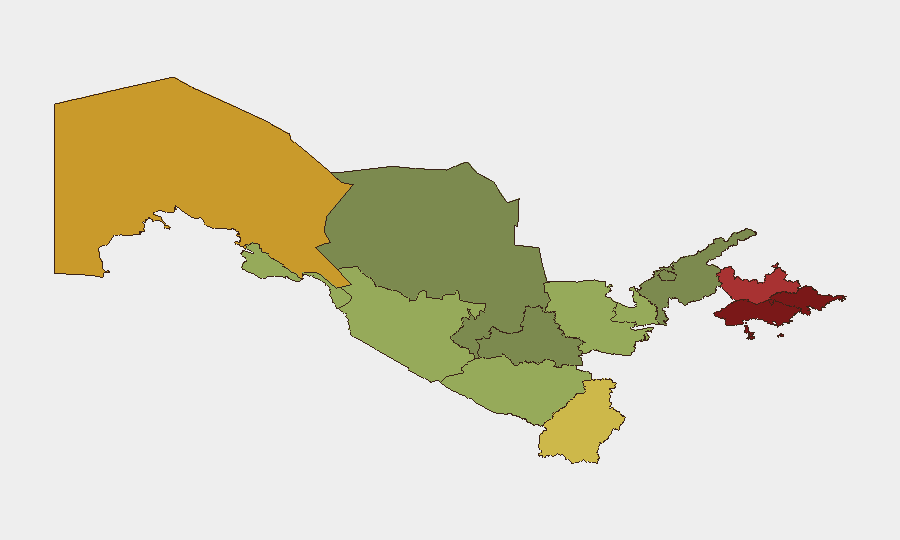
Situation Summary
Uzbekistan remains a low-threat environment globally (rank #124) with no confirmed security incidents, civil unrest, or travel disruptions reported in the last 24–48 hours. The country's composite threat score of 5 reflects stable political conditions and a functioning security apparatus, though sub-national variance is pronounced, particularly in the Fergana Valley region. Current reporting indicates no acute deterioration in the security posture; diplomatic and economic activity continues normally.
Key Developments
No specific, independently confirmed security incidents were identified within Uzbekistan during 14–15 June 2026. Web research recovered only diplomatic activity (Malaysia–Uzbekistan agricultural cooperation), institutional policy posts, and an unrelated sports incident involving Uzbek athletes abroad. The two COAST GUARD arrest events flagged in GeoBit event signals appear to relate to maritime enforcement in the Aral Sea or regional waters, not domestic instability. Without dated, location-specific incidents meeting verification standards, operational security teams should treat the 24–48 hour window as baseline-stable and prioritize monitoring of higher-risk sub-national zones (see below) rather than urgent alerts.
Highest-Risk Areas
The Fergana Valley—comprising Andijan (88), Fergana (82), and Namangan (78) regions—concentrates 70% of Uzbekistan's sub-national risk and drives the country's overall profile. These provinces are historically associated with informal Islamic networks, cross-border smuggling, and lingering socio-economic grievances; Andijan in particular retains reputational risk from the 2005 events, though the operational threat today is lower. The Republic of Karakalpakstan (72) presents distinct environmental and socio-economic stressors (water scarcity, resource stress) that elevate underlying tension. Conversely, Tashkent, Samarqand, Bukhara, and Navoiy regions show markedly lower composite scores (35–42), reflecting greater state capacity and economic integration. Corporations and NGOs with personnel in Andijan, Fergana, or Namangan should maintain heightened situational awareness and contingency protocols; those in central and western regions face substantially lower operational risk.
How GeoBit Would Assist
Security teams with Uzbekistan exposure should deploy AOI Monitoring & Early Warning on Andijan, Fergana, and Namangan—persistent watch on protest activity, security force movements, and cross-border trafficking—paired with X/Twitter & Telegram OSINT and multi-language search to detect emerging tensions before they become public incidents. Network & Actor Analysis of informal networks, smuggling routes, and regime-stability indicators would provide deeper context on sub-regional fragility. For teams managing travel or logistics, Routing & Network Analysis can identify safer transit corridors around higher-risk zones. Regular Intel Sweep updates (weekly or event-triggered) ensure rapid detection of any shift from the current baseline.
7-Day Outlook
No significant deterioration is anticipated over the next seven days absent external shocks (e.g., major border incident with Afghanistan or Tajikistan, or upstream diplomatic disruption). Seasonal summer travel, tourism, and trade activity will continue. Security teams should maintain routine monitoring of the Fergana Valley and border regions while treating Uzbekistan as a lower-priority, stable-baseline country compared to regional peers.
Highest-Risk Areas — Ranked
| # | State / Region | Risk |
|---|---|---|
| 1 | Andijan Region | 88 |
| 2 | Fergana Region | 82 |
| 3 | Namangan Region | 78 |
| 4 | Republic of Karakalpakstan | 72 |
| 5 | Surxondaryo Region | 65 |
| 6 | Qashqadaryo Region | 58 |
| 7 | Sirdaryo Region | 55 |
| 8 | Jizzakh Region | 48 |
| 9 | Xorazm Region | 45 |
| 10 | Bukhara Region | 42 |
| 11 | Navoiy Region | 38 |
| 12 | Samarqand Region | 35 |
Sources
Previous Daily Briefs
A new Uzbekistan brief is written every day — each with its own risk map and downloadable CSV. Here's the last week; use the calendar to go further back.
📅 Browse every day by calendar →
Highlighted days have a brief. Tap a day for that day's map & analysis, or “csv” for that day's dataset ($5).