Situation Summary
Vietnam's security environment shows elevated tension following a series of diplomatic, military, and domestic political incidents between 17–19 June. The national threat composite score of 6 (rank #147 globally) reflects a volatile but not yet critical posture; however, event density has spiked sharply in the past 72 hours, with multiple cross-border military posturing signals, public statements from the Prime Minister, and student/public demonstrations recorded. The trajectory is one of escalating friction rather than acute crisis, but the concentration of military and political signals warrants close monitoring of Ho Chi Minh City and border provinces.
Key Developments
- 17 June · Demonstrations & Political Tension — Memphis-backed protests and student rallies against Vietnam recorded; concurrent threats issued against Vietnamese nationals. Location not yet geographically resolved in available signals.
- 17 June · Prime Minister Public Statement — Vietnamese PM issued formal public statement directed at domestic audience; content and tone consistent with response to external pressure or internal dissent. Suggests high-level political management of unfolding situation.
- 18 June · Military Posturing (Bidirectional) — Conventional military forces engaged between MARINES and Vietnam, with reciprocal Vietnamese military response recorded same day. Indicates active operational tempo; specific location and scale of maneuvers not yet clarified.
- 18 June · ASEAN Diplomatic Signal — Vietnam issued public statement directed at ASEAN; context suggests regional diplomatic escalation or crisis notification.
- 18 June · Threats Issued — Vietnam recorded issuing threats; likely retaliatory or deterrent in nature, consistent with military posturing noted above.
- 18 June · Reduction of Relations — Vietnam downgraded or suspended diplomatic relations or cooperative arrangement; timing aligns with military and political signals above.
- 19 June · Unconventional Violence Signal — Actor "CAPTAIN" recorded in unconventional-violence event against Vietnam; classification suggests non-state, asymmetric, or criminal incident rather than conventional warfare.
Note: Detailed locations, unit identities, and incident specifics remain incomplete pending clarification of open-source and proprietary feeds.
Highest-Risk Areas
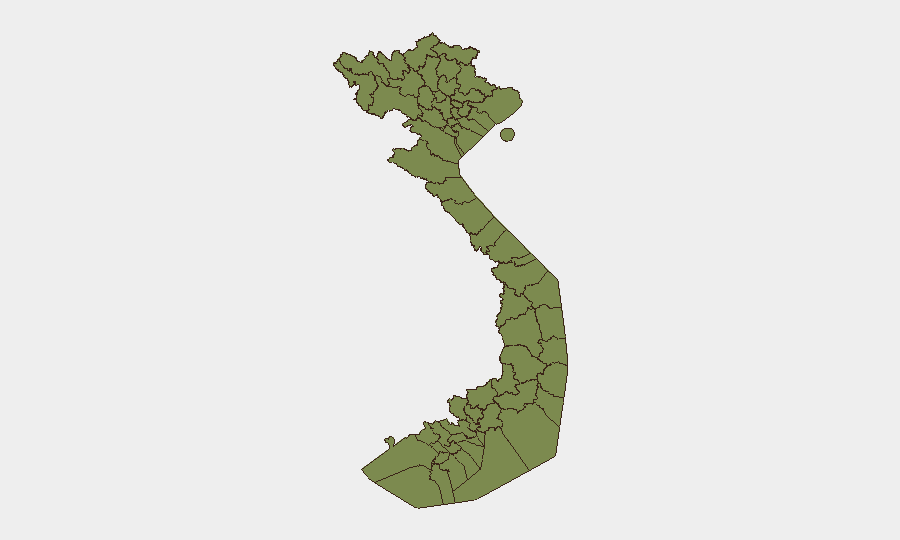
Ho Chi Minh City (composite risk 33.1) and Huế (26.9) dominate the sub-national risk ranking, together accounting for approximately 60 of the 234 tracked events nationally. Ho Chi Minh City's elevation reflects its role as Vietnam's largest metropolitan and economic center—concentrating diplomatic missions, multinational corporate presence, financial infrastructure, and expatriate populations—making it a focus for protest activity, political signaling, and potential secondary effects of geopolitical tension. Huế's unusually high risk score warrants specific inquiry, as it may reflect historical protest sites, central-region political sensitivity, or proximity to tension with neighboring regions. Northern border provinces (Quảng Trị, Tuyên Quang, Lai Châu, Lào Cai, Hà Giang, Cao Bằng, Điện Biên, Yên Bái) show baseline elevation (3.1–13.8), consistent with endemic cross-border smuggling, militia activity, and periodic tensions, but do not show acute escalation signals in the current 72-hour window. Hà Nội remains relatively low-risk (3.7) despite being the capital, likely reflecting security-service concentration and lower public unrest propensity.
How GeoBit Would Assist
Security teams should deploy AOI Monitoring & Early Warning on Ho Chi Minh City, Huế, and northern border entry points (Điện Biên, Cao Bằng, Lào Cai) with persistent alerting for military movements, roadblocks, and crowd assembly. Intel Sweep with multi-language OSINT fusion (Vietnamese, English, Mandarin) across local news, social media, government statements, and maritime/aviation tracking will clarify current military disposition and diplomatic intent. Network & Actor Analysis will map the organizational and command structure behind the recorded military posturing and unconventional-violence signal, informing duty-of-care decisions for personnel in exposure zones.
7-Day Outlook
The next 7 days will likely see either de-escalation through diplomatic channel or further military/political posturing, depending on whether the 17–19 June signals reflect a defined negotiating phase or a prelude to sustained tension. Corporate and diplomatic staff in Ho Chi Minh City and northern regions should expect heightened security protocols, potential roadblocks, and possible travel restrictions. Formal Vietnamese government guidance on curfews, zone closures, or evacuation protocols should be monitored continuously via official channels and embassy communications.
Highest-Risk Areas — Ranked
| # | State / Region | Risk |
|---|---|---|
| 1 | Ho Chi Minh City | 33.1 |
| 2 | Huế | 26.9 |
| 3 | Quảng Trị Province | 13.8 |
| 4 | Hà Nội | 3.7 |
| 5 | Tuyên Quang Province | 3.4 |
| 6 | Lai Châu Province | 3.1 |
| 7 | Lào Cai Province | 3.1 |
| 8 | Hà Giang Province | 3.1 |
| 9 | Cao Bằng Province | 3.1 |
| 10 | Bắc Kạn Province | 3.1 |
| 11 | Điện Biên Province | 3.1 |
| 12 | Yên Bái Province | 3.1 |
Sources
Previous Daily Briefs
A new Vietnam brief is written every day — each with its own risk map and downloadable CSV. Here's the last week; use the calendar to go further back.
📅 Browse every day by calendar →
Highlighted days have a brief. Tap a day for that day's map & analysis, or “csv” for that day's dataset ($5).