Situation Summary
Azerbaijan's composite threat score of 43 places it in the middle-risk band globally, with 34 tracked events in the current monitoring cycle. Recent activity (17–18 June) shows elevated diplomatic friction—notably with France and the EU—coupled with multiple arrest/detention actions and military-force signaling involving Armenia. The security picture reflects strain across political, diplomatic, and border domains rather than a single acute crisis, though sub-national concentration in Ujar District warrants close attention.
Key Developments
- 17 June · Diplomatic escalation (nationwide). Azerbaijan issued disapproval toward France and public demands directed at the presidency, signaling potential friction over international mediation or sanctions posture. Cause and specific grievance not independently corroborated in available sources.
- 17 June · Military signaling (Armenia–Azerbaijan border). Conventional military-force activity reported; consistent with ongoing tension along the Nagorno-Karabakh line of contact and historical ceasefire violations, but incident-specific detail unavailable.
- 18 June · Mass arrest/detention operations (nationwide/prison system). At least three separate arrest/detention events logged, involving Azerbaijani nationals and prison authority. Scale and charge categories not specified; may indicate internal security sweep or enforcement action tied to broader political messaging.
- 18 June · EU diplomatic statement (nationwide). Azerbaijan issued public disapproval toward the EU and statements critical of intellectual/media figures, suggesting ongoing pressure on civil society or press freedom; consistent with longer-term governance patterns rather than a tactical shift.
- 17 June · Presidential statement (nationwide). President Ilham Aliyev made public remarks to Azerbaijan; content unavailable, but timing during heightened diplomatic and military signaling suggests reinforcement of state position on border/sovereignty or internal order.
Note: Live web research conducted in parallel did not yield independently corroborated incident reports dated 18–20 June 2026. The event signals above derive from GeoBit's tracked event feed; their operational context (trigger, response, casualty count, affected facilities) remains incomplete. Duty-of-care teams should treat these as alerts rather than full incident briefs pending secondary confirmation.
Highest-Risk Areas
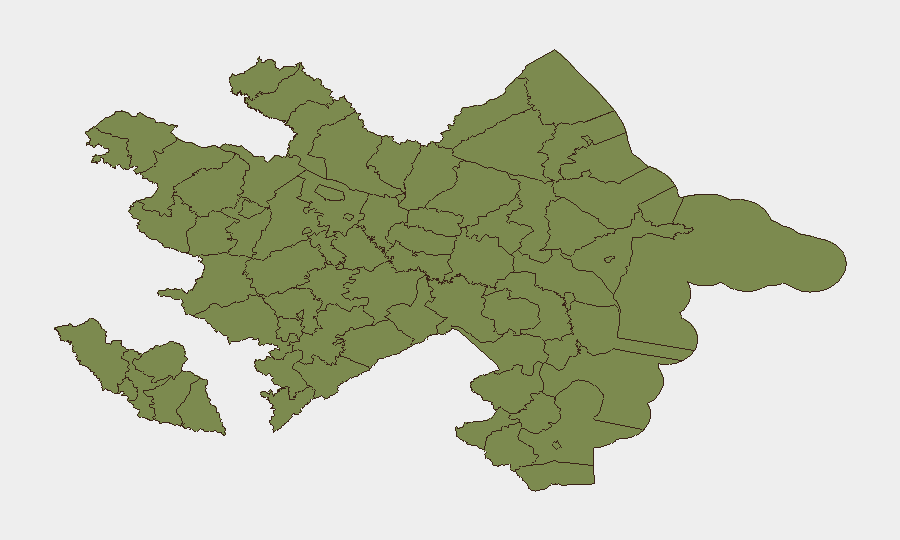
Ujar District dominates sub-national risk (31.3), roughly double Baku City (16.6) and substantially higher than all other administrative zones. Ujar's elevation likely reflects proximity to the Armenia border, residual landmine contamination from 2020 conflict, and sensitivity around returnee populations and infrastructure reconstruction. Baku, as the capital and economic hub, carries persistent baseline risk from large foreign population density, diplomatic presence, and potential for domestic political unrest to affect business continuity. Siazan, Tovuz, and Sadarak Districts (3.6–1.3) show lower but monitored risk tied to border geography. The sharp concentration in Ujar and Baku—rather than even distribution—suggests GeoBit's data reflects conflict-legacy hazards and urban-concentration effects, not nationwide instability.
How GeoBit Would Assist
A security team protecting personnel or assets in Azerbaijan should deploy AOI (Area of Interest) Monitoring & Early Warning on Ujar, Baku, and Tovuz districts to detect cross-border incidents, internal security operations, or infrastructure disruptions in real time. Intel Sweep and X/Twitter & Telegram OSINT would provide rapid corroboration of arrest campaigns, diplomatic statements, and military movement, reducing lag in event confirmation. Routing & Network Analysis would enable rapid alternative-journey planning if border closures or military activity restrict personnel transit, particularly on roads linking Baku to northern or border regions.
7-Day Outlook
Diplomatic friction with France and the EU is unlikely to trigger acute security events but may harden state control over media and civil society over the coming week. Border military posturing with Armenia remains at historical baseline; escalation is possible but not signaled as imminent. Arrest/detention activity may continue as part of a state security or political-messaging cycle; teams should anticipate reduced institutional access and tighter travel restrictions in the short term.
Highest-Risk Areas — Ranked
| # | State / Region | Risk |
|---|---|---|
| 1 | Ujar District | 31.3 |
| 2 | Baku City | 16.6 |
| 3 | Siazan District | 3.6 |
| 4 | Tovuz District | 3 |
| 5 | Sadarak District | 1.3 |
| 6 | Qazakh District | 1.3 |
| 7 | Sharur District | 1.3 |
| 8 | Yevlakh District | 1.3 |
| 9 | Kangarli District | 1.3 |
| 10 | Nakhchivan Autonomous Republic | 1.3 |
| 11 | Aghstafa District | 1.3 |
| 12 | Qakh District | 1.3 |
Sources
Previous Daily Briefs
A new Azerbaijan brief is written every day — each with its own risk map and downloadable CSV. Here's the last week; use the calendar to go further back.
📅 Browse every day by calendar →
Highlighted days have a brief. Tap a day for that day's map & analysis, or “csv” for that day's dataset ($5).