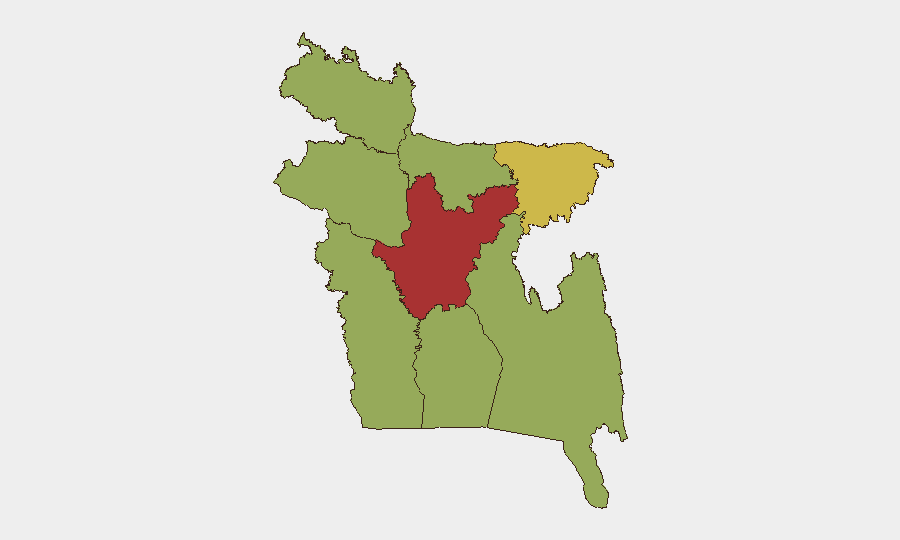
Situation Summary
Bangladesh faces elevated cross-border tension with India, driven by a sharp increase in fatal incidents, detention operations, and forced push-backs along the international frontier over the past 48 hours. At least four confirmed deaths and coordinated deportations of approximately 386 individuals have triggered a visible security response from Border Guard Bangladesh (BGB) and heightened anxiety in frontier communities. Dhaka Division remains the highest-risk zone (79.8 composite score), but northeastern border divisions—particularly Sylhet—are experiencing acute tactical volatility that has not yet fully translated into national-level disruption.
Key Developments
- Patgram border, Lalmonirhat District (13 June, late evening): BSF personnel fired on suspected smugglers, killing at least two Bangladeshi nationals and sparking stone-pelting confrontations. Multiple social-media sources confirm heightened alert on both sides of the fence immediately following.
- India–Bangladesh zero-point area, West Bengal sector (13–14 June, ~48-hour duration): Nine Bangladeshi nationals, including women and children, remained stranded between the international border and Indian barbed-wire fencing after an alleged failed push-back attempt, neither accepted by India nor returned by Bangladeshi authorities.
- Multiple India–Bangladesh crossing points (13–14 June): Coordinated Indian border operations resulted in deportation of approximately 386 "illegal infiltrators" within 48 hours, producing tense standoffs with BGB at several crossing points across West Bengal and neighboring sectors.
- Moulvibazar border points, Sylhet Division (13–14 June): Indian BSF personnel reportedly forced dozens of individuals—including at least 12 Rohingya refugees—back into Bangladeshi territory, amplifying local complaints about rising push-in incidents and community grievance.
- Unspecified border sector (13–14 June, last 48 hours): Two additional Bangladeshi fatalities attributed to BSF fire, contributing to documented pattern of lethal cross-border incidents.
- Border-fencing work sites along the international frontier (13–14 June): Verbal altercations and minor scuffles reported between Bangladeshi villagers and Indian personnel at locations where India is accelerating demarcation and construction activities.
- BGB positions, northern and northeastern Bangladesh (14 June): Visible mobilization of Bangladeshi border forces and local volunteers in show-of-readiness posture, reflecting elevated cross-border security alertness and civilian anxiety.
Highest-Risk Areas
Dhaka Division dominates the national risk ranking (79.8), reflecting concentration of political activity, critical infrastructure, and dense population; however, the immediate tactical threat is concentrated in Sylhet Division (68.7) and the broader northeastern frontier corridor. Sylhet's elevation reflects the intensity and lethality of current border incidents, the prevalence of informal cross-border movement, and limited institutional capacity to manage escalation in remote border communities. Lalmonirhat District (within Rangpur Division, 49.8) has also emerged as a flashpoint. The remaining divisions cluster at 49.8, indicating baseline vulnerability to spillover but lower acute incident density.
How GeoBit Would Assist
Real-time AOI Monitoring & Early Warning on border crossing points and BGB positions would detect force mobilization and incident onset before news confirmation. Multi-language OSINT fusion across Bengali social media, regional news feeds, and cross-border observer accounts enables correlation of BSF and BGB actions and civilian reporting, reducing reliance on delayed official statements. Conflict battle mapping and network analysis of frontier communities and smuggling routes would identify secondary friction points and vulnerable civilian clusters at risk of entrapment or injury.
7-Day Outlook
The trajectory over the next week hinges on whether the current spike in deportations and lethal incidents represents a temporary enforcement surge or the opening of a sustained enforcement campaign. If incidents continue at current frequency, BGB and village-level mobilization will intensify, increasing risk of accidental escalation or civilian harm. Diplomatic messaging and de-escalation communication between the capitals will be critical signals to monitor.
Highest-Risk Areas — Ranked
| # | State / Region | Risk |
|---|---|---|
| 1 | Dhaka Division | 79.8 |
| 2 | Sylhet Division | 68.7 |
| 3 | Khulna Division | 50.6 |
| 4 | Barishal Division | 49.8 |
| 5 | Chittagong Division | 49.8 |
| 6 | Rangpur Division | 49.8 |
| 7 | Rajshahi Division | 49.8 |
| 8 | Mymensingh Division | 49.8 |
Sources
Previous Daily Briefs
A new Bangladesh brief is written every day — each with its own risk map and downloadable CSV. Here's the last week; use the calendar to go further back.
📅 Browse every day by calendar →
Highlighted days have a brief. Tap a day for that day's map & analysis, or “csv” for that day's dataset ($5).