Situation Summary
Barbados remains a stable, low-threat environment with no corroborated security incidents, civil unrest, infrastructure disruptions, or travel advisories reported in the last 24–48 hours. The island's composite threat score of 14 places it at rank #82 globally, reflecting persistent but manageable baseline crime risk concentrated in specific urban parishes. No acute escalation is anticipated over the near term absent triggering incidents.
Key Developments
No verified security incidents meeting recency and corroboration criteria were identified in the last 24–48 hours. Open-source monitoring, regional news aggregation, and multi-source cross-checks yielded no time-stamped reports (dated 14–15 July 2026) of shootings, homicides, assaults, protests, political instability, or infrastructure failure that could be independently verified. A Caribbean news item referencing a homicide in Christ Church exists but lacks a confirmed date and independent corroboration, placing it outside the evidentiary threshold for inclusion in this briefing. Institutional activity, including police leadership operations, continues without associated disruption. The absence of reported incidents aligns with a security assessment dated 11 July 2026 noting continuing stable conditions.
Highest-Risk Areas
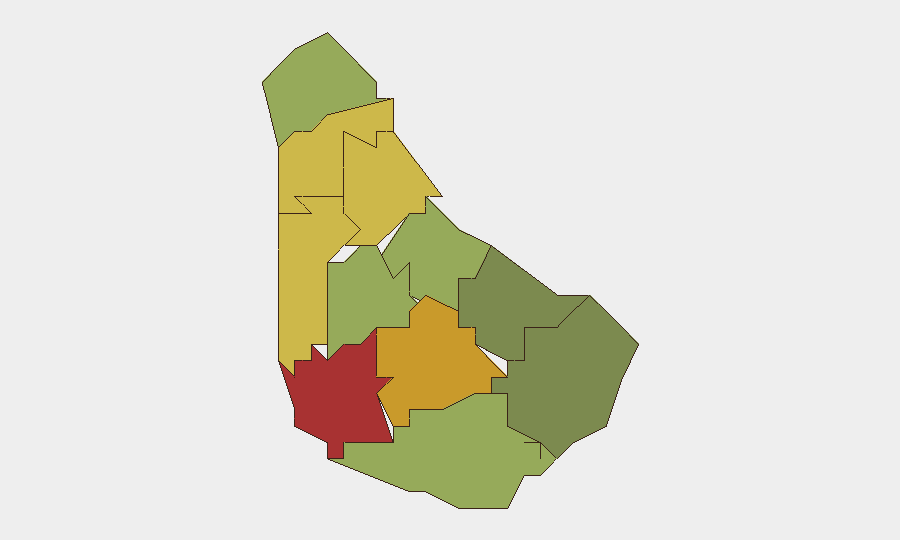
Saint Michael (risk score 78) and Saint George (risk 72) drive the majority of Barbados's measurable threat profile, reflecting urban concentration of routine property and violent crime typical of Caribbean capital and port regions. Saint James (68) and Saint Andrew (65) present elevated secondary risk. These four parishes account for the bulk of the island's composite score; peripheral parishes Saint Philip (28) and Saint John (35) present substantially lower threat profiles. Risk concentration in urban coastal zones reflects predictable patterns of gang activity, drug trafficking, and street crime rather than acute or destabilizing events. Corporate assets and personnel in Bridgetown, Saint Michael, and port-adjacent areas warrant standard duty-of-care protocols; southern and eastern parishes present lower operational friction.
How GeoBit Would Assist
Corporate security teams would deploy AOI Monitoring & Early Warning with persistent watch over high-risk parishes (Saint Michael, Saint George, Saint James) to detect upticks in crime reporting, gang activity signaling, or protest formation before they mature into duty-of-care events. Intel Sweep and multi-language OSINT (X, Telegram, regional news feeds, radio monitoring) would provide 24–48-hour leading indicators of political statements, police operations, or civil announcements affecting travel or asset access. Network & Actor Analysis would map local criminal and trafficking networks to inform route planning and personnel movement patterns. These capabilities enable early warning and proactive risk mitigation rather than reactive incident response.
7-Day Outlook
No indicators suggest material security deterioration over the next seven days. Routine institutional and commercial activity is expected to continue. Security teams should maintain baseline monitoring protocols and update contingency plans if regional signals (broader Caribbean unrest, hurricane tracking, maritime incidents affecting port operations) emerge.
Highest-Risk Areas — Ranked
| # | State / Region | Risk |
|---|---|---|
| 1 | Saint Michael | 78 |
| 2 | Saint George | 72 |
| 3 | Saint James | 68 |
| 4 | Saint Andrew | 65 |
| 5 | Saint Peter | 62 |
| 6 | Saint Joseph | 58 |
| 7 | Saint Thomas | 52 |
| 8 | Saint Lucy | 48 |
| 9 | Christ Church | 42 |
| 10 | Saint John | 35 |
| 11 | Saint Philip | 28 |
Previous Daily Briefs
A new Barbados brief is written every day — each with its own risk map and downloadable CSV. Here's the last week; use the calendar to go further back.
📅 Browse every day by calendar →
Highlighted days have a brief. Tap a day for that day's map & analysis, or “csv” for that day's dataset ($5).
Atlas — our AI intelligence desk — emails them this snapshot personally. Nothing else, no list.