Situation Summary
Botswana maintains a low and stable security environment with no acute incidents or unrest documented in the past 24–48 hours. The country ranks 157th globally on composite threat assessment, with routine institutional activity—including defence force digitalization and police staffing updates—dominating recent public statements. Current indicators support continued operational normalcy across most districts, though sub-national risk concentrations in urban centers (Gaborone, South-East District, Lobatse) warrant sector-specific monitoring.
Key Developments
- Gaborone, 10 July 2026 – The Botswana Defence Force announced a pilot of the Online Visitor Application Platform (OVAP) beginning 13 July to digitize access control at military facilities, framed as a security and efficiency measure with no incident trigger reported.
- Nationwide (Botswana Police Service), recent – The Botswana Police Service reiterated 24-hour staffing and rapid-response commitment at police stations; no specific incident or escalation was cited in the statement.
- National level, recent – The Drug Enforcement Agency Botswana unveiled new branding and uniforms as part of a sustained narcotics-control focus; no incident spike or policy change was indicated.
- National politics, recent – Opposition leader Adv. Duma Boko and the Leader of the Opposition publicly affirmed commitment to strengthening democratic institutions in a widely shared statement emphasizing political cooperation.
- Web research (24–48h) – No independently confirmed crime, unrest, infrastructure disruption, or travel-risk incidents were identified across open-source news and social platforms for Botswana in this window.
Highest-Risk Areas
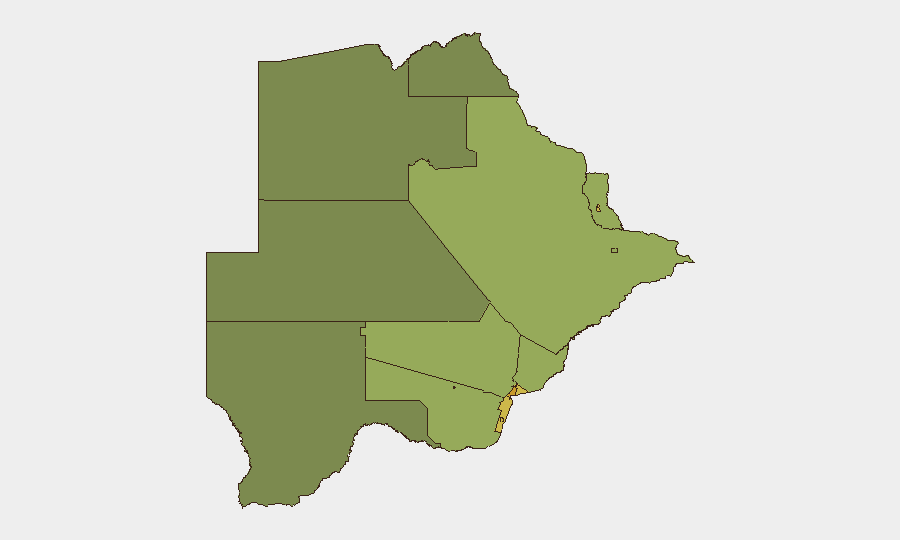
Gaborone (risk 72), South-East District (68), and Lobatse (65) represent the highest composite-risk concentrations, reflecting the country's urbanization patterns and economic activity hubs. Francistown, Jwaneng, and Selebi Phikwe (62–58) follow, with these mining and industrial centers carrying elevated exposure to labor disputes, petty crime, and infrastructure vulnerabilities. Risk declines markedly in peripheral and rural districts (Central, North-West, North-East) where population density and transactional complexity are lower. Corporate personnel and supply chains should prioritize awareness and incident reporting in the top-ranked urban centers while maintaining routine precautions elsewhere.
How GeoBit Would Assist
Security teams should employ AOI Monitoring & Early Warning on Gaborone, South-East District, and Lobatse to detect emerging labor, crime, or governance signals before they escalate. Intel Sweep and multi-language OSINT fusion (X/Twitter, Telegram, local news) enable 24-hour verification of incident claims and sentiment shifts in real time. Routing & Network Analysis helps identify safe transit corridors and alternative supply-chain pathways should localized disruptions occur in high-risk urban zones.
7-Day Outlook
No significant deterioration is forecast over the next seven days. Institutional activity (police operations, defence force digitalization, drug enforcement) suggests steady-state governance focus. Continued monitoring of Gaborone and South-East District for labor announcements or crime upticks is prudent; any deviation from the current low-activity baseline should trigger rapid sector alert.
Highest-Risk Areas — Ranked
| # | State / Region | Risk |
|---|---|---|
| 1 | Gaborone | 72 |
| 2 | South-East District | 68 |
| 3 | Lobatse | 65 |
| 4 | Francistown | 62 |
| 5 | Jwaneng | 61 |
| 6 | Selebi Phikwe | 58 |
| 7 | Southern District | 55 |
| 8 | Kgatleng District | 50 |
| 9 | Kweneng District | 48 |
| 10 | North-East District | 45 |
| 11 | Central District | 42 |
| 12 | North-West District | 38 |
Sources
Previous Daily Briefs
A new Botswana brief is written every day — each with its own risk map and downloadable CSV. Here's the last week; use the calendar to go further back.
📅 Browse every day by calendar →
Highlighted days have a brief. Tap a day for that day's map & analysis, or “csv” for that day's dataset ($5).
Atlas — our AI intelligence desk — emails them this snapshot personally. Nothing else, no list.