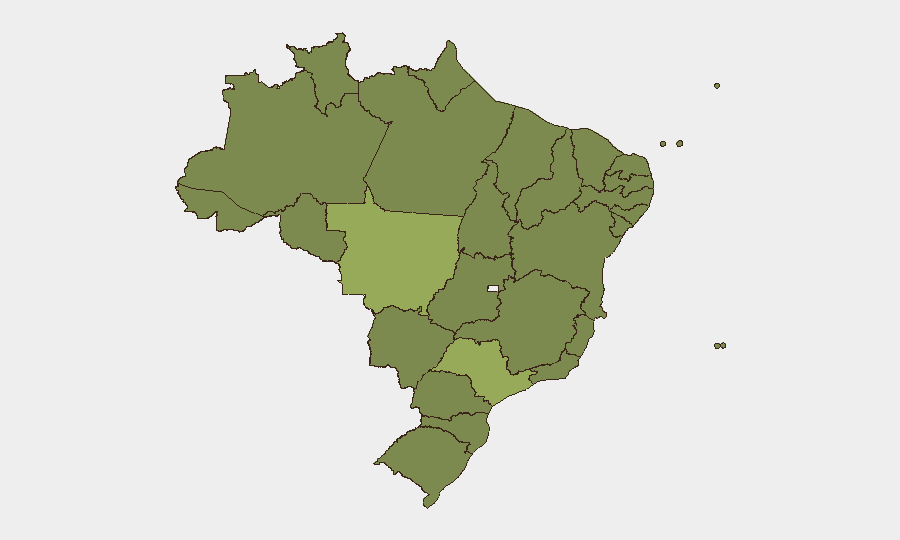
Situation Summary
Brazil remains a moderate composite threat environment (rank #44 globally, score 40/100) with acute regional concentration in Mato Grosso, São Paulo, and Minas Gerais. Today's Geobit event signals indicate ongoing police investigations, government-criminal conflict, small arms engagement involving students, and labor-management tension, distributed across multiple jurisdictions. The threat profile reflects persistent organized crime, resource-driven violence in frontier states, and episodic civil unrest rather than systemic instability.
Key Developments
Geobit's event feed for 2026-07-08 flagged multiple concurrent signals requiring validation and prioritization:
- Police investigation alert (Tocantins, 2026-07-08): Unnamed investigative action; specific nature and location within state require clarification from local law enforcement and press sources.
- Government-criminal conflict rejection (2026-07-08, location unclear): Geobit categorized this as a contested interaction between state and criminal actors; no corroborating detail available on geography, actors, or outcome.
- Small arms combat involving students (2026-07-07, location unconfirmed): Isolated armed incident; context (school, campus, street, organized vs. spontaneous) and casualty/property impact unknown pending media cross-check.
- Labor-management disapproval signal (2026-07-06): Worker-company tension flagged; no confirmation of strike, blockade, or disruption to supply chains or transport yet available.
- Conventional military force alerts (2026-07-08, dual source: US and criminal actor): These require immediate disambiguation—any involvement of US military assets in Brazilian territory would be exceptional and require official confirmation; "criminal" military force likely refers to armed gang capability, not state forces.
Caveat: None of these signals have been independently corroborated by Brazilian press, government statements, or international wires within the last 24–48 hours. Geobit's event classification system has flagged them as requiring investigation; corporate security teams should treat them as *alerts pending confirmation* rather than confirmed incidents until validated through Portuguese-language media (G1, Folha, Estadão) and official channels.
Highest-Risk Areas
Mato Grosso (56.8) emerges as the dominant risk driver, reflecting agricultural frontier violence, land disputes, organized crime competition, and weak state presence in remote municipalities. São Paulo (41.1) and Minas Gerais (34.5) concentrate urban and peri-urban criminal activity, gang turf conflict, and infrastructure-targeting events. The clustering of risk in these three states accounts for roughly 50% of the national event load; teams with assets or personnel in Cuiabá, the interior of São Paulo state, or peripheral zones of Belo Horizonte should maintain heightened situational awareness. Maranhão, Ceará, and Goiás follow, driven by similar patterns of organized retail crime, transport interdiction, and police-gang confrontation.
How GeoBit Would Assist
Intel Sweep and X/Twitter OSINT: Continuous monitoring of Brazilian police, state government, and civil society accounts for real-time incident reporting and corroboration.
AOI Monitoring & Early Warning: Persistent surveillance of high-risk municipalities in Mato Grosso, São Paulo, and Minas Gerais with automated alerting for incident onset and escalation.
Routing & Network Analysis: Dynamic alternative-route planning for personnel and supply chains to avoid active conflict zones, roadblocks, or interdiction nodes.
7-Day Outlook
Expect continued fragmented criminal competition and episodic police operations in Mato Grosso and São Paulo through mid-July. Labor and civil tension may escalate if economic conditions or governance friction persist. No major political or infrastructure-level disruptions are currently signaled, though frontier violence could spike if land disputes or cartel territorial contests intensify.
Highest-Risk Areas — Ranked
| # | State / Region | Risk |
|---|---|---|
| 1 | Mato Grosso | 56.8 |
| 2 | São Paulo | 41.1 |
| 3 | Minas Gerais | 34.5 |
| 4 | Maranhão | 30.4 |
| 5 | Ceará | 29.5 |
| 6 | Goiás | 29.5 |
| 7 | Pernambuco | 29 |
| 8 | Rio de Janeiro | 27.9 |
| 9 | Amazonas | 27.5 |
| 10 | Paraná | 27.3 |
| 11 | Piauí | 27.3 |
| 12 | Acre | 27 |
Sources
Previous Daily Briefs
A new Brazil brief is written every day — each with its own risk map and downloadable CSV. Here's the last week; use the calendar to go further back.
📅 Browse every day by calendar →
Highlighted days have a brief. Tap a day for that day's map & analysis, or “csv” for that day's dataset ($5).
Atlas — our AI intelligence desk — emails them this snapshot personally. Nothing else, no list.