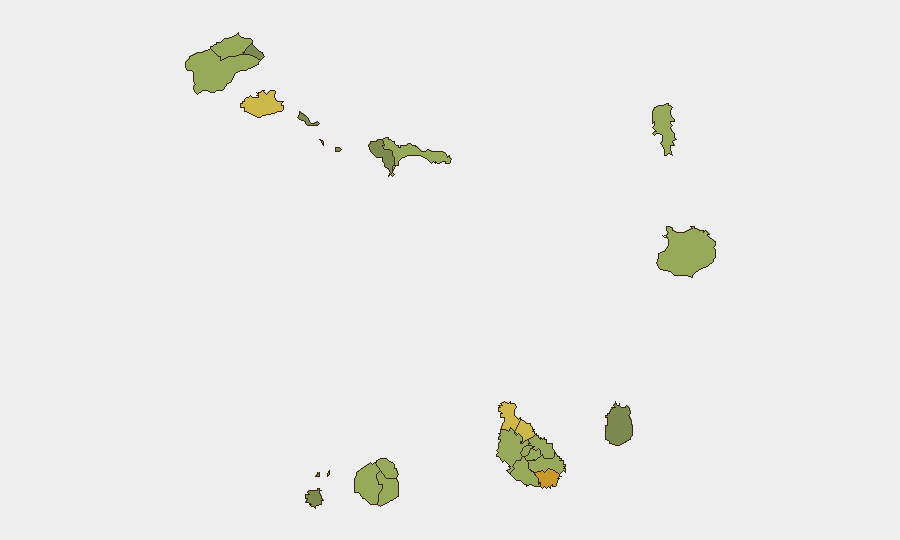
Situation Summary
Cape Verde remains a low-threat environment with a composite national threat score of 6 and no tracked security events in the current assessment window. Open-source monitoring over the last 24–48 hours has detected no credible reports of conflict, civil unrest, major crime incidents, political instability, or infrastructure disruption. The security posture is stable, though sub-national variation exists, with urban centers presenting elevated localized risk profiles compared to rural or less-populated islands.
Key Developments
No discrete security or instability events meeting time-verification and multi-source confirmation criteria have been identified in Cape Verde during the last 24–48 hours. Current open-web coverage is dominated by sports and human-interest content with no concurrent reporting of security incidents, travel disruptions, or threat escalation. Duty-of-care teams should note that the absence of reported events does not constitute a zero-risk environment; baseline crime, maritime transit risk, and localized economic pressures remain present but are not exhibiting acute spike indicators at this time.
Highest-Risk Areas
Praia (risk score 72) and São Miguel (68) drive the national sub-national risk profile, reflecting their status as the largest urban centers and primary commercial hubs. São Vicente (65) and Tarrafal (62) follow, indicating that island-based urbanization and population density correlate with elevated composite risk. These rankings reflect cumulative exposure to petty crime, port-area vulnerabilities, informal settlement activity, and higher foot traffic rather than acute political or conflict risk. Mid-tier and lower-scored municipalities show marked risk reduction, suggesting that geographic dispersion and lower population density provide natural risk mitigation for personnel and assets located outside the top four municipalities.
How GeoBit Would Assist
Corporate security and risk teams operating in Cape Verde should deploy Intel Sweep and multi-language OSINT fusion to maintain real-time monitoring of emerging incidents across local and diaspora news sources, social media, and community reporting channels—particularly for Praia, São Miguel, and São Vicente, where risk density is highest. AOI Monitoring & Early Warning with persistent geofencing of high-risk neighborhoods, ports, and commercial zones would provide automated alerting if incident patterns or crowd movements exceed baseline thresholds. Network & Actor Analysis combined with entity extraction from local criminal-justice and law-enforcement reporting would enable identification of organized crime trends and informal-economy disruptions before they impact supply chains or personnel movement.
7-Day Outlook
No material escalation is anticipated over the next seven days based on current open-source indicators and baseline stability metrics. Duty-of-care teams should maintain standard Cape Verde security protocols (awareness of petty theft in urban areas, maritime transit vetting, informal-settlement avoidance) without elevation to heightened alert status. Continued OSINT monitoring is recommended to detect any emerging economic, maritime, or political signals that could alter this assessment.
Highest-Risk Areas — Ranked
| # | State / Region | Risk |
|---|---|---|
| 1 | Praia | 72 |
| 2 | São Miguel | 68 |
| 3 | São Vicente | 65 |
| 4 | Tarrafal | 62 |
| 5 | São Filipe | 58 |
| 6 | Santa Catarina | 58 |
| 7 | Santa Cruz | 55 |
| 8 | Mosteiros | 52 |
| 9 | São Salvador do Mundo | 52 |
| 10 | Ribeira Grande | 50 |
| 11 | Porto Novo | 48 |
| 12 | Sal | 48 |
Sources
Previous Daily Briefs
A new Cape Verde brief is written every day — each with its own risk map and downloadable CSV. Here's the last week; use the calendar to go further back.
📅 Browse every day by calendar →
Highlighted days have a brief. Tap a day for that day's map & analysis, or “csv” for that day's dataset ($5).