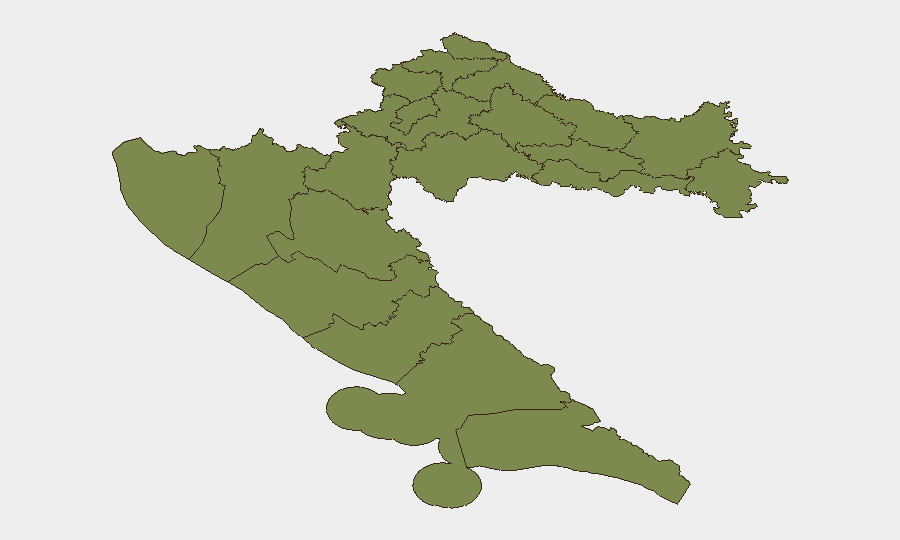
Situation Summary
Croatia remains a low-threat environment with composite threat score of 6 (rank #139 globally) and no credible security incidents reported in the last 24–48 hours. Current event signals are dominated by routine political statements and World Cup coverage rather than security or civil-order developments. The country's overall stability trajectory remains stable, with risk concentrated in a single sub-national hotspot.
Key Developments
No security-relevant incidents meeting 24–48 hour recency and verification standards have been identified in current web research. Recent event signals flagged by the platform (28–29 June) relate to political statements and parliamentary activity rather than security, civil unrest, crime, or infrastructure disruption. Duty-of-care teams with personnel or assets in Croatia should monitor routine updates but do not face elevated alert conditions at this time.
Highest-Risk Areas
Karlovac County dominates sub-national risk with a composite score of 31.4—approximately 10 times higher than all other regions. This score warrants direct investigation into underlying drivers (historical conflict legacy, organized crime, border proximity, or specific ongoing incidents). All other counties, including Zagreb, score at 1.4 or 3.2, indicating Karlovac is the sole concentration point for monitored threat activity. Security teams with assets or personnel in Karlovac should apply enhanced monitoring protocols; operations in other regions face standard baseline risk.
How GeoBit Would Assist
Teams responsible for Croatia should deploy AOI Monitoring & Early Warning on Karlovac County to receive real-time alerting if event frequency or severity escalates. Intel Sweep and OSINT fusion (X/Twitter, Telegram, local-language sources, radio SIGINT) will detect emerging civil unrest, crime spikes, or border-related activity before mainstream reporting. Network & Actor Analysis and conflict/terrorism search capabilities can profile the specific threat actors and networks driving Karlovac's elevated score, enabling targeted risk mitigation.
7-Day Outlook
No significant escalation is anticipated in the near term. Monitoring should remain routine for most of Croatia, with heightened watch maintained on Karlovac County pending clarification of the underlying risk drivers. Teams should establish baseline alerting thresholds and verify that travel protocols and emergency contacts reflect current sub-national risk differentiation.
Highest-Risk Areas — Ranked
| # | State / Region | Risk |
|---|---|---|
| 1 | Karlovac County | 31.4 |
| 2 | Krapina-Zagorje County | 3.2 |
| 3 | Dubrovnik-Neretva County | 3.2 |
| 4 | Međimurje County | 1.4 |
| 5 | Varaždin County | 1.4 |
| 6 | Koprivnica-Križevci County | 1.4 |
| 7 | City of Zagreb | 1.4 |
| 8 | Zagreb County | 1.4 |
| 9 | Sisak-Moslavina County | 1.4 |
| 10 | Istria | 1.4 |
| 11 | Primorje-Gorski Kotar County | 1.4 |
| 12 | Lika-Senj County | 1.4 |
Sources
Previous Daily Briefs
A new Croatia brief is written every day — each with its own risk map and downloadable CSV. Here's the last week; use the calendar to go further back.
📅 Browse every day by calendar →
Highlighted days have a brief. Tap a day for that day's map & analysis, or “csv” for that day's dataset ($5).