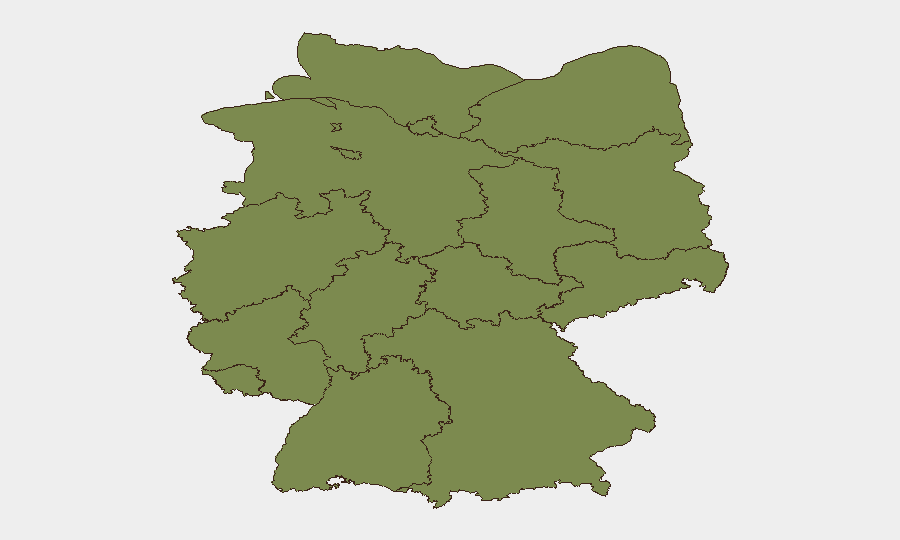
Situation Summary
Germany remains a stable, low-threat environment globally (ranked #110 out of 195+ countries) with a composite threat score of 10 and 276 tracked events. However, a mass shooting in Lower Saxony on 29 June has triggered a significant localized security response and investigative effort. Threat exposure remains geographically concentrated, with Thuringia substantially elevated relative to other states, followed by Hamburg and Berlin; most German states remain in low-risk bands.
Key Developments
- Mass shooting, Stade youth welfare facility, Lower Saxony (29 June 2026): A gunman opened fire at a youth center on Dankersstraße in Stade (40 km west of Hamburg), killing six adults—five on-scene and one later in hospital. All victims were employees or affiliates of the facility. Police arrested a main suspect and reported no ongoing public danger; early investigation suggests a link to a custody dispute.
- Police cordon and forensic operations, Stade (29–30 June 2026): Large-scale police presence and cordons remained in place around the crime scene into the evening of 30 June, with active searches, evidence collection, and witness interviews ongoing. Authorities characterized the incident as an "extremely violent crime" and "extended family tragedy" with no wider threat identified.
- Travel disruption, Stade area (29–30 June): Localized road and area restrictions around Dankersstraße and the youth facility are in effect due to the police operation; broader transport networks (rail, highway) remain unaffected.
- No additional major incidents confirmed (24–48h window): Available open-source reporting and curated feeds do not confirm other significant security, civil-unrest, crime, or infrastructure incidents in Germany within the last 24–48 hours. Older items in circulation (e.g., sentencing in the 2024 Magdeburg Christmas market case) are adjudication, not new events.
Highest-Risk Areas
Thuringia's risk score of 31.8 is substantially higher than all other German states and warrants focused monitoring; Hamburg (17.4) and Berlin (9.4) follow at considerable distance. The elevated Thuringia risk profile reflects cumulative event density over the tracked period and should prompt security teams with personnel or assets in that state to maintain heightened situational awareness and pre-positioned contingency plans. Lower Saxony's risk score (8.0) places it in the middle band; the Stade incident is a localized, contained event unlikely to elevate broader state-level risk trajectory. North Rhine-Westphalia, despite its economic and population density, remains the lowest-risk major state (2.0).
How GeoBit Would Assist
Security teams can employ Intel Sweep and global event feeds paired with multi-language OSINT (X/Twitter, Telegram, regional news) to detect and validate incidents in real time, avoiding reliance on delayed commercial media. AOI Monitoring & Early Warning on key facilities (offices, employee residences, logistics hubs) in Thuringia, Hamburg, and Berlin would provide persistent alerting for emerging unrest, crime, or infrastructure disruption. Routing & Network Analysis enables rapid identification of safe transit corridors around active incidents (as in the Stade case) to support duty-of-care and continuity planning.
7-Day Outlook
The Stade incident is expected to close investigatively within days, with normalization of local travel and operations to follow. No indicators suggest contagion or broader civil unrest; the event appears contained as a singular, motive-driven crime. Baseline risk in Thuringia, Hamburg, and Berlin should be monitored for any secondary developments, but the near-term security posture for most corporate operations in Germany remains stable.
Highest-Risk Areas — Ranked
| # | State / Region | Risk |
|---|---|---|
| 1 | Thuringia | 31.8 |
| 2 | Hamburg | 17.4 |
| 3 | Berlin | 9.4 |
| 4 | Bavaria | 8.9 |
| 5 | Lower Saxony | 8 |
| 6 | Saxony | 6 |
| 7 | Saxony-Anhalt | 5.7 |
| 8 | Brandenburg | 3.7 |
| 9 | Saarland | 3.7 |
| 10 | Schleswig-Holstein | 3.5 |
| 11 | Mecklenburg-Vorpommern | 3.5 |
| 12 | North Rhine-Westphalia | 2 |
Sources
Previous Daily Briefs
A new Germany brief is written every day — each with its own risk map and downloadable CSV. Here's the last week; use the calendar to go further back.
📅 Browse every day by calendar →
Highlighted days have a brief. Tap a day for that day's map & analysis, or “csv” for that day's dataset ($5).