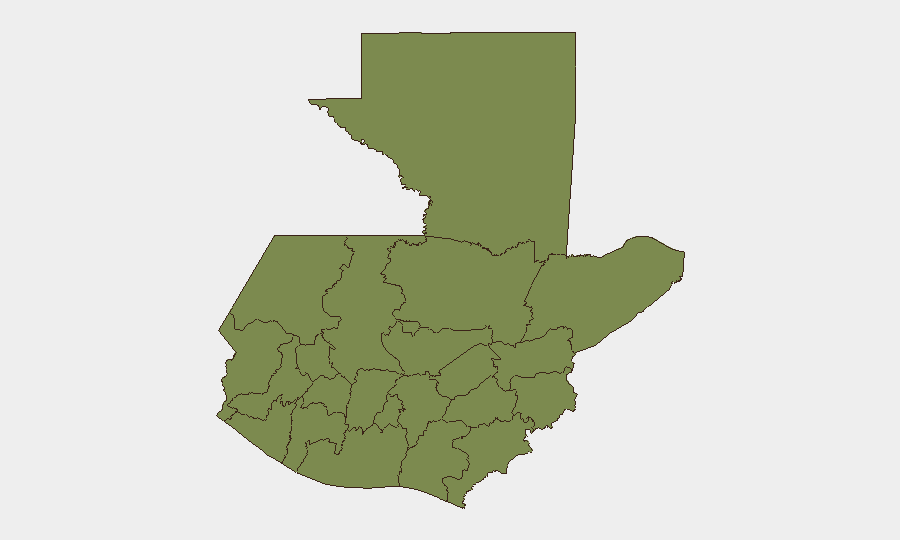
Situation Summary
Guatemala remains a moderate regional security concern (global rank #55, composite score 30) with 23 tracked threat events. The security environment is characterized by competing institutional tensions—judicial, executive, and military actors—alongside persistent organized crime activity in specific high-risk departments. The last 48 hours show elevated rhetoric and institutional friction rather than widespread violence, though sub-national risk remains heavily concentrated in Alta Verapaz (31.9), which significantly skews the national threat profile.
Key Developments
- 2026-06-25 · School Disapproval Statement – Institutional opposition signaled regarding education sector policy or operation; no kinetic impact reported but indicates internal governance friction.
- 2026-06-25 · Political Public Statements (Guatemala vs. Switzerland) – Diplomatic or political disagreement between Guatemalan officials and an external politician; likely regarding governance, anti-corruption, or human rights matters; no immediate security threat identified.
- 2026-06-24 · Military Deployment (Guatemala vs. Saint) – Conventional military force movement; context suggests possible border or maritime posture adjustment; no active engagement reported.
- 2026-06-24 · Arrest/Detain (Argentine National) – Detention of Argentine national; reason and location not specified in available signals; potential organized crime, migration, or sanctions-related matter.
- 2026-06-24 · Prosecutor vs. Business (Rejection) – Prosecution or regulatory authority rejected a business filing or submission; suggests ongoing anti-corruption or compliance enforcement activity.
- 2026-06-23 · Institutional Military Action (Government vs. Guatemala) – Domestic military or security force action; framing suggests government directive; likely related to crime suppression or institutional response.
- 2026-06-23 · US–Guatemala Public Statement (Washington) – US diplomatic messaging on Guatemala; typical themes include governance, drug trafficking, or migration policy.
Data Limitation Note: Available OSINT signals show institutional and diplomatic activity but lack granular incident detail (specific casualty counts, street-level violence, roadblocks, or infrastructure disruption in the last 24–48 hours). Local news verification for armed attacks, protests, or transportation disruptions in major corridors (CA-1, CA-9, border crossings) requires direct Spanish-language source search (Prensa Libre, Emisoras Unidas, PNC/Gobernación feeds).
Highest-Risk Areas
Alta Verapaz dominates the risk profile with a score of 31.9—more than double the second-ranking department (Sololá, 13.1). This concentration reflects known trafficking corridors, gang presence, and limited state capacity in the region's remote areas. Sololá's secondary elevation (13.1) correlates with organized crime activity and gang territorial disputes in the western highlands; Retalhuleu (4.7) shows lower but notable risk linked to Pacific coast smuggling networks. The remaining nine departments cluster at 1.9, indicating either baseline risk or limited recent activity signals, with risk in Guatemala City and surrounding urban zones not separately ranked but operationally significant for corporate presence.
How GeoBit Would Assist
Security teams monitoring Guatemala should prioritize AOI Monitoring & Early Warning on Alta Verapaz, Sololá, and major transit nodes (borders, airports, ports) to detect roadblocks, protests, or armed activity in real time. Multi-language OSINT and X/Twitter feeds combined with Entity & Network Analysis allow continuous tracking of institutional statements, judicial actions, and organized crime signaling. Routing & Network Analysis supports contingency planning for overland personnel movement, with alternative corridor assessment if primary routes (CA-1, CA-9) become disrupted.
7-Day Outlook
Institutional friction and diplomatic messaging are likely to persist through early July; no imminent large-scale kinetic event is signaled. Organized crime activity in Alta Verapaz and Sololá remains chronic and should be treated as standing operational risk. Monitoring for roadblock escalation, protest activity, or unexpected military/police deployments on primary routes is prudent for the coming week.
Highest-Risk Areas — Ranked
| # | State / Region | Risk |
|---|---|---|
| 1 | Alta Verapaz | 31.9 |
| 2 | Sololá | 13.1 |
| 3 | Retalhuleu | 4.7 |
| 4 | Petén | 1.9 |
| 5 | Huehuetenango | 1.9 |
| 6 | San Marcos | 1.9 |
| 7 | Quetzaltenango | 1.9 |
| 8 | Quiché | 1.9 |
| 9 | Totonicapán | 1.9 |
| 10 | Chimaltenango | 1.9 |
| 11 | Suchitepéquez | 1.9 |
| 12 | Sacatepéquez | 1.9 |
Sources
Previous Daily Briefs
A new Guatemala brief is written every day — each with its own risk map and downloadable CSV. Here's the last week; use the calendar to go further back.
📅 Browse every day by calendar →
Highlighted days have a brief. Tap a day for that day's map & analysis, or “csv” for that day's dataset ($5).