Situation Summary
Jordan maintains a composite threat score of 53 (global rank #41), with military strikes identified as the primary driver of risk across 57 tracked events. No confirmed in-country security incidents, civil unrest, or infrastructure disruptions were verified in the last 24–48 hours; recent diplomatic statements by Jordan condemning regional attacks do not constitute operational security events within Jordanian territory. The security environment remains influenced by broader regional dynamics, particularly developments affecting Palestinian territories and Iranian interests, rather than by acute domestic instability.
Key Developments
- No verified in-country incidents in the last 24–48 hours. Web research identified only diplomatic statements by Jordan's government (2026-07-01) and condemnations of attacks on Bahrain, neither of which represent active security events in Jordan itself.
- Diplomatic activity (2026-07-01, national level). Jordan issued a public statement of disapproval toward Iranian actions, consistent with longstanding regional positioning but not indicative of imminent domestic threat escalation.
- Regional context: Palestinian-Israeli physical assaults (2026-06-30, Palestinian territories). While not occurring in Jordan, cross-border tensions affect Jordanian border security posture, particularly along the Jordan Valley.
- Detention event in North Carolina (2026-06-30, external). A U.S.-based arrest with Jordan linkage was noted in signals; source and operational relevance require clarification and do not directly affect in-country operations.
- Military rejection (2026-06-30, Jordan). A military-related rejection was flagged but lacks operational detail; consistent with routine defense-policy stance adjustments rather than crisis signals.
Highest-Risk Areas
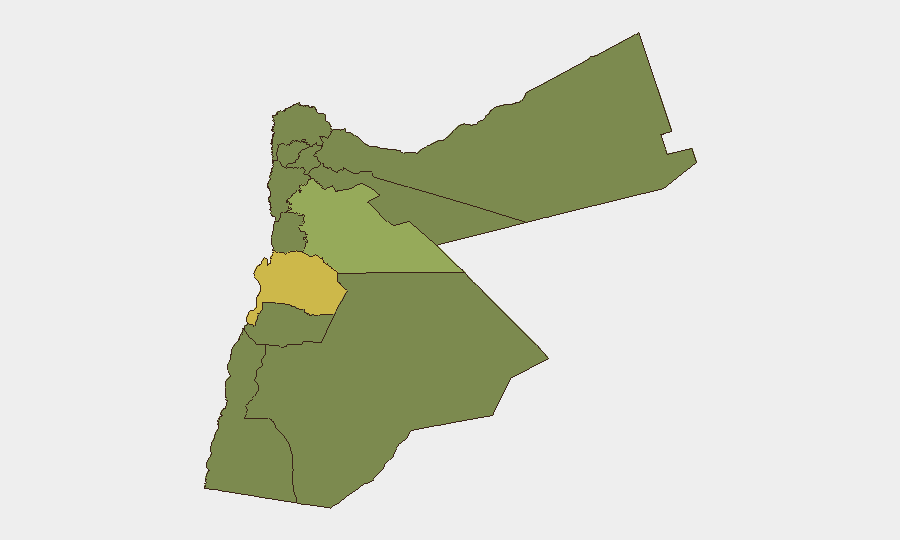
Karak governorate carries the highest sub-national risk score (67.2), significantly above the national average and all other regions, primarily due to historical military-activity exposure and proximity to conflict zones. Amman (41.1) remains the second-highest-risk area, reflecting its status as the capital and concentration of diplomatic, commercial, and security infrastructure; routine diplomatic tension and regional statement activity inflate this score without evidence of acute in-country incidents. The remaining nine governorates cluster at 37.2, suggesting relatively homogeneous baseline risk profiles across the rest of the kingdom, with differentiation driven by military-strike frequency and regional proximity rather than by independent domestic instability.
How GeoBit Would Assist
Teams with people or assets in Jordan should employ AOI Monitoring & Early Warning on Karak and border zones (Jordan Valley, Syria border) to detect military activity escalation with automated alerting. Conflict & Military mapping combined with GIS & Spatial Analysis enables security teams to track force posture and weapons systems near the Jordan–Syria and Jordan–Palestine borders, informing movement and facility-security decisions. Intel Sweep and multi-language OSINT (X, Telegram, local media) provide real-time detection of civil unrest, protest activity, or diplomatic escalation that may precede operational impact on expatriate staff or supply chains.
7-Day Outlook
Jordan's threat profile is expected to remain stable absent major regional escalation (Syrian instability, Israeli–Palestinian surge, or Iranian military action). Diplomatic activity and military posture adjustments will likely continue, but do not currently signal imminent domestic security degradation. Organizations should maintain baseline monitoring of Karak and border-adjacent areas and remain alert to regional developments that could trigger rapid policy changes affecting entry, movement, or facility access.
Highest-Risk Areas — Ranked
| # | State / Region | Risk |
|---|---|---|
| 1 | Karak | 67.2 |
| 2 | Amman | 41.1 |
| 3 | Irbid | 37.2 |
| 4 | Ajlun | 37.2 |
| 5 | Balqa | 37.2 |
| 6 | Jarash | 37.2 |
| 7 | Mafraq | 37.2 |
| 8 | Madaba | 37.2 |
| 9 | Zarqa | 37.2 |
| 10 | Tafilah | 37.2 |
| 11 | Aqaba | 37.2 |
| 12 | Maan | 37.2 |
Sources
Previous Daily Briefs
A new Jordan brief is written every day — each with its own risk map and downloadable CSV. Here's the last week; use the calendar to go further back.
📅 Browse every day by calendar →
Highlighted days have a brief. Tap a day for that day's map & analysis, or “csv” for that day's dataset ($5).