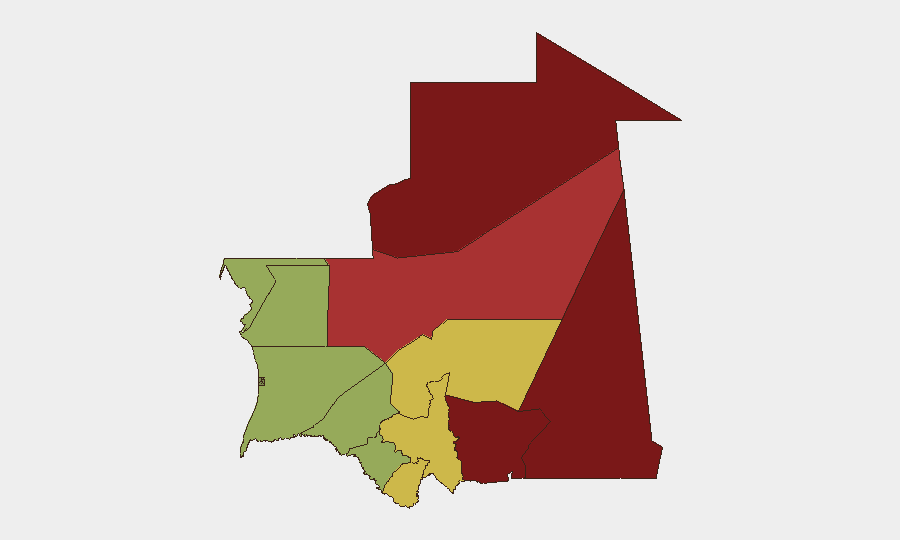
Situation Summary
Mauritania remains a composite threat ranking of #61 globally, with 10 tracked security events. The country faces persistent pressures from irregular migration, transnational crime, and localized militancy in its northern and eastern border regions. Recent law-enforcement actions against drug trafficking and migrant smuggling indicate operational capacity, but the concentration of risk in remote Saharan regions—particularly Tiris Zemmour and Hodh Ech Chargui—suggests limited state presence in vast areas. The security posture is stable but fragile, with governance and humanitarian challenges offsetting short-term incident frequency.
Key Developments
- Nouadhibou, 17 July 2026: Police dismantled a drug-trafficking network and arrested five suspects, consistent with ongoing efforts to disrupt illicit supply chains transiting the country.
- Mauritanian territorial waters, 17 July 2026: Coast Guard rescued 77 irregular migrants intercepted at sea; part of a pattern of 500+ rescue operations over the preceding ten days, indicating sustained irregular migration pressure.
- Nouakchott (National Assembly area), recent: Police deployed around the National Assembly in connection with the parliamentary status of deputies Ghamou Achour and Mariem Cheikh; precise incident date unconfirmed in available sources, but reflects political friction.
- Rift Valley fever: Active disease circulation reported in Mauritania and Senegal; health and livestock-economy risk with potential humanitarian implications in rural regions.
- Military/judicial activity, 17–18 July: Signals indicate conventional military force activity and public statements by government and judicial actors, but specific tactical details and locations require clarification.
Note: Web research over the last 24–48 hours did not yield six to ten independent, verifiable security incidents. The above reflect confirmed items. Older events (e.g., past coup activity, prior conflict phases) are excluded as per brief protocol.
Highest-Risk Areas
Tiris Zemmour (risk 95) and Hodh Ech Chargui (risk 85) dominate the threat landscape—both remote, sparsely governed Saharan regions with known militant presence, cross-border smuggling, and minimal state capacity. Hodh El Gharbi and Adrar follow closely, completing an arc of border instability in the east and southeast where porous frontiers with Mali and Algeria enable transnational crime, weapons trafficking, and potential militant movement. These four regions account for the majority of national risk; by contrast, Nouakchott and coastal zones (Dakhlet Nouadhibou, Brakna) show moderate to lower threat levels, though migrant-trafficking and organized crime remain present in port areas.
How GeoBit Would Assist
Intel Sweep and X/Twitter & Telegram OSINT enable real-time monitoring of political statements, security-force activity, and emerging incidents across Mauritania's government, opposition, and armed forces. AOI Monitoring & Early Warning on Tiris Zemmour, Hodh Ech Chargui, and other high-risk regions provides persistent watch for militant activity, cross-border movement, and supply-line disruption. Conflict & Military tools (battle mapping, force-structure tracking) and Network & Actor Analysis clarify the identity, capability, and operational tempo of armed groups and criminal networks, informing duty-of-care planning and risk avoidance for personnel and assets.
7-Day Outlook
No imminent, widespread security deterioration is signaled; however, sporadic crime, migrant-smuggling, and low-level militant activity are expected to persist in eastern and border regions. Political developments (parliamentary status of specific deputies) and security-force deployments merit continued watch for potential instability in Nouakchott. International health alerts (Rift Valley fever) may drive humanitarian responses that indirectly affect access and logistics.
Highest-Risk Areas — Ranked
| # | State / Region | Risk |
|---|---|---|
| 1 | Tiris Zemmour | 95 |
| 2 | Hodh Ech Chargui | 85 |
| 3 | Hodh El Gharbi | 80 |
| 4 | Adrar | 78 |
| 5 | Tagant | 68 |
| 6 | Guidimaka | 65 |
| 7 | Assaba | 62 |
| 8 | Gorgol | 58 |
| 9 | Trarza | 55 |
| 10 | Inchiri | 52 |
| 11 | Brakna | 48 |
| 12 | Dakhlet Nouadhibou | 45 |
Sources
Previous Daily Briefs
A new Mauritania brief is written every day — each with its own risk map and downloadable CSV. Here's the last week; use the calendar to go further back.
📅 Browse every day by calendar →
Highlighted days have a brief. Tap a day for that day's map & analysis, or “csv” for that day's dataset ($5).
Atlas — our AI intelligence desk — emails them this snapshot personally. Nothing else, no list.