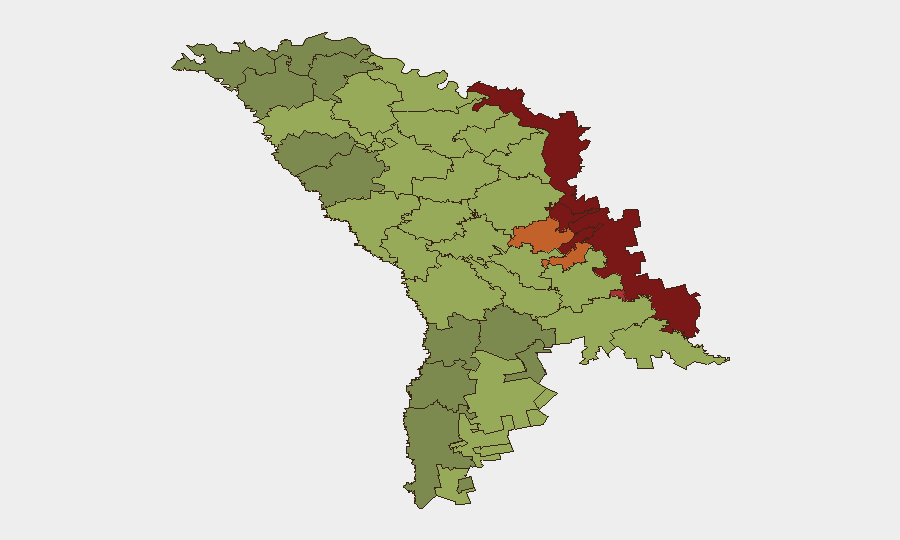
Situation Summary
Moldova remains a low-to-moderate global security concern (ranked #75) but faces elevated localized risk from cross-border airspace violations, spillover instability from Ukraine, and systemic corruption within security institutions. Recent drone incursions and formal diplomatic protests with Russia have renewed focus on airspace control and civil safety. The security environment is stable relative to regional peers but deteriorating incrementally due to repeated drone incidents and friction over attribution and investigation protocols.
Key Developments
- Copanca, Căușeni district (July 13, with diplomatic follow-up July 18–20): Moldova's Foreign Ministry lodged a formal protest after a Russian drone crashed and exploded near Copanca in south-east Moldova; the Russian ambassador subsequently demanded a "thorough investigation" and additional technical data, creating ongoing diplomatic tension and uncertainty over attribution and airspace control.
- Southern Moldova unidentified UAV (July 14–15, live reporting in last 24–48h): Following the Copanca incident, Moldova reported a second unidentified UAV of alleged Russian origin fell in southern Moldova; Russia contested the claim and demanded evidence, sustaining a pattern of airspace violations with disputed responsibility.
- Chișinău – EU security funding (July 20): EU Foreign Affairs Council adopted an additional €120 million under the European Peace Facility for Moldova, specifically earmarked for defense and security capacity-building, including drone detection and airspace-control systems, signaling international concern about spillover from Ukraine.
- National – anti-drone procurement (announced July 18–20): Moldova's Ministry of Defense announced acquisition of new detection systems and drone interceptors, funded by the EU, following 34 recorded drone and ballistic-missile incidents in Moldovan airspace since Russia's invasion of Ukraine began.
- Cimișlia district (current reporting cycle): A fatal ammunition explosion in a residential courtyard killed one individual, illustrating ongoing civil hazards from unsecured munitions in rural areas and potential infrastructure risk.
- National – corruption in security sectors (January–June data, highlighted July 18–20): Ministry of Internal Affairs departments recorded 469 active corruption reports in the first half of 2026—the highest figure in recent years—undercutting institutional capacity for law enforcement and border control.
- Chișinău – anti-corruption detention (July 8, referenced in current reporting): Eduard Timofei, director of Penitentiary No. 9 "Pruncul," was detained on corruption charges, exemplifying ongoing justice-sector instability and high-level malfeasance.
- National – telephone-fraud activity (last 24 hours): Police reported prevention of at least 152 telephone-fraud attempts in a 24-hour window, followed by a subsequent report of zero new cases, indicating active but volatile scam activity targeting residents and potentially foreign nationals.
Highest-Risk Areas
The left-bank Dniester region (ATMU, Dubăsari, Bender, and Criuleni) dominates the risk landscape due to proximity to Ukraine, Russian military presence, contested territorial control, and limited Moldovan state authority. Bender (risk 79) and Dubăsari (risk 82) face direct spillover from cross-border artillery and drone activity. Secondary clusters in Rezina, Taraclia, and Gagauzia reflect ethnic and political fracture lines, weak law enforcement, and smuggling networks. Even Chișinău (risk 49) carries material risk from corruption, organized crime, and periodic political tension; corporate operations in the capital require standard duty-of-care protocols but no acute threat-elevation at present.
How GeoBit Would Assist
Security teams should deploy AOI Monitoring & Early Warning over high-risk sub-national zones (Dniester region, Bender, Dubăsari) to detect cross-border incidents, drone activity, and military movement in near-real time. Intel Sweep (X/Telegram OSINT, multi-language news aggregation, and sentiment analysis) enables continuous tracking of diplomatic protests, airspace violations, and corruption cases without manual overhead. GIS & Spatial Analysis combined with Conflict & Military capabilities support route planning, asset positioning, and safe-zone identification around drone-incident clusters and militia-controlled territories.
7-Day Outlook
Airspace violations and diplomatic friction with Russia are expected to persist as Ukraine conflict dynamics remain fluid and drone strikes continue. EU defense funding and Moldova's own anti-drone procurement will gradually raise institutional capacity but will not eliminate near-term incursion risk. Corruption investigations and internal-security instability will remain a drag on coherent response, particularly in border regions; no major escalation is forecast, but operational risk for foreign personnel in outlying areas will remain elevated.
Highest-Risk Areas — Ranked
| # | State / Region | Risk |
|---|---|---|
| 1 | Administrative-Territorial Units of the Left Bank of the Dniester | 85 |
| 2 | Dubăsari | 82 |
| 3 | Bender | 79 |
| 4 | Criuleni | 75 |
| 5 | Rezina | 58 |
| 6 | Taraclia | 55 |
| 7 | Gagauzia | 54 |
| 8 | Căușeni | 53 |
| 9 | Soroca | 52 |
| 10 | Ștefan Vodă | 51 |
| 11 | Orhei | 50 |
| 12 | Chișinău | 49 |
Sources
Previous Daily Briefs
A new Moldova brief is written every day — each with its own risk map and downloadable CSV. Here's the last week; use the calendar to go further back.
📅 Browse every day by calendar →
Highlighted days have a brief. Tap a day for that day's map & analysis, or “csv” for that day's dataset ($5).
Atlas — our AI intelligence desk — emails them this snapshot personally. Nothing else, no list.