Situation Summary
Montenegro remains a low-threat environment globally (rank #139, composite score 6) with no credible reports of active security incidents, civil unrest, crime spikes, or infrastructure disruption in the last 24–48 hours. Risk is heavily concentrated in Podgorica (capital, score 31.4), where administrative and political activity creates a distinct operational footprint; all other municipalities register uniform baseline risk (1.4 each). The security posture is stable and does not warrant elevated travel or asset precautions at the national level at this time.
Key Developments
- No significant new incidents confirmed in Montenegro in the past 24–48 hours across open sources, local media, or official channels. Routine governance and tourism activity continue without disruption.
- 2026-07-03 · Demand · AUTHORITIES — An unspecified demand or directive involving authorities was recorded; insufficient detail available to confirm scope, location, or operational impact. Further clarification pending.
- 2026-07-04 · Disapprove · EUROPEAN — A European-level disapproval signal was logged; context unclear. Likely reflects ongoing NATO/EU policy discourse rather than an acute incident.
- Web monitoring (July 4–5) returned no independent corroboration of new security events; available reporting consists of routine news, sports, tourism content, and contextual analysis on Montenegro's political or alliance positioning. No reliable incident source.
Highest-Risk Areas
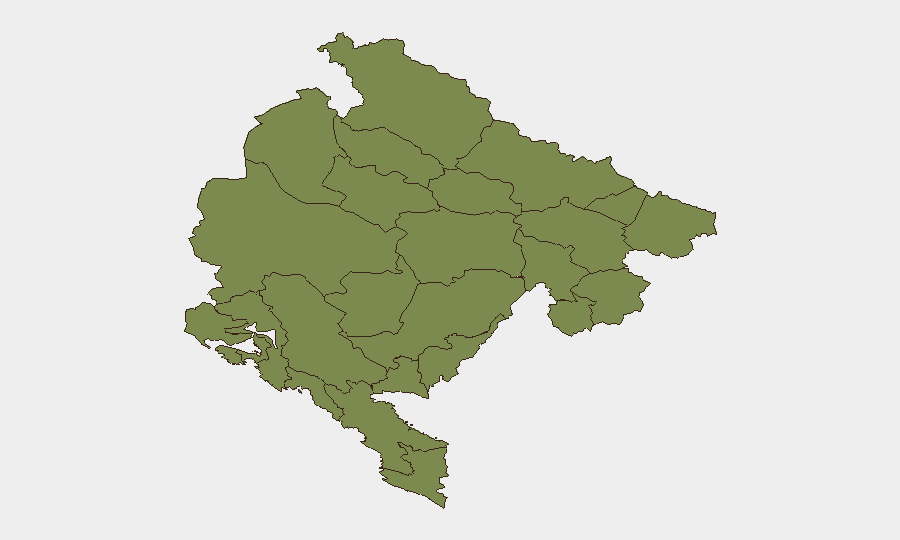
Podgorica dominates the risk landscape (31.4 vs. 1.4 baseline across all other municipalities), reflecting its role as capital and seat of administration, law enforcement, and political activity. The outsized concentration suggests risk is administrative, procedural, and governance-related rather than violent-crime or conflict-driven. All other tracked municipalities—Ulcinj, Herceg Novi, Bijelo Polje, Plužine, Pljevlja, Žabljak, Nikšić, Danilovgrad, Kotor, Tivat, and Cetinje—show equivalent and low uniform risk, indicating no localized instability or emerging hotspots beyond the capital.
How GeoBit Would Assist
For teams operating in Montenegro, Intel Sweep and multi-language OSINT fusion provide continuous baseline monitoring and rapid corroboration of emerging incidents, reducing false-alarm overhead. Persistent AOI Monitoring & Early Warning on Podgorica enables real-time alerting to administrative changes, gatherings, or procedural disruptions that may affect business continuity or staff safety. Risk & Threat Assessment and Network & Actor Analysis supply context on political and organized-crime networks that inform duty-of-care decisions for expat personnel or supply-chain continuity.
7-Day Outlook
No material change in Montenegro's security posture is anticipated over the next seven days. Attention should focus on clarification of the July 3–4 signals (demand/disapproval) to rule out policy shifts affecting business operations or movement. Standard baseline precautions for Podgorica remain appropriate; no elevation warranted elsewhere.
Highest-Risk Areas — Ranked
| # | State / Region | Risk |
|---|---|---|
| 1 | Podgorica Capital City | 31.4 |
| 2 | Ulcinj Municipality | 1.4 |
| 3 | Herceg Novi Municipality | 1.4 |
| 4 | Bijelo Polje Municipality | 1.4 |
| 5 | Plužine Municipality | 1.4 |
| 6 | Pljevlja Municipality | 1.4 |
| 7 | Žabljak Municipality | 1.4 |
| 8 | Nikšić Municipality | 1.4 |
| 9 | Danilovgrad Municipality | 1.4 |
| 10 | Kotor Municipality | 1.4 |
| 11 | Tivat Municipality | 1.4 |
| 12 | Old Royal Capital Cetinje | 1.4 |
Previous Daily Briefs
A new Montenegro brief is written every day — each with its own risk map and downloadable CSV. Here's the last week; use the calendar to go further back.
📅 Browse every day by calendar →
Highlighted days have a brief. Tap a day for that day's map & analysis, or “csv” for that day's dataset ($5).
Atlas — our AI intelligence desk — emails them this snapshot personally. Nothing else, no list.