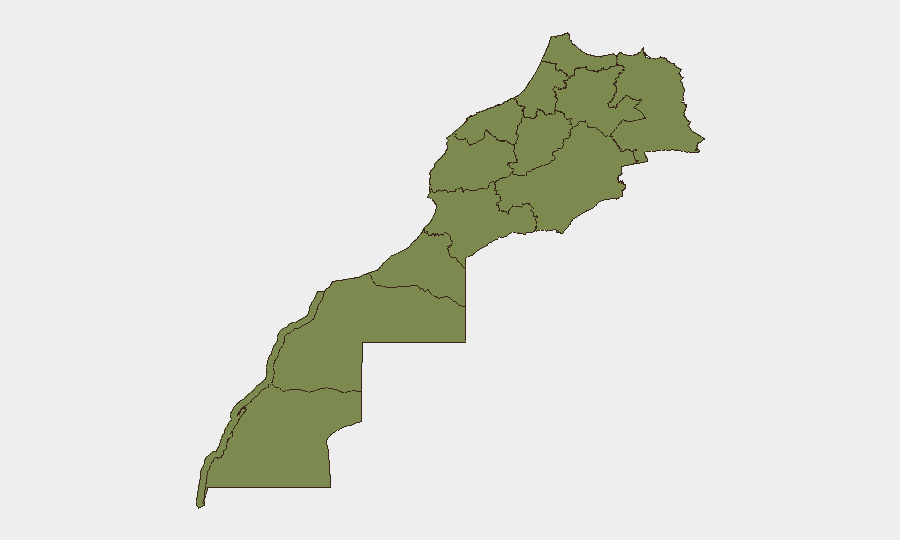
Situation Summary
Morocco's composite threat score of 16 reflects a fragmented security picture dominated by localized volatility rather than systemic instability. The past 48 hours have generated elevated signal activity across multiple event categories—including military mobilization, inter-agency friction, and public statements from senior officials—but open-source reporting has not yet corroborated discrete security or civil unrest incidents with clear timestamps within 27–28 July 2026. The threat environment remains concentrated in Souss-Massa (risk 31.3), which accounts for the bulk of national risk elevation; secondary concern attaches to Rabat-Salé-Kénitra and diplomatic flashpoints involving Spain and Western Sahara actors.
Key Developments
- Souss-Massa region – 28 July: Military mobilization event recorded involving Moroccan security forces; specific operational scope and trigger remain under investigation per GeoBit event signals.
- National command level – 28 July: Disapproval signal between Moroccan gendarmerie and unspecified civilian or political actors; no casualty or operational detail confirmed in available open-source channels.
- Diplomatic posture – 27–28 July: Spain and Morocco exchanged public statements; Western Sahara actors (including Algerian alignment) issued parallel disapproval signals, suggesting renewed friction on territorial or maritime claims.
- Executive/Legislative statements – 28 July: Public statements issued by Prime Minister and Presidential office regarding Morocco's security posture; content and tone indicate either policy reassertion or response to internal or external pressure, but specifics remain opaque in open-source reporting.
- Religious/community voice – 28 July: Public statement by an imam-affiliated actor; context unclear but consistent with civil-society signaling during periods of heightened state activity.
- Investigative action – 28 July: Morocco initiated an investigation; subject and scope not yet detailed in accessible reporting.
Note: Open-source web research did not yield clearly time-stamped, discrete security, conflict, or civil-unrest incidents in the last 48 hours beyond the event signals above. Longer-term context includes Morocco's dismantling of 229 terrorist cells and foiling of 400+ plots since 2002 (cumulative through April 2026) and recent sentencing of 18 individuals linked to Gen Z-affiliated protests (timing unclear).
Highest-Risk Areas
Souss-Massa dominates the risk landscape, with a composite score of 31.3—nearly 2.5 times the national average—and is the primary driver of Morocco's threat ranking. Rabat-Salé-Kénitra (risk 19.3) follows as a secondary concern, likely reflecting capital-region political and security volatility. The remaining ten regions cluster at risk scores below 6, indicating that both localized instability and national-level policy tensions are geographically concentrated. Foreign and defense teams with footprint in Souss-Massa should treat it as the priority tier for duty-of-care monitoring.
How GeoBit Would Assist
A security team covering Morocco would deploy AOI Monitoring & Early Warning on Souss-Massa and Rabat-Salé-Kénitra to detect operational escalation, civil assembly, or border/security-force movement in real time. Conflict & Military tracking and Network & Actor Analysis would map command changes, force mobilization, and factional alignment shifts during periods of heightened executive activity. Multi-language OSINT and entity extraction on news, social media, and radio would disambiguate the trigger and scope of the 28 July events ahead of mainstream reporting, enabling faster risk-posture adjustment for personnel and assets.
7-Day Outlook
Near-term trajectory depends on clarification of the 28 July military mobilization and the apparent friction between civilian and gendarmerie actors. If the investigation concludes quickly and executive statements normalize, risk should revert toward baseline. Conversely, if Spain or Western Sahara actors escalate diplomatic or asymmetric pressure, or if Souss-Massa mobilization persists, operational tempo could increase through early August.
Highest-Risk Areas — Ranked
| # | State / Region | Risk |
|---|---|---|
| 1 | Souss-Massa | 31.3 |
| 2 | Rabat-Salé-Kénitra | 19.3 |
| 3 | Laâyoune-Sakia El Hamra | 5.3 |
| 4 | Casablanca-Settat | 3.3 |
| 5 | Western Sahara | 1.3 |
| 6 | Guelmim-Oued Noun | 1.3 |
| 7 | Dakhla-Oued Ed-Dahab | 1.3 |
| 8 | Béni Mellal-Khénifra | 1.3 |
| 9 | Tangier-Tetouan-Al Hoceima | 1.3 |
| 10 | Fez-Meknes | 1.3 |
| 11 | Oriental | 1.3 |
| 12 | Marrakech-Safi | 1.3 |
Sources
Previous Daily Briefs
A new Morocco brief is written every day — each with its own risk map and downloadable CSV. Here's the last week; use the calendar to go further back.
📅 Browse every day by calendar →
Highlighted days have a brief. Tap a day for that day's map & analysis, or “csv” for that day's dataset ($5).
Atlas — our AI intelligence desk — emails them this snapshot personally. Nothing else, no list.