Situation Summary
Nicaragua's security environment is deteriorating under structural factors: authoritarian consolidation, elevated street crime, and widening international isolation. President Ortega's July 20 declaration to eliminate national elections has triggered sharp U.S. diplomatic condemnation and signals further closure of peaceful political channels. While no major protests or civil unrest have been reported in the last 48 hours, the combination of political repression, mass prisoner releases (6,400+ common criminals in 2026), and weak rule of law creates persistent risk of street violence, potential future flashpoints for dissent, and cascading economic/reputational damage.
Key Developments
- Managua – Plaza de la Fe Juan Pablo II – July 20, 2026: President Ortega announced Nicaragua will hold no further elections and plans to use the Sandinista-controlled National Assembly to pass laws blocking opposition parties from power. This signals permanent consolidation of authoritarian rule and closure of electoral competition.
- National – Bilateral diplomacy – July 21, 2026: U.S. Secretary of State Marco Rubio issued a public condemnation of Ortega's election cancellation, characterizing it as a threat to U.S. national security and calling for international action. This indicates likely escalation of sanctions, visa restrictions, and investment chilling.
- National – Electoral framework – July 20–21, 2026: Multiple major news outlets confirmed Ortega's move cancels national elections scheduled for November 2027 (originally shifted to a six-year presidential term in 2025). Eliminates the next lawful opportunity for political transition.
- Online – Information environment – July 21, 2026: Widely circulated social-media content amplified Ortega's "never again" statement on elections, reinforcing international perception of Nicaragua as a hardened dictatorship and raising reputational pressure.
- No discrete incidents of protest, civil unrest, or infrastructure disruption reported in Managua or other major centers in the last 24–48 hours, despite the political shock. Street-crime risk remains elevated due to ongoing prisoner releases and weak enforcement.
Highest-Risk Areas
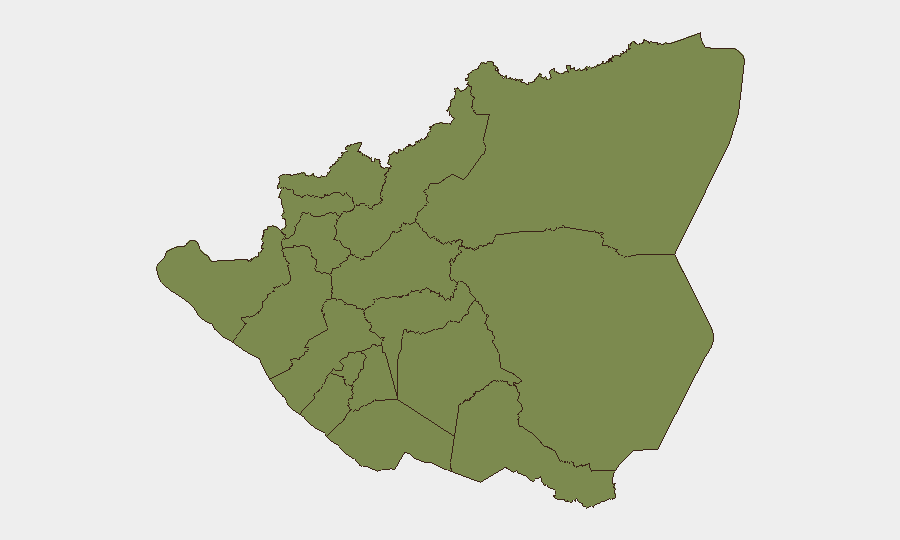
Managua Department dominates the risk profile (31.3 composite score), reflecting the capital's concentration of political power, police/military presence, opposition activity, and organized crime. All other departments score substantially lower (1.3–2.1), indicating risks are either diffuse across rural areas (Caribbean Coast) or manageable in secondary cities (Masaya, León, Estelí). Corporate assets and personnel in Managua face highest exposure to both political repression and street violence; secondary locations face lower acute risk but should monitor for cascading effects of national instability.
How GeoBit Would Assist
Teams operating in Nicaragua should deploy Intel Sweep and multi-language OSINT fusion to track regime statements, opposition networks, and civil-society signals in near real-time; use Election Monitoring and regime-stability analysis to map the closure of democratic space and predict flashpoints for unrest; and maintain AOI Monitoring with alerting on Managua (especially government, opposition, and business districts) and key economic zones to detect sudden shifts in protests, security operations, or crime surges. Entity extraction and network analysis can map political/criminal actor relationships to anticipate enforcement actions or escalation.
7-Day Outlook
No major new incidents are expected in the immediate 7 days, but the political declaration will likely trigger secondary effects: international statements, potential sanction announcements, economic anxiety, and slow-building opposition organizing (primarily online and private). Street crime will remain the primary day-to-day threat. Monitor for any opposition gatherings or police operations in response to the regime's move; these could occur within 10–14 days as civil-society groups coordinate response.
Highest-Risk Areas — Ranked
| # | State / Region | Risk |
|---|---|---|
| 1 | Managua Department | 31.3 |
| 2 | South Caribbean Coast | 2.1 |
| 3 | Carazo Department | 1.3 |
| 4 | Chontales Department | 1.3 |
| 5 | Rivas Department | 1.3 |
| 6 | Río San Juan Department | 1.3 |
| 7 | Chinandega Department | 1.3 |
| 8 | Nueva Segovia Department | 1.3 |
| 9 | Madriz Department | 1.3 |
| 10 | Estelí Department | 1.3 |
| 11 | León Department | 1.3 |
| 12 | Masaya Department | 1.3 |
Sources
Previous Daily Briefs
A new Nicaragua brief is written every day — each with its own risk map and downloadable CSV. Here's the last week; use the calendar to go further back.
📅 Browse every day by calendar →
Highlighted days have a brief. Tap a day for that day's map & analysis, or “csv” for that day's dataset ($5).
Atlas — our AI intelligence desk — emails them this snapshot personally. Nothing else, no list.