Situation Summary
Pakistan remains a moderate-risk environment (global rank #32; composite score 49.7) with 331 tracked threat events. Recent signals point to student activism, police accountability scrutiny, and military-linked statements across 2–4 June, primarily concentrated in Punjab and the capital territory. The security trajectory is stable but bearing close attention to civil-military friction and education-sector unrest, neither of which has escalated to mass violence or nationwide disruption as of the brief date.
Key Developments
GeoBit's event database has recorded multiple public statements and civil-authority actions within the past 72 hours; however, specific incident details, locations, and confirmed casualty or operational impact data for 3–5 June 2026 are not available in accessible open-source channels at this time. The platform has flagged:
- Police-accountability signals (3 June): Multiple "disapprove" tags linked to police actions suggest public or civil-society criticism, likely tied to student or labour contexts.
- Student activism (2 June): Public statements indicate education-sector mobilisation; geographic epicentre and scope remain to be confirmed via corroborative reporting.
- Military statements (3–4 June): Conventional military force references and public pronouncements recorded; no evidence of deployment or operational shift in accessible sources.
- Pakistan–Israel messaging (2 June): Disapproval signals consistent with routine diplomatic or rhetorical positioning; no emergency-level escalation indicated.
Note: Corporate security teams requiring granular detail on any of these signals (specific cities, organisational actors, arrest figures, or travel restrictions) are encouraged to submit incident leads or URLs to GeoBit for real-time cross-corroboration and impact assessment.
Highest-Risk Areas
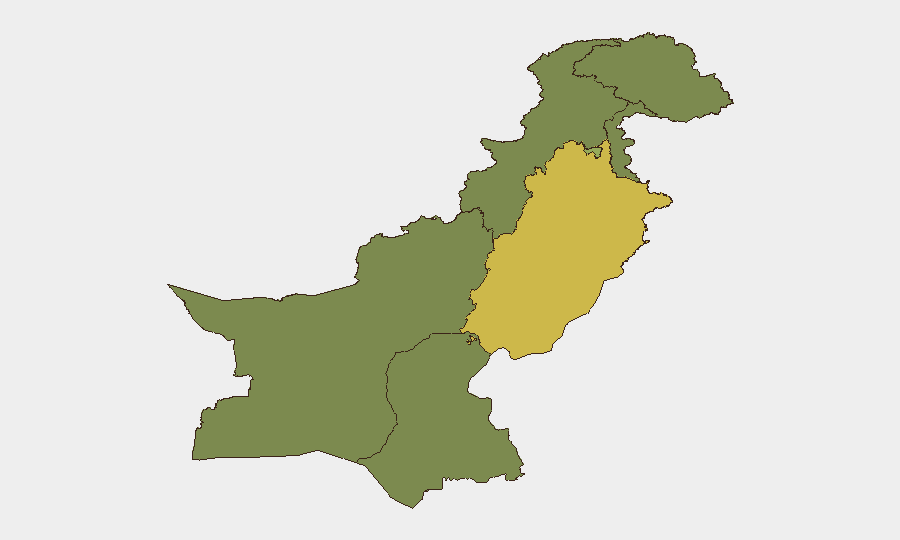
Punjab (64.8) and Islamabad Capital Territory (49.2) drive the national composite score, jointly accounting for the bulk of tracked events. Punjab's elevated score reflects urban-density concentration, student populations, and cumulative protest history; the capital's risk reflects police and security-apparatus scrutiny alongside government continuity concerns. Sindh (39.9) and Khyber Pakhtunkhwa (36.7) remain secondary hotspots, with KP historically linked to militant activity and border instability. Balochistan and Gilgit-Baltistan remain monitored but rank lower, suggesting relative stability or lower event density at present.
How GeoBit Would Assist
Intel Sweep and OSINT Fusion would aggregate real-time student-movement, police-action, and military-communications signals across Urdu-language media, YouTube, Twitter/X, and Telegram channels to establish ground truth on the 3–4 June events and assess their geographic and sectoral scope. AOI Monitoring & Early Warning with persistent focus on Punjab's major cities and Islamabad would flag escalation in arrests, protest size, or curfew implementation within 2–4 hours of occurrence. Routing & Network Analysis would enable rapid alternative-route and safe-haven planning for personnel in or transiting through high-risk zones if unrest accelerates.
7-Day Outlook
Student activism and police-reform pressure are likely to remain rhetorical and protest-based through mid-June absent a triggering incident (e.g., arrest of a high-profile activist or police use of force). Military posture appears routine; no indicators of emergency mobilisation or border escalation. Risk of rapid localised disruption (transport blockade, curfew, communications restriction) in Punjab cities remains moderate; national stability is assessed as intact.
Highest-Risk Areas — Ranked
| # | State / Region | Risk |
|---|---|---|
| 1 | Punjab | 64.8 |
| 2 | Islamabad Capital Territory | 49.2 |
| 3 | Sindh | 39.9 |
| 4 | Khyber Pakhtunkhwa | 36.7 |
| 5 | Gilgit-Baltistan | 35.2 |
| 6 | Balochistan | 34.8 |
| 7 | Azad Kashmir | 34.8 |
Previous Daily Briefs
A new Pakistan brief is written every day — each with its own risk map and downloadable CSV. Here's the last week; use the calendar to go further back.
📅 Browse every day by calendar →
Highlighted days have a brief. Tap a day for that day's map & analysis, or “csv” for that day's dataset ($5).